Mot Alexandra I, Depp Constanze, Nave Klaus-Armin
Department of Neurogenetics, Max Planck Institute of Experimental Medicine, Gottingen, Germany.
Dialogues Clin Neurosci. 2018 Dec;20(4):283-292. doi: 10.31887/dcns.2018.20.4/amot.
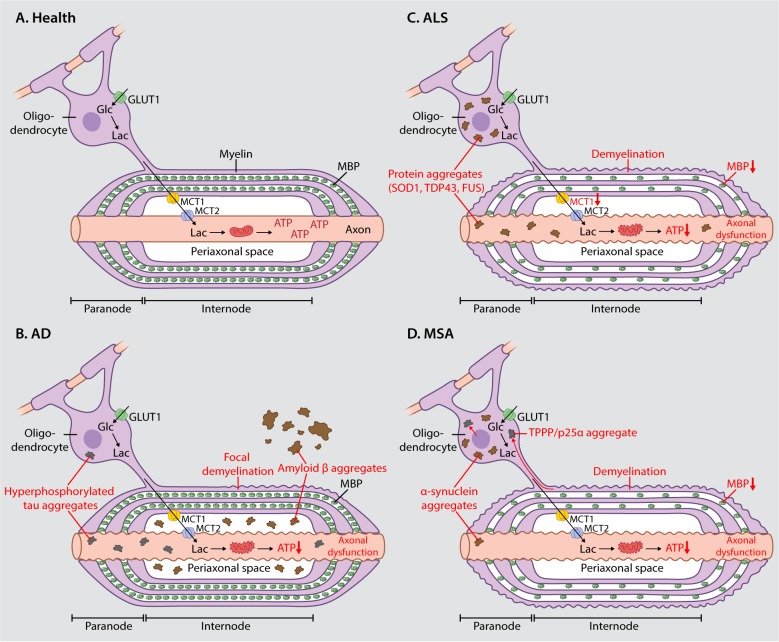
Myelin is made by highly specialized glial cells and enables fast axonal impulse propagation. Recent studies show that oligodendrocytes in the central nervous system are, in addition to myelination, required for the integrity and survival of axons, independent of the presence or absence of myelin itself. The underlying mechanism of this support is given by glycolytic oligodendrocytes which provide axons with energy-rich metabolites. These findings represent a paradigm shift for the physiological function of axon-associated glia, and open the intriguing possibility that oligodendrocytes are important contributors to neurodegenerative diseases in which myelinated axons are lost, such as in Alzheimer disease, amyotrophic lateral sclerosis, and multiple system atrophy. Understanding the role of axon-oligodendrocyte coupling in neurodegenerative diseases may pave the way for the development of metabolism-based therapeutic approaches.
髓磷脂由高度特化的神经胶质细胞产生,并能使轴突快速传导冲动。最近的研究表明,中枢神经系统中的少突胶质细胞除了形成髓鞘外,对于轴突的完整性和存活也是必需的,这与髓鞘本身的有无无关。这种支持的潜在机制是由糖酵解少突胶质细胞提供的,它们为轴突提供富含能量的代谢物。这些发现代表了轴突相关神经胶质细胞生理功能的范式转变,并开启了一个有趣的可能性,即少突胶质细胞是神经退行性疾病的重要促成因素,在这些疾病中,有髓轴突会丢失,如阿尔茨海默病、肌萎缩侧索硬化症和多系统萎缩症。了解轴突-少突胶质细胞耦合在神经退行性疾病中的作用可能为基于代谢的治疗方法的开发铺平道路。