Lin Pei-Ying, Chu Chun-Hui, Chang Fang-Yu, Huang Ya-Wen, Tsai Hui-Ju, Yao Tsung-Chieh
Division of Internal Medicine and Pediatrics, Department of Traditional Chinese Medicine, Chang Gung Memorial Hospital, Taoyuan, Taiwan.
School of Traditional Chinese Medicine, Chang Gung University College of Medicine, Taoyuan, Taiwan.
World Allergy Organ J. 2019 Jan 26;12(2):100001. doi: 10.1016/j.waojou.2018.11.001. eCollection 2019.
The alarmingly rising prevalence of allergic diseases has led to substantial healthcare and economic burdens worldwide. The integrated use of traditional Chinese medicines (TCM) and Western medicines has been common in treating subjects with allergic diseases in clinical practice in Taiwan. However, limited studies have been conducted to evaluate long-term trends and prescription patterns of TCM use among subjects with allergic diseases. Thus, we conducted a nationwide population-based study to characterize TCM use among subjects with allergic diseases.
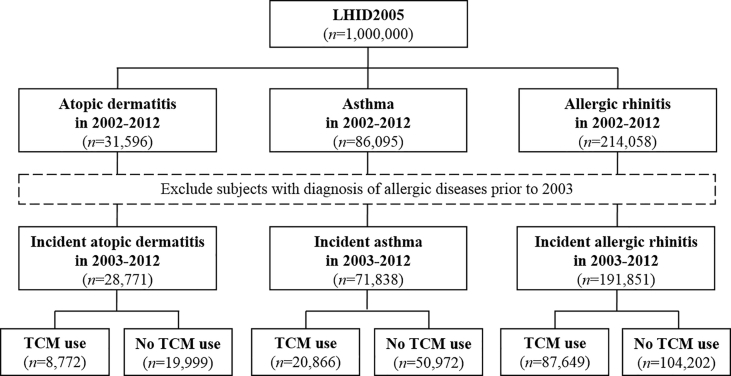
A total of 241,858 subjects with diagnosed atopic dermatitis, asthma or allergic rhinitis in the period of 2003-2012 were identified from the National Health Insurance Research Database (NHIRD) in Taiwan and included in this study. We assessed trends and prescribed patterns related to TCM (both single herbs and herbal formulas) among the study subjects over the 10-year study period.
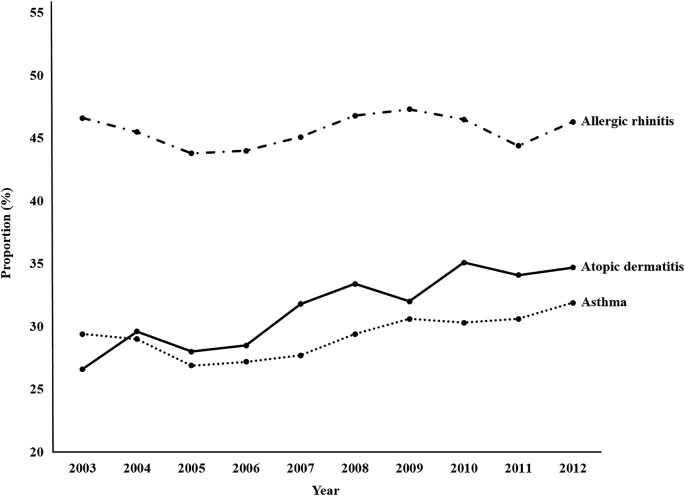
The overall proportions of TCM use were 30.5%, 29.0% and 45.7% in subjects with atopic dermatitis, asthma and allergic rhinitis, respectively. We found increasing trends of TCM use among subjects having atopic dermatitis and asthma, with annual increase of 0.91% and 0.38%, respectively, over the 10-year study period while the proportion remained steadily high (from 46.6% in 2003 to 46.3% in 2012) among subjects having allergic rhinitis. Moreover, the number of hospitalization due to allergic diseases in TCM users was significantly smaller than that in non TCM users for all three allergic diseases.
A notable proportion (30%-50%) of subjects with allergic diseases in Taiwan has used TCM, with the highest proportion of TCM use found in subjects with allergic rhinitis, whereas increasing trends of TCM use are found among subjects with atopic dermatitis and asthma, respectively. Our results suggest that TCM use may help reduce the severe episodes of allergic diseases necessitating hospitalizations.
过敏性疾病患病率惊人地上升,已在全球范围内造成了巨大的医疗和经济负担。在台湾的临床实践中,中西医结合治疗过敏性疾病患者已很常见。然而,针对过敏性疾病患者使用中药的长期趋势和处方模式的研究有限。因此,我们开展了一项基于全国人口的研究,以描述过敏性疾病患者使用中药的情况。
从台湾国民健康保险研究数据库(NHIRD)中识别出2003年至2012年期间共241,858名被诊断患有特应性皮炎、哮喘或过敏性鼻炎的患者,并纳入本研究。我们评估了在为期10年的研究期间,研究对象中与中药(单味草药和草药配方)相关的趋势和处方模式。
特应性皮炎、哮喘和过敏性鼻炎患者使用中药的总体比例分别为30.5%、29.0%和45.7%。我们发现,特应性皮炎和哮喘患者使用中药的趋势呈上升趋势,在10年研究期间,年增长率分别为0.91%和0.38%,而过敏性鼻炎患者使用中药的比例在10年间一直保持在较高水平(从2003年的46.6%降至2012年的46.3%)。此外,对于所有三种过敏性疾病,使用中药的患者因过敏性疾病住院的次数均显著少于未使用中药的患者。
台湾相当比例(30%-50%)的过敏性疾病患者使用过中药,其中过敏性鼻炎患者使用中药的比例最高,而特应性皮炎和哮喘患者使用中药的趋势分别呈上升趋势。我们的结果表明,使用中药可能有助于减少过敏性疾病导致住院的严重发作次数。