Department of Geography, Environment and Geomatics, University of Ottawa, Ottawa, ON, K1N 6N5, Canada.
Department of Geography and Planning, Queen's University, Kingston, ON, K7L 3N6, Canada.
Nat Commun. 2019 Apr 2;10(1):1329. doi: 10.1038/s41467-019-09314-7.
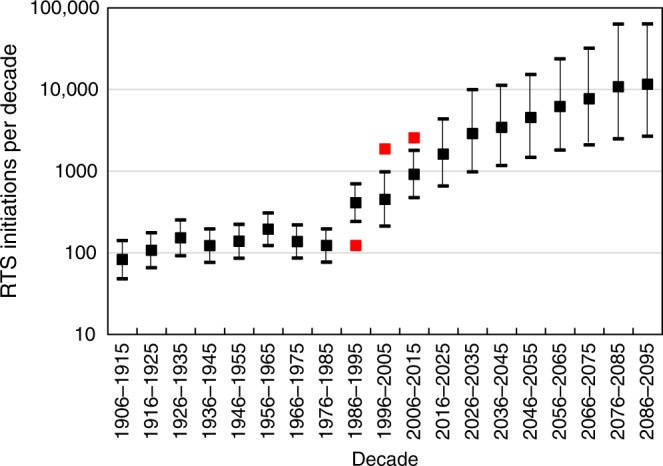
Retrogressive thaw slumps (RTS) - landslides caused by the melt of ground ice in permafrost - have become more common in the Arctic, but the timing of this recent increase and its links to climate have not been fully established. Here we annually resolve RTS formation and longevity for Banks Island, Canada (70,000 km) using the Google Earth Engine Timelapse dataset. We describe a 60-fold increase in numbers between 1984 and 2015 as more than 4000 RTS were initiated, primarily following four particularly warm summers. Colour change due to increased turbidity occurred in 288 lakes affected by RTS outflows and sediment accumulated in many valley floors. Modelled RTS initiation rates increased by an order of magnitude between 1906-1985 and 2006-2015, and are projected under RCP4.5 to rise to >10,000 decade after 2075. These results provide additional evidence that ice-rich continuous permafrost terrain can be highly vulnerable to changing summer climate.
后退性融冻泥流(RTS)——由多年冻土中的地冰融化引起的滑坡——在北极地区变得更加普遍,但最近这种增加的时间及其与气候的联系尚未完全确定。在这里,我们使用谷歌地球引擎时间序列数据集,每年确定加拿大班克斯岛(70000 平方公里)的 RTS 形成和持续时间。我们描述了 1984 年至 2015 年间数量增加了 60 倍,超过 4000 个 RTS 被触发,主要是在四个特别温暖的夏季之后。受 RTS 流出物影响的 288 个湖泊的浊度增加导致颜色发生变化,许多山谷底部都有沉积物堆积。模拟的 RTS 触发率在 1906-1985 年和 2006-2015 年之间增加了一个数量级,根据 RCP4.5 的预测,在 2075 年后的十年内,该触发率将上升到超过 10000。这些结果提供了更多证据表明,富冰连续多年冻土地形可能非常容易受到夏季气候变化的影响。