Department of Geosciences, University of Oslo, Oslo, Norway.
University Centre in Svalbard (UNIS), Longyearbyen, Norway.
Sci Rep. 2019 Apr 3;9(1):5541. doi: 10.1038/s41598-019-41117-0.
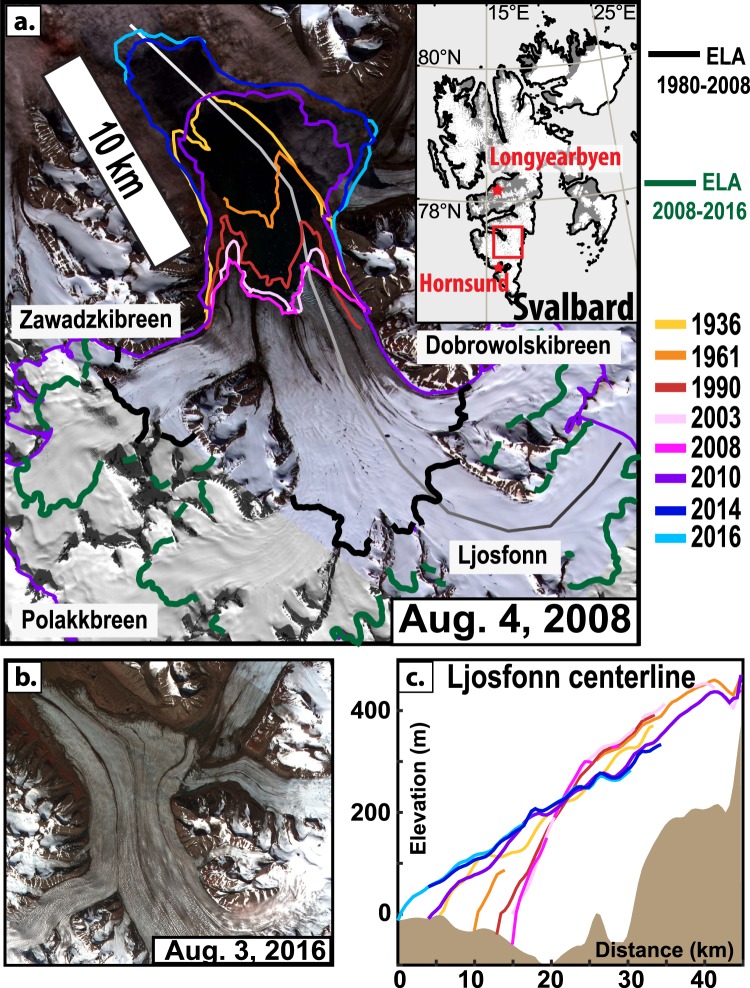
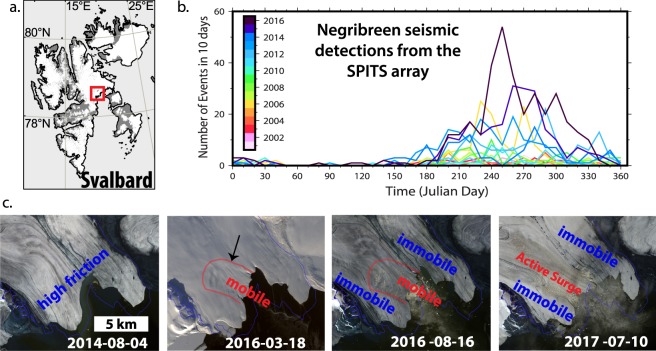
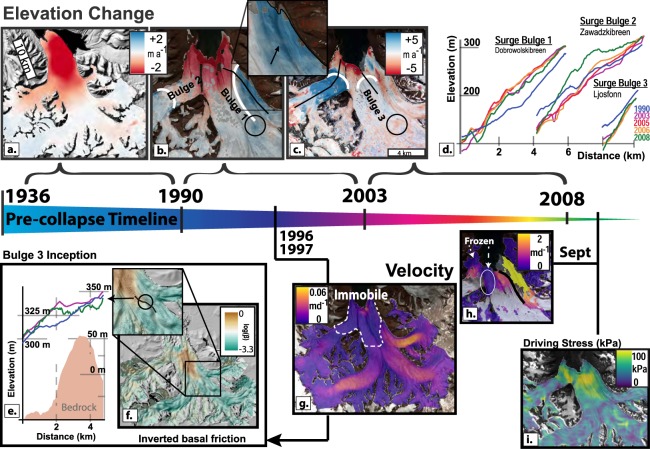
Glacier flow instabilities can rapidly increase sea level through enhanced ice discharge. Surge-type glacier accelerations often occur with a decadal to centennial cyclicity suggesting internal mechanisms responsible. Recently, many surging tidewater glaciers around the Arctic Barents Sea region question whether external forces such as climate can trigger dynamic instabilities. Here, we identify a mechanism in which climate change can instigate surges of Arctic tidewater glaciers. Using satellite and seismic remote sensing observations combined with three-dimensional thermo-mechanical modeling of the January 2009 collapse of the Nathorst Glacier System (NGS) in Svalbard, we show that an underlying condition for instability was basal freezing and associated friction increase under the glacier tongue. In contrast, continued basal sliding further upstream increased driving stresses until eventual and sudden till failure under the tongue. The instability propagated rapidly up-glacier, mobilizing the entire 450 km glacier basin over a few days as the till entered an unstable friction regime. Enhanced mass loss during and after the collapse (5-7 fold compared to pre-collapse mass losses) combined with regionally rising equilibrium line altitudes strongly limit mass replenishment of the glacier, suggesting irreversible consequences. Climate plays a paradoxical role as cold glacier thinning and retreat promote basal freezing which increases friction at the tongue by stabilizing an efficient basal drainage system. However, with some of the most intense atmospheric warming on Earth occurring in the Arctic, increased melt water can reduce till strength under tidewater glacier tongues to orchestrate a temporal clustering of surges at decadal timescales, such as those observed in Svalbard at the end of the Little Ice Age. Consequently, basal terminus freezing promotes a dynamic vulnerability to climate change that may be present in many Arctic tidewater glaciers.
冰川流动不稳定可能通过增强冰排放迅速增加海平面。涌浪型冰川加速通常以十年到百年的周期性发生,这表明存在内部机制。最近,北极巴伦支海地区的许多涌浪性潮汐冰川质疑外部力量(如气候)是否可以引发动态不稳定。在这里,我们确定了一种机制,即气候变化可以引发北极潮汐冰川的涌浪。我们使用卫星和地震遥感观测,并结合对 2009 年 1 月斯瓦尔巴纳德霍斯特冰川系统(NGS)崩塌的三维热机械建模,表明不稳定的一个基本条件是冰川舌下的基底冻结和相关摩擦增加。相比之下,在冰川上游继续基底滑动会增加驱动力,直到最终在舌下突然发生土石流。不稳定沿着冰川迅速向上传播,在几天内移动了整个 450 公里的冰川流域,因为土石流进入了不稳定的摩擦状态。崩塌期间和之后的质量损失(与崩塌前的质量损失相比增加了 5-7 倍)以及区域平衡线高度的上升强烈限制了冰川的质量补充,表明存在不可逆转的后果。气候起到了矛盾的作用,因为寒冷的冰川变薄和后退促进了基底冻结,通过稳定有效的基底排水系统增加了舌部的摩擦。然而,随着地球上最强烈的大气变暖之一发生在北极,增加的融水可以降低潮汐冰川舌下的土石流强度,从而在数十年的时间尺度上协调涌浪的时间聚类,就像在小冰期结束时在斯瓦尔巴德观察到的那样。因此,基底末端冻结促进了对气候变化的动态脆弱性,这种脆弱性可能存在于许多北极潮汐冰川中。