Virology Research Center, School of Medicine of Ribeirão Preto of University of São Paulo, Ribeirão Preto, 14049-900, SP, Brazil.
MRC-University of Glasgow Centre for Virus Research, Glasgow, G61 1QH, Scotland, United Kingdom.
Sci Rep. 2019 Apr 3;9(1):5556. doi: 10.1038/s41598-019-42110-3.
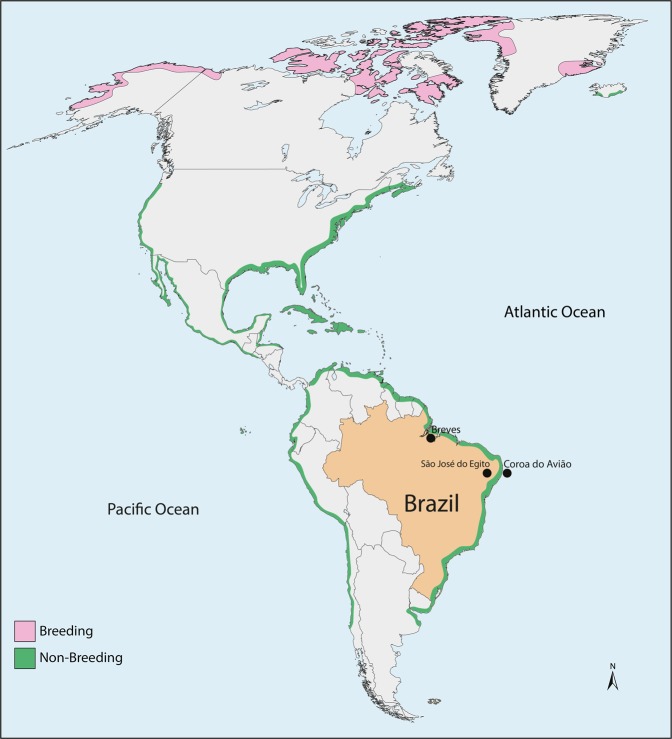
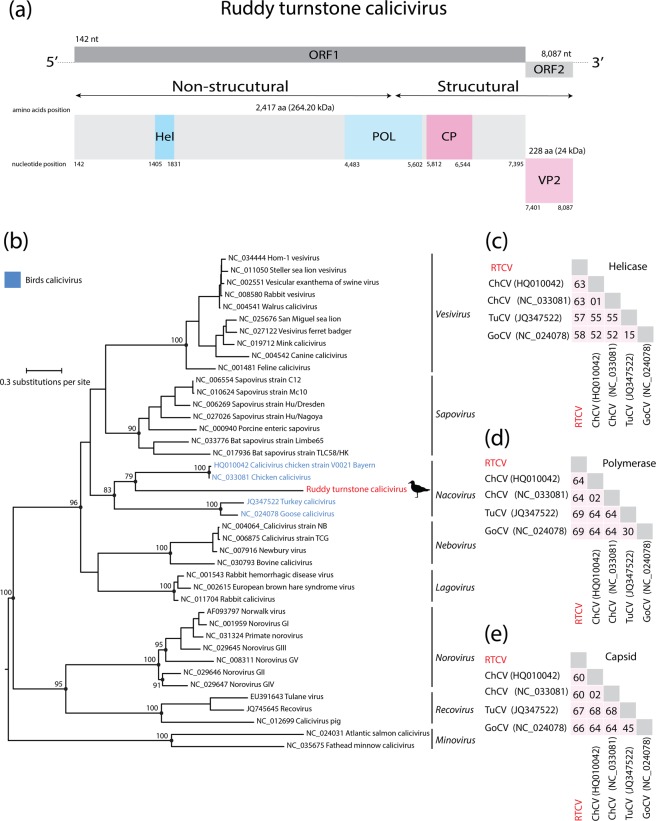
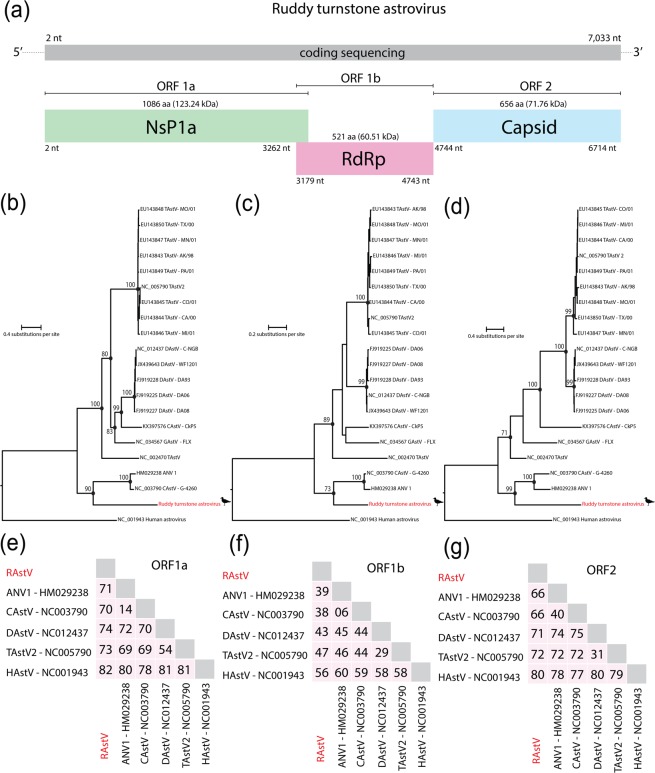
Birds are the natural reservoir of viruses with zoonotic potential, as well as contributing to the evolution, emergence, and dissemination of novel viruses. In this study, we applied a high-throughput screening approach to identify the diversity of viruses in 118 samples of birds captured between October 2006 to October 2010 in the North and Northeast regions of Brazil. We found nearly complete genomes of novel species of astrovirus and calicivirus in cloacal swabs of ruddy turnstones (Arenaria interpres) collected in Coroa do Avião islet, Pernambuco State. These viruses are positive-sense single-stranded RNA with a genome of ~7 to 8 kb, and were designated as Ruddy turnstone astrovirus (RtAstV) and Ruddy turnstone calicivirus (RTCV), respectively. Phylogenetic analysis showed that RtAstV and RTCV grouped in a monophyletic clade with viruses identified from poultry samples (i.e., chicken, goose, and turkey), including viruses associated with acute nephritis in chickens. Attempts of viral propagation in monkey and chicken cell lines for both viruses were unsuccessful. Also, we found genomes related with viral families that infect invertebrates and plants, suggesting that they might be ingested in the birds' diet. In sum, these findings shed new light on the diversity of viruses in migratory birds with the notable characterization of a novel astrovirus and calicivirus.
鸟类是具有潜在人畜共患性的病毒的天然宿主,也是新病毒进化、出现和传播的贡献者。在这项研究中,我们应用高通量筛选方法来鉴定 2006 年 10 月至 2010 年 10 月期间在巴西北部和东北部地区捕获的 118 份鸟类样本中的病毒多样性。我们在从伯南布哥州科罗阿·多·阿维昂岛采集的红腹滨鹬的泄殖腔拭子中发现了新型星状病毒和杯状病毒的近乎完整基因组。这些病毒是正链单链 RNA,基因组大小约为 7 到 8kb,分别被命名为红腹滨鹬星状病毒(RtAstV)和红腹滨鹬杯状病毒(RTCV)。系统发育分析表明,RtAstV 和 RTCV 与从家禽样本中鉴定出的病毒(即鸡、鹅和火鸡)形成单系分支,包括与鸡急性肾炎相关的病毒。在猴和鸡细胞系中对这两种病毒进行病毒繁殖的尝试均未成功。此外,我们还发现了与感染无脊椎动物和植物的病毒家族相关的基因组,这表明它们可能是鸟类饮食中的摄入物。总之,这些发现为候鸟中的病毒多样性提供了新的认识,显著特征是一种新型星状病毒和杯状病毒。