Bae Sung Uk, Park Won-Jin, Jeong Woon Kyung, Baek Seong Kyu, Lee Hye-Won, Lee Jae-Ho
Department of Surgery.
Department of Anatomy.
Medicine (Baltimore). 2019 Apr;98(14):e14932. doi: 10.1097/MD.0000000000014932.
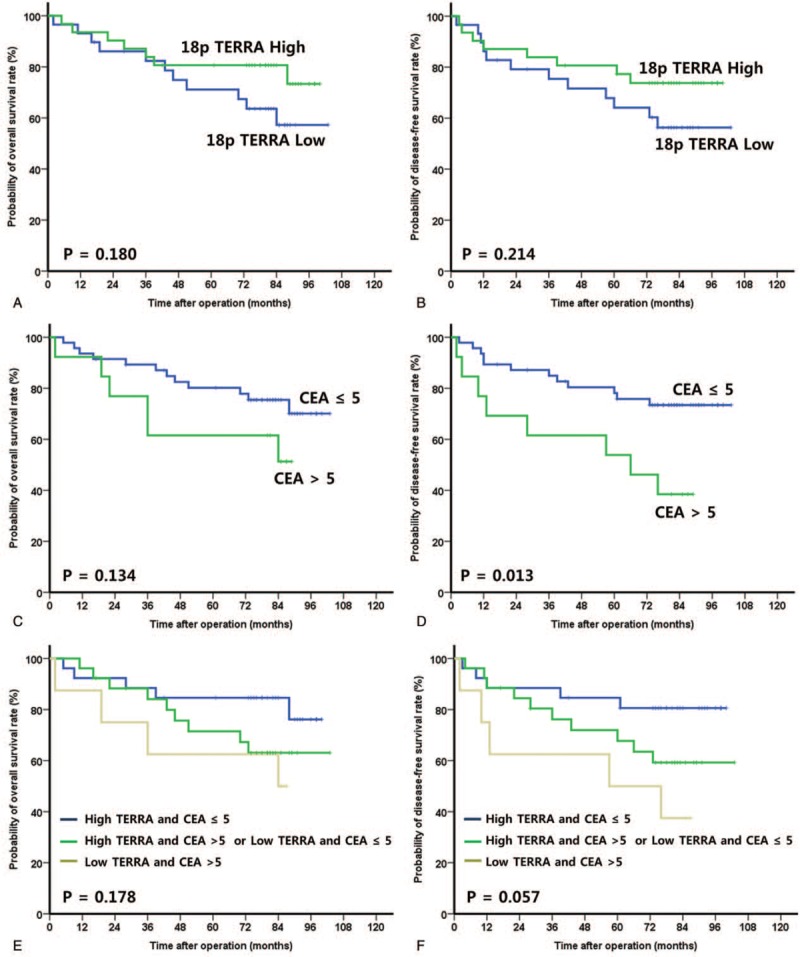
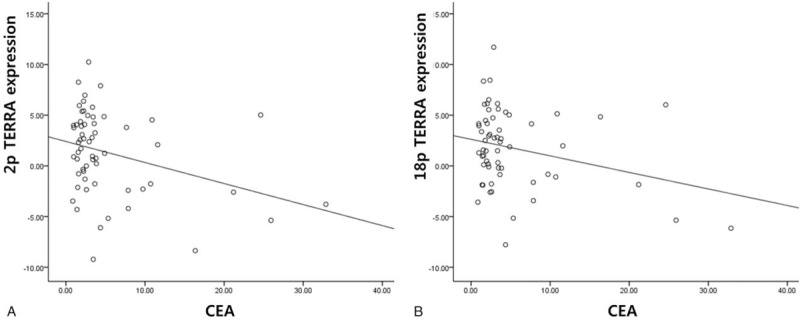
Telomeres are transcribed into long, noncoding telomeric repeat-containing RNAs (TERRA) that have been implicated in the regulation of telomerase, the enzyme that lengthens telomeres, in heterochromatin formation at telomeres, and in telomere stability. This study aimed to evaluate the correlation between TERRA expression and long-term oncologic outcomes in colorectal cancer (CRC).We evaluated 18p TERRA expression and telomere length using quantitative real-time PCR in 60 patients who underwent surgical resection for CRC between June 2008 and November 2010.Patients were grouped according to 18p TERRA expression, with 29 (48.3%) and 31 (51.7%) patients in the low and high TERRA expression groups, respectively. The median follow-up period was 80 months (range 2-103). The 18p TERRA expression was marginally significantly associated with preoperative carcinoembryonic antigen (CEA; P = .082) and was significantly associated with telomere length (P < .05). Multivariate analysis revealed that preoperative CEA (hazard ratio [HR], 2.728; 95% confidence interval [CI], 0.832-8.944, P = .098) and 18p TERRA expression (HR, 0.113; 95% CI, 0.011-1.126, P = .071) were marginally significant independent prognostic factors for overall survival (OS), whereas preoperative CEA (HR, 4.254; 95% CI, 1.394-12.985, P = .011) and 18p TERRA expression (HR, 0.108; 95% CI, 0.011-1.037, P = .054) were significant independent prognostic factors for disease-free survival (DFS). According to our prognostic model with 2 prognostic factors, the OS and DFS rate increased to 76.2% and 80.63%, respectively, in patients with high 18p TERRA expression and CEA levels ≤5 (P = .178, P = .057, respectively).18p TERRA expression was marginally significantly associated with preoperative CEA and significantly associated with telomere length, rendering it a potential prognostic factor for long-term oncologic outcomes in CRC.
端粒被转录成长链非编码的含端粒重复序列RNA(TERRA),其与端粒酶(一种延长端粒的酶)的调控、端粒处异染色质的形成以及端粒稳定性有关。本研究旨在评估TERRA表达与结直肠癌(CRC)长期肿瘤学结局之间的相关性。我们使用定量实时PCR对2008年6月至2010年11月期间接受CRC手术切除的60例患者的18p TERRA表达和端粒长度进行了评估。根据18p TERRA表达对患者进行分组,低TERRA表达组和高TERRA表达组分别有29例(48.3%)和31例(51.7%)患者。中位随访期为80个月(范围2 - 103个月)。18p TERRA表达与术前癌胚抗原(CEA;P = 0.082)呈边缘显著相关,与端粒长度显著相关(P < 0.05)。多因素分析显示,术前CEA(风险比[HR],2.728;95%置信区间[CI],0.832 - 8.944,P = 0.098)和18p TERRA表达(HR,0.113;95% CI,0.011 - 1.126,P = 0.071)是总生存期(OS)的边缘显著独立预后因素,而术前CEA(HR,4.254;95% CI,1.394 - 12.985,P = 0.011)和18p TERRA表达(HR,0.108;95% CI,0.011 - 1.037,P = 0.054)是无病生存期(DFS)的显著独立预后因素。根据我们包含两个预后因素的预后模型,18p TERRA表达高且CEA水平≤5的患者的OS率和DFS率分别提高到76.2%和80.63%(分别为P = 0.178,P = 0.057)。18p TERRA表达与术前CEA呈边缘显著相关,与端粒长度显著相关,使其成为CRC长期肿瘤学结局的潜在预后因素。