Zhang Shengchao, Tang Meiwen, Ma Jianghua, Yang Juhua, Qin Xuan, Jin Wei, Qian Jin, Li Feng, Cheng Yunfeng, Chen Hao
Department of Thoracic Surgery.
Department of Hematology.
Medicine (Baltimore). 2019 Apr;98(14):e14993. doi: 10.1097/MD.0000000000014993.
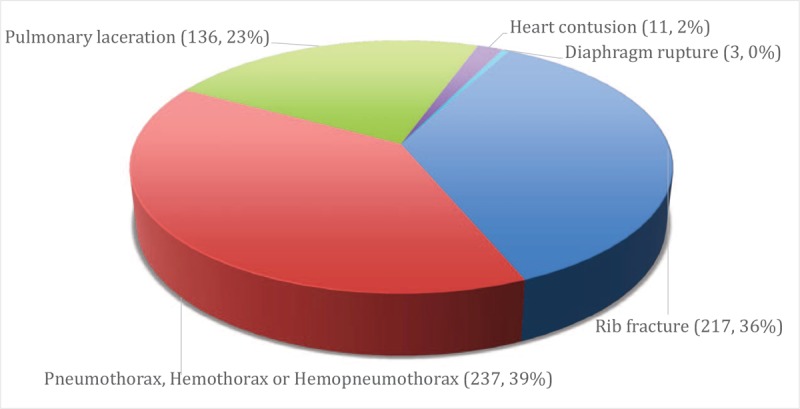
Thoracic trauma in China was scarcely reported. This study aimed to summarize the clinical profiles and to analyze the management approaches of patients with traumatic thoracic injury.Data for consecutive patients with thoracic trauma from January 2003 to January 2018 were retrospectively collected and analyzed. Patients' profiles and clinical outcomes were compared between those patients treated with a dedicated thoracic trauma team and those without.The study included 4168 patients with mean age of 49.0 years, of whom 82.1% were male. Traffic accident accounted for 42.7% of the injuries. Most of the patients (66.8%) had rib fractures. Associated injuries were present in 48.3% of the patients; of them 86.0% were extremity fractures. Majority of the patients were managed without surgical procedures other than tube thoracostomy (33.2%). ICU service was needed in 12.0% of the patients. Patients treated with thoracic trauma team were older (53.59 ± 16.8 year vs 45.1 ± 18.0 year, P < .001), less male (78.3% vs 85.2%, P < .001), with higher injury severity scores (17.5 ± 10.1 vs 13.7 ± 8.2, P < .001), required more ventilator support (48.3% vs 25.3%, P < .001) and underwent more tube thoracostomy and other surgeries (43.8% vs 24.2%, and 34.4% vs 14.1%, respectively, all P < .001), yet with a shorter hospital stay (11.7 ± 9.0 days vs 12.7 ± 8.8 days, P < .001), and numerically lower ICU usage and mortality when compared to those without.Thoracic trauma in China usually affects mid-age males. Traffic accident is the top one etiology. The most common type of thoracic injuries is rib fracture. Associated injuries occur frequently. Nonoperative treatment and tube thoracostomy are effective for majority of the patients. A multidisciplinary approach with a dedicated thoracic trauma team could improve the treatment for these patients.
中国胸部创伤的报道较少。本研究旨在总结创伤性胸部损伤患者的临床特征,并分析其治疗方法。回顾性收集并分析了2003年1月至2018年1月期间连续性胸部创伤患者的数据。比较了由专门的胸部创伤团队治疗的患者与未由该团队治疗的患者的资料和临床结局。该研究纳入了4168例患者,平均年龄49.0岁,其中82.1%为男性。交通事故导致的损伤占42.7%。大多数患者(66.8%)有肋骨骨折。48.3%的患者存在合并伤;其中86.0%为四肢骨折。除胸腔闭式引流术外,大多数患者(33.2%)无需手术治疗。12.0%的患者需要入住重症监护病房(ICU)。由胸部创伤团队治疗的患者年龄更大(53.59±16.8岁 vs 45.1±18.0岁,P<0.001),男性比例更低(78.3% vs 85.2%,P<0.001),损伤严重程度评分更高(17.5±10.1 vs 13.7±8.2,P<0.001),需要更多的机械通气支持(48.3% vs 25.3%,P<0.001),接受胸腔闭式引流术和其他手术的比例更高(分别为43.8% vs 24.2%和34.4% vs 14.1%,均P<0.001),但住院时间更短(11.7±9.0天 vs 12.7±8.8天,P<0.001),与未由该团队治疗的患者相比,入住ICU的比例和死亡率在数值上更低。中国的胸部创伤通常影响中年男性。交通事故是首要病因。最常见的胸部损伤类型是肋骨骨折。合并伤很常见。非手术治疗和胸腔闭式引流术对大多数患者有效。采用多学科方法并组建专门的胸部创伤团队可以改善对这些患者的治疗。