Marín-Jiménez Ignacio, Casellas Francesc, Cortés Xavier, García-Sepulcre Mariana F, Juliá Berta, Cea-Calvo Luis, Soto Nadia, Navarro-Correal Ester, Saldaña Roberto, de Toro Javier, Galindo María J, Orozco-Beltrán Domingo
IBD Unit, Gastroenterology Department; Clinical Research Institute Gregorio Marañón (IiSGM); Gregorio Marañón University Hospital, Madrid.
Crohn-Colitis Care Unit, Hospital Universitari Vall d'Hebron, Barcelona.
Medicine (Baltimore). 2019 Apr;98(14):e15044. doi: 10.1097/MD.0000000000015044.
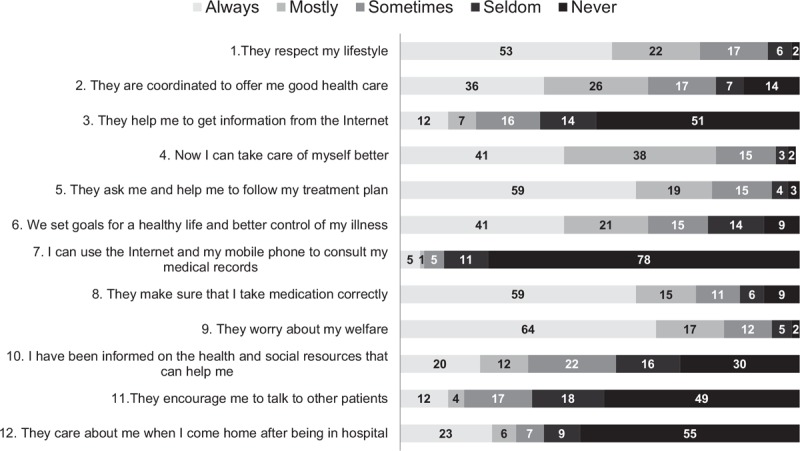
To assess inflammatory bowel disease (IBD) patients' experience of chronic illness care and the relationship with demographic and healthcare-related characteristics.This cross-sectional survey used the Instrument to Evaluate the EXperience of PAtients with Chronic diseases (IEXPAC) questionnaire to identify parameters associated with a better healthcare experience for IBD patients. IEXPAC questionnaire responses are grouped into 3 factors - productive interactions, new relational model, and patient self-management, scoring from 0 (worst) to 10 (best experience). Scores were analyzed by bivariate comparisons and multiple linear regression models.Surveys were returned by 341 of 575 patients (59.3%, mean age 46.8 (12.9) years, 48.2% women). Mean (SD) IEXPAC score was 5.9 (2.0); scores were higher for the productive interactions (7.7) and patient self-management factors (6.7) and much lower for the new relational model factor (2.2). Follow-up by a nurse, being seen by the same physician, and being treated with a lower number of medicines were associated with higher (better) overall patient experience score, and higher productive interactions and self-management factor scores. A higher productive interactions score was also associated with patients receiving medication subcutaneously or intravenously. Higher new relational model scores were associated with follow-up by a nurse, affiliation to a patients' association, receiving help from others for healthcare, a lower number of medicines and a higher educational level.In patients with IBD, a better overall patient experience was associated with follow-up by a nurse, being seen by the same physician, and being treated with a lower number of medicines.
评估炎症性肠病(IBD)患者的慢性病护理体验及其与人口统计学和医疗保健相关特征的关系。这项横断面调查使用慢性病患者体验评估工具(IEXPAC)问卷来确定与IBD患者更好的医疗保健体验相关的参数。IEXPAC问卷的回答分为3个因素——有效互动、新型关系模式和患者自我管理,评分从0(最差)到10(最佳体验)。通过双变量比较和多元线性回归模型分析得分。575名患者中有341名(59.3%)回复了调查问卷,平均年龄46.8(12.9)岁,女性占48.2%。IEXPAC平均(标准差)得分为5.9(2.0);有效互动(7.7)和患者自我管理因素(6.7)得分较高,而新型关系模式因素得分(2.2)低得多。由护士进行随访、由同一位医生诊治以及用药数量较少与患者总体体验得分较高(较好)以及有效互动和自我管理因素得分较高相关。有效互动得分较高还与患者接受皮下或静脉用药有关。新型关系模式得分较高与护士随访、加入患者协会、在医疗保健方面得到他人帮助、用药数量较少以及教育水平较高有关。在IBD患者中,患者总体体验较好与护士随访、由同一位医生诊治以及用药数量较少有关。