Hui-Juan Cao, Shi-Bing Liang, Jian-Ping Liu, Bin Wang, Hai-Song Li, Ji-Sheng Wang, Si-Qi Guan, Yu-Tian Zhu, Heng-Heng Dai, Chun-Yu Zhou
Centre for Evidence-Based Chinese Medicine, Beijing University of Chinese Medicine, Beijing.
Graduate school, Shanxi University of Chinese Medicine, Taiyuan, Shanxi Province, China.
Medicine (Baltimore). 2019 Apr;98(14):e15072. doi: 10.1097/MD.0000000000015072.
Chronic prostatitis (CP) is an inflammation of the prostate gland that seriously affects the quality of life of patients. The existing evidence of antibiotics and α-blockers for the treatment of CP is limited.
This review evaluated the effectiveness and safety of Qian Lie An Suppository (Prostant) in treating CP.
Randomized controlled trials comparing Prostant (alone or plus the control) with placebo, conventional drugs, or nonpharmaceutical therapies for CP were included in this article through searching from 6 databases. Data were analyzed using RevMan 5.3 software. Meta-analysis was performed when the clinical or statistical heterogeneity was found acceptable among trials. Estimate effects were present with risk ratio (RR) or mean difference and their 95% confidence interval (CI) for dichotomies or continuous variables. Quality of the evidence for each primary outcome was assessed using GRADE criteria.
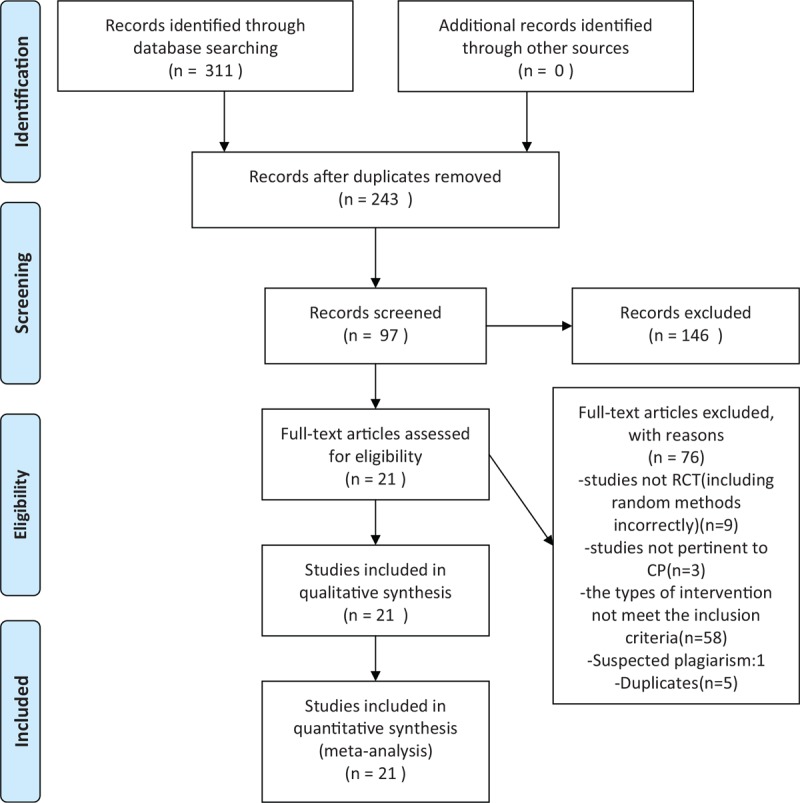
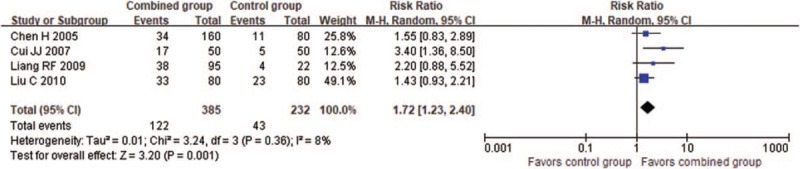
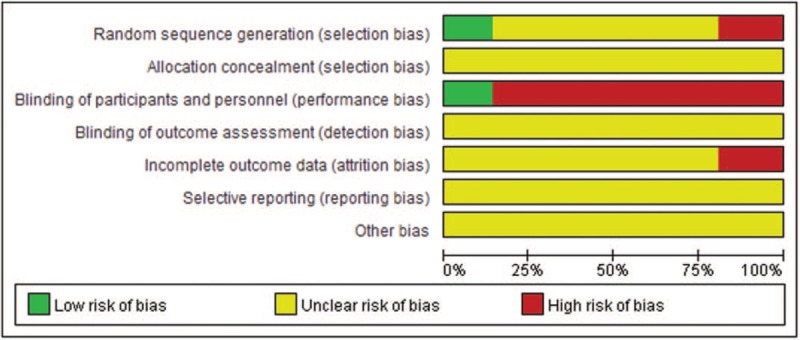
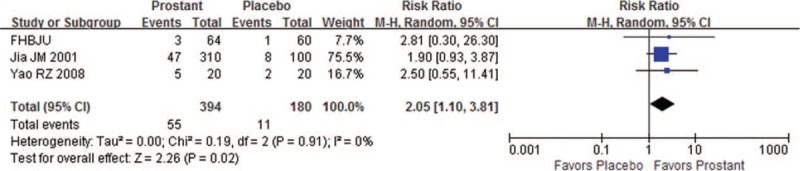
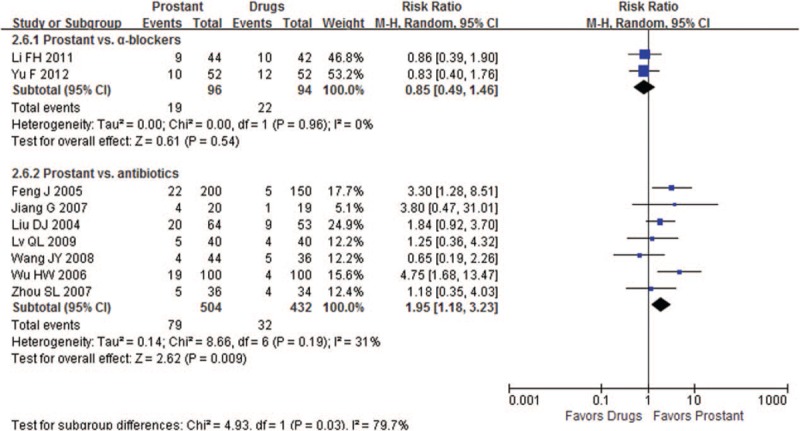
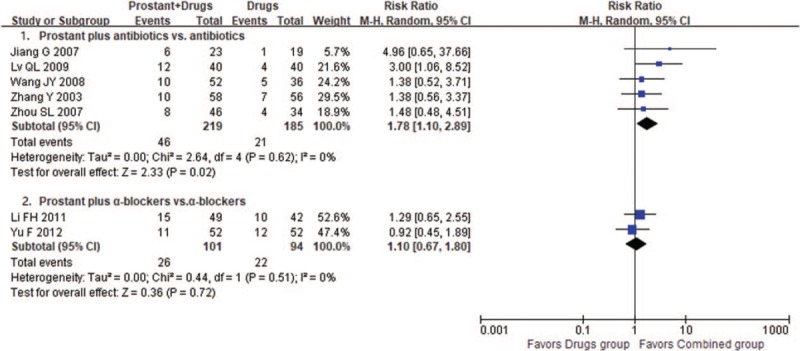
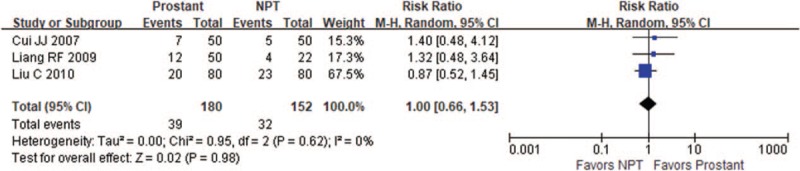
Totally 21 trials involving 3359 participants were included. There were 2 included trials had unclear risk of bias, and the remaining trials had high risk of bias. Meta-analyses showed the number of cured patients in the Prostant group was 2 times more than that of the placebo (RR 2.05, 95%CI 1.10 to 3.81) or antibiotics (RR 1.95, 95%CI 1.18 to 3.23) groups. Similar results were found when Prostant in combination with antibiotics or hyperthermia compared with the antibiotics (RR 1.78, 95% CI 1.10-2.89) or hyperthermia (RR 1.72, 95% CI 1.23-2.40) alone. However, there was no difference in the number of cured patients between Prostant and α-blockers or hyperthermia therapy. No severe adverse event was reported in all included trials. The main adverse events in Prostant group were reported (in 8 included trials) as diarrhea and anal discomfort.
Low-quality evidence showed that the Prostant may have add-on effect for patients with CP on increasing the number of cured patients, relieving pain, and improving the quality of life. There is not sufficient evidence to determine the effectiveness and safety of Prostant for the treatment of CP compared with placebo, antibiotics, α-blockers or the hyperthermia therapy.
慢性前列腺炎(CP)是前列腺的一种炎症,严重影响患者的生活质量。现有关于抗生素和α受体阻滞剂治疗CP的证据有限。
本综述评估前列安栓(Prostant)治疗CP的有效性和安全性。
通过检索6个数据库,纳入比较Prostant(单独使用或联合对照)与安慰剂、传统药物或CP非药物疗法的随机对照试验。使用RevMan 5.3软件进行数据分析。当试验间临床或统计异质性可接受时,进行Meta分析。对于二分变量或连续变量,采用风险比(RR)或均值差及其95%置信区间(CI)估计效应。使用GRADE标准评估每个主要结局的证据质量。
共纳入21项试验,涉及3359名参与者。有2项纳入试验的偏倚风险不明确,其余试验偏倚风险高。Meta分析显示,Prostant组治愈患者数量比安慰剂组(RR 2.05,95%CI 1.10至3.81)或抗生素组(RR 1.95,95%CI 1.18至3.23)多2倍。当Prostant联合抗生素或热疗与单独使用抗生素(RR 1.78,95%CI 1.10 - 2.89)或热疗(RR 1.72,95%CI 1.23 - 2.40)相比时,也发现了类似结果。然而,Prostant组与α受体阻滞剂或热疗组的治愈患者数量没有差异。所有纳入试验均未报告严重不良事件。Prostant组主要不良事件(8项纳入试验报告)为腹泻和肛门不适。
低质量证据表明,Prostant可能对CP患者增加治愈患者数量、缓解疼痛和改善生活质量有附加作用。与安慰剂、抗生素、α受体阻滞剂或热疗相比,尚无足够证据确定Prostant治疗CP的有效性和安全性。