Sajobi Tolulope T, Amoozegar Farnaz, Wang Meng, Wiebe Natalie, Fiest Kirsten M, Patten Scott B, Jette Nathalie
Department of Community Health Sciences and O'Brien Institute for Public Health, University of Calgary, Cumming School of Medicine 3280 Hospital Drive NW Calgary, Calgary, Alberta, T2N 4Z6, Canada.
Department of Clinical Neurosciences, University of Calgary, Calgary, Canada.
BMC Neurol. 2019 Apr 4;19(1):53. doi: 10.1186/s12883-019-1284-8.
In persons with migraine, severity of migraine is an important determinant of several health outcomes (e.g., patient quality of life and health care resource utilization). This study investigated how migraine patients rate the severity of their disease and how these ratings correlate with their socio-demographic, clinical, and psycho-social characteristics.
This is a cohort of 263 adult migraine patients consecutively enrolled in the Neurological Disease and Depression Study (NEEDs). We obtained a broad range of clinical and patient-reported measures (e.g., patients' ratings of migraine severity using the Global Assessment of Migraine Severity (GAMS), and migraine-related disability, as measured by the Migraine Disability Scale (MIDAS)). Depression was measured using the 9-item Patient Health Questionnaire (PHQ-9) and the 14-item Hospital Anxiety and Depression Scale (HADS). Median regression analysis was used to examine the predictors of patient ratings of migraine severity.
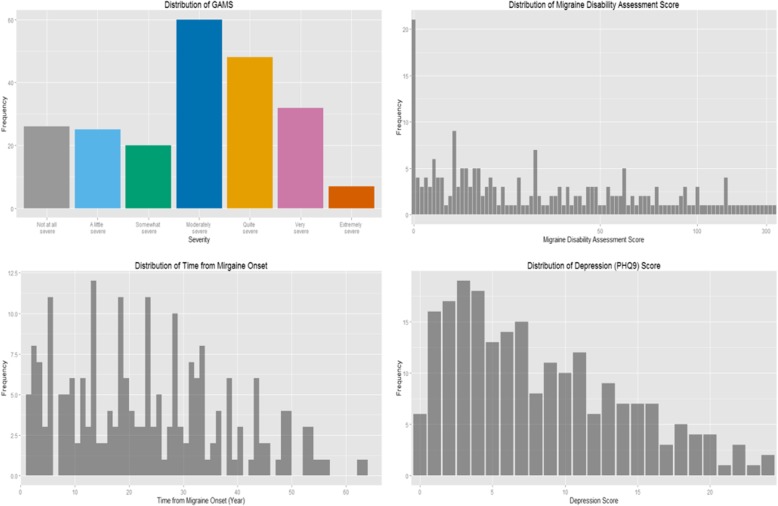
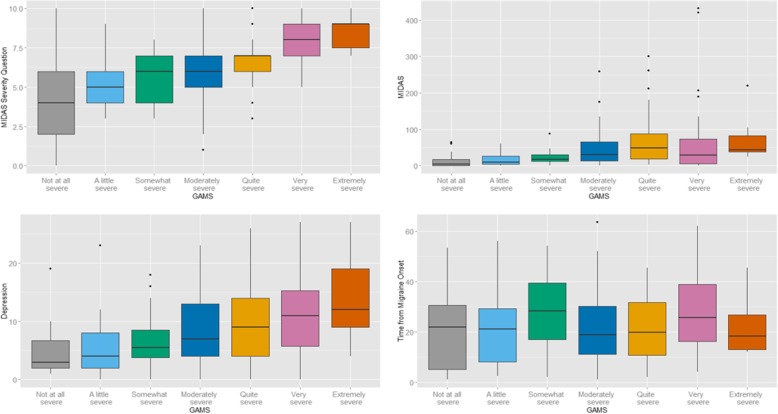
The mean age for the patients was 42.5 years (SD = 13.2). While 209 (79.4%) patients were females, 177 (67.4%) participants reported "moderately severe" to "extremely severe" migraine on the GAMS, and 100 (31.6%) patients had chronic migraine. Patients' report of severity on the GAMS was strongly correlated with patients' ratings of MIDAS global severity question, overall MIDAS score, migraine type, PHQ-9 score, and frequency of migraine attacks. Mediation analyses revealed that MIDAS mediated the effect of depression on patient ratings of migraine severity, accounting for about 32% of the total effect of depression. Overall, migraine subtype, frequency of migraine, employment status, depression, and migraine-related disability were statistically significant predictors of patient-ratings of migraine severity.
This study highlights the impact of clinical and psychosocial determinants of patient-ratings of migraine severity. GAMS is a brief and valid tool that can be used to assess migraine severity in busy clinical settings.
在偏头痛患者中,偏头痛的严重程度是多种健康结局(如患者生活质量和医疗资源利用)的重要决定因素。本研究调查了偏头痛患者如何对其疾病的严重程度进行评分,以及这些评分与他们的社会人口统计学、临床和心理社会特征之间的相关性。
这是一组连续纳入神经疾病与抑郁症研究(NEEDs)的263名成年偏头痛患者。我们获取了广泛的临床和患者报告指标(例如,患者使用偏头痛严重程度全球评估量表(GAMS)对偏头痛严重程度的评分,以及通过偏头痛残疾评定量表(MIDAS)测量的偏头痛相关残疾)。使用9项患者健康问卷(PHQ - 9)和14项医院焦虑抑郁量表(HADS)测量抑郁。采用中位数回归分析来检验偏头痛严重程度患者评分的预测因素。
患者的平均年龄为42.5岁(标准差 = 13.2)。209名(79.4%)患者为女性,177名(67.4%)参与者在GAMS上报告为“中度严重”至“极度严重”偏头痛,100名(31.6%)患者患有慢性偏头痛。患者在GAMS上报告的严重程度与患者对MIDAS全球严重程度问题的评分、MIDAS总分、偏头痛类型、PHQ - 9评分以及偏头痛发作频率密切相关。中介分析显示,MIDAS介导了抑郁对偏头痛严重程度患者评分的影响,约占抑郁总效应的32%。总体而言,偏头痛亚型、偏头痛频率、就业状况、抑郁和偏头痛相关残疾是偏头痛严重程度患者评分的统计学显著预测因素。
本研究强调了偏头痛严重程度患者评分的临床和心理社会决定因素的影响。GAMS是一种简短有效的工具,可用于繁忙临床环境中评估偏头痛严重程度。