Priority Research Centre for Physical Activity and Nutrition, University of Newcastle, Callaghan, NSW 2308, Australia.
School of Education, Faculty of Education and Arts, University of Newcastle, University Drive, Newcastle, 2308, Australia.
BMC Public Health. 2019 Apr 4;19(1):379. doi: 10.1186/s12889-019-6635-2.
The current and declining physical activity levels of children is a global concern. Integrating physical activity into the school curriculum may be an effective way not only to improve children's physical activity levels but also enhance educational outcomes. Given the recent national focus in Australia on improving the literacy levels of children in primary school, and an increasing proportion of time spent on explicitly teaching these skills, integrating physical activity into English could be a viable strategy to improve literacy levels and physical activity at the same time. The aim of this study is to evaluate the impact of the 'Thinking While Moving in English' (TWM-E) program on children's physical activity, on-task behavior in the classroom, academic achievement, and executive function.
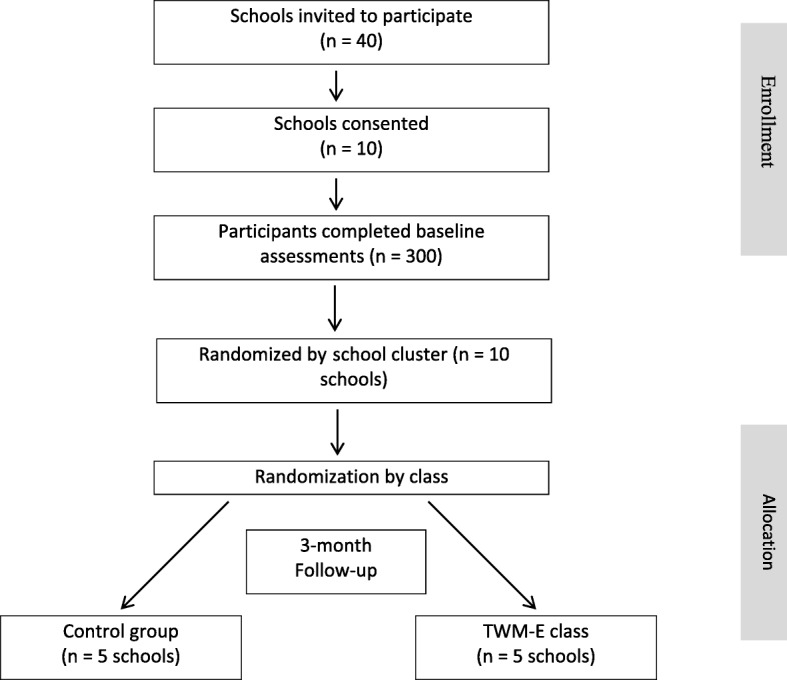
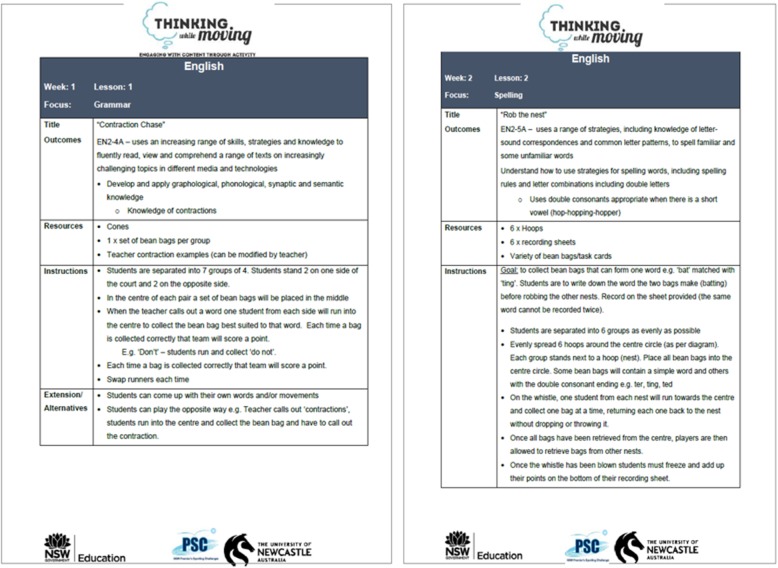
Grade 3-4 children from 10 public schools in New South Wales, Australia will be randomly allocated to intervention (n = 5) or control (n = 5) groups. All teachers will receive 1-day workshop of registered professional learning and a TWM-E equipment pack (e.g., chalk, lettered bean bags). Intervention schools will be asked to adapt their English lessons to embed movement-based learning in their daily program for three 40-min lessons per week, over a six-week period. The primary outcome is children's physical activity levels across the school day (measured using accelerometry). Secondary outcomes are children's on-task behavior during English lessons, academic achievement in English, and executive function. A detailed process evaluation will be undertaken including questionnaires, fidelity checks, and teacher and student interviews.
The TWM-E program has the potential to improve primary school children's physical activity levels, along with academic outcomes (on-task behavior, cognition, and academic achievement), and provide stakeholders with exemplar lessons and guidelines which illustrate how to teach English to children whilst they are moving.
Australian and New Zealand Clinical trial Register ACTRN12618001009202 Date registered: 15/06/2018 retrospectively registered.
目前儿童的身体活动水平不断下降,这是一个全球性的问题。将身体活动融入学校课程不仅是提高儿童身体活动水平的有效途径,也是提高教育成果的有效途径。鉴于澳大利亚最近对提高小学儿童的读写水平的重视,以及用于专门教授这些技能的时间比例不断增加,将身体活动融入英语教学可能是提高读写水平和身体活动水平的一种可行策略。本研究旨在评估“英语思维与运动”(TWM-E)计划对儿童身体活动、课堂参与度、学业成绩和执行功能的影响。
来自澳大利亚新南威尔士州 10 所公立学校的 3-4 年级儿童将被随机分配到干预组(n=5)或对照组(n=5)。所有教师将接受为期 1 天的注册专业学习研讨会和 TWM-E 设备包(例如粉笔、字母豆袋)。干预学校将被要求调整其英语课程,在每周 3 节 40 分钟的课程中融入基于运动的学习,为期 6 周。主要结果是整个上学日儿童的身体活动水平(使用加速度计测量)。次要结果是儿童在英语课上的课堂参与度、英语学业成绩和执行功能。将进行详细的过程评估,包括问卷调查、保真度检查以及教师和学生访谈。
TWM-E 计划有可能提高小学生的身体活动水平,同时提高学业成绩(课堂参与度、认知和学业成绩),并为利益相关者提供范例课程和指导,说明如何在儿童运动时教授英语。
澳大利亚和新西兰临床试验注册中心 ACTRN12618001009202 注册日期:2018 年 6 月 15 日回溯性注册。