AIDS and Cancer Virus Program, Frederick National Laboratory for Cancer Research, Frederick, MD, 21702, USA.
HIV Dynamics and Replication Program, National Cancer Institute, Frederick, MD, 21702, USA.
Retrovirology. 2019 Apr 4;16(1):11. doi: 10.1186/s12977-019-0473-2.
Reverse transcription (RT) of HIV and SIV is initiated by the binding of the acceptor stem of tRNA to the primer binding site (PBS) of the viral RNA genome. Previous studies have suggested that this tRNA is not the only molecule capable of priming reverse transcription, and that at least one other lysyl tRNA, tRNA, which has an acceptor stem sequence varying from tRNA by only a single transition mutation resulting in the integration of a thymine (T) at position 8 of the PBS in the viral genome, can prime reverse transcription.
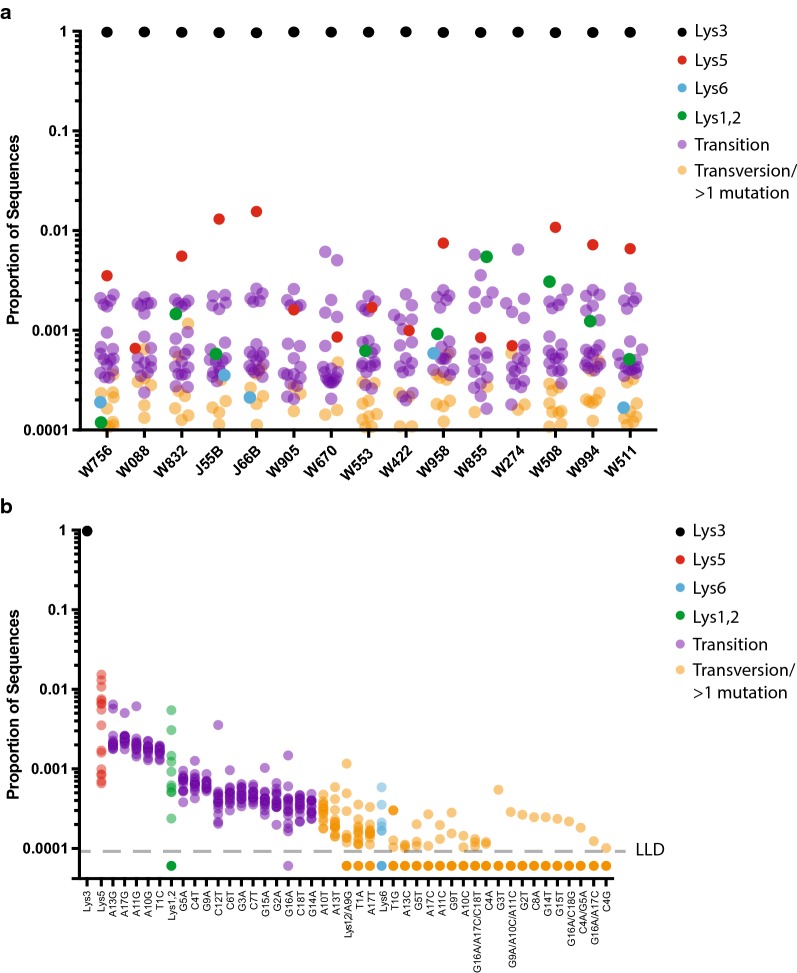
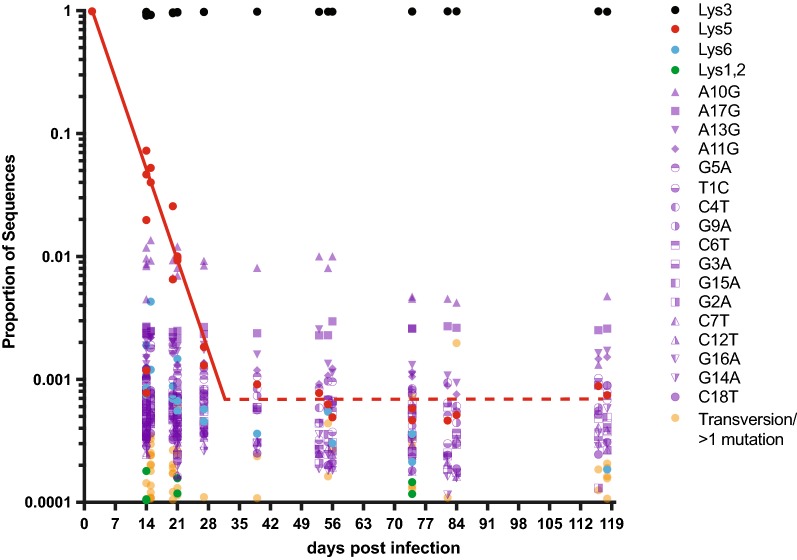
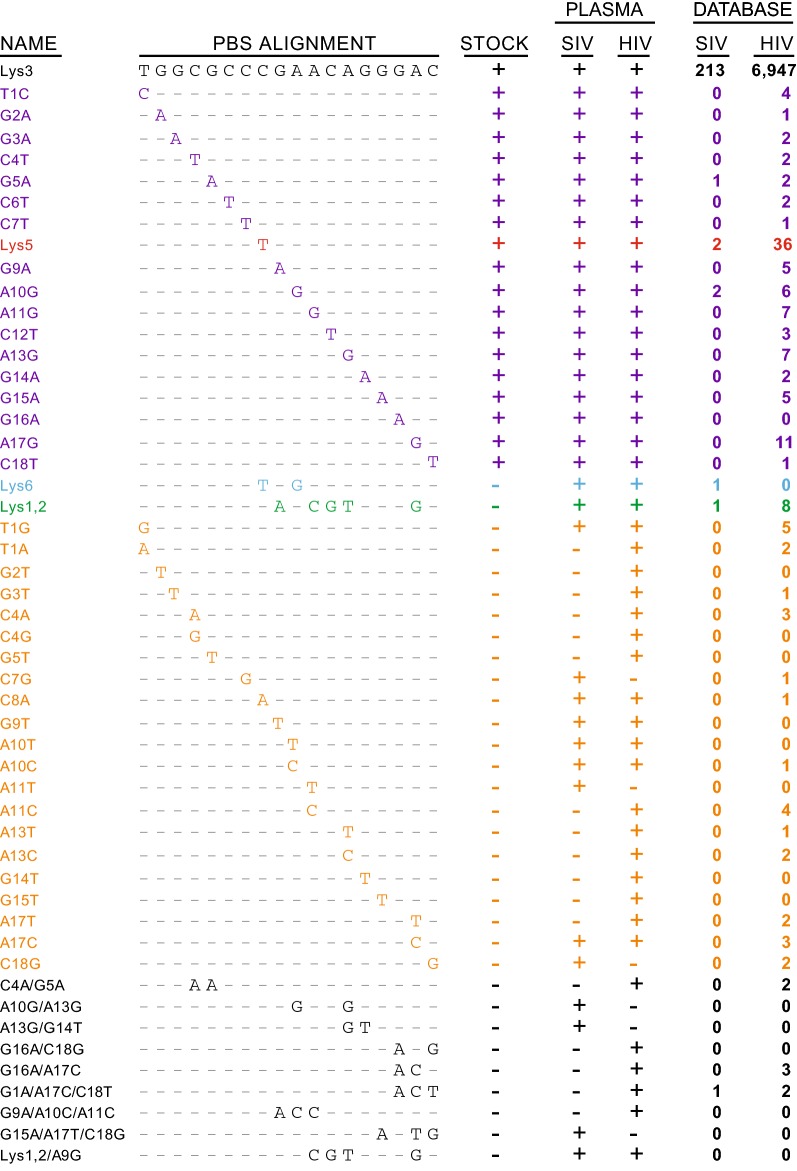
We undertook an unbiased approach, evaluating the primer binding site by deep-sequencing of HIV and SIV directly from the plasma of 15 humans and 11 macaques. We found that in humans there are low but measurable levels of viral RNA genomes harboring a PBS containing the noncanonical T at position 8 (PBS-Lys5) corresponding to the tRNA sequence and representing an average of 0.52% (range 0.07-1.6%) of the total viral population. This value is remarkably consistent with the proportion of PBS-Lys5 we identified in a cross-sectional assessment of the LANL HIV database (0.51%). In macaques chronically infected with SIVmac239, the PBS-Lys5 was also detected but at a frequency 1-log less than seen for HIV, with an average of 0.056% (range 0.01-0.09%). At this proportion, PBS-Lys5 was comparable to other transition mutations, making it impossible to determine whether the mutation observed is a result of use of tRNA as an RT primer at very low levels or merely the product of in vitro cDNA synthesis/PCR error. We also identified two novel PBS sequences in HIV and SIV at low levels in vivo corresponding to tRNA and tRNA, suggesting that these tRNAs may rarely also be used to prime RT. In vivo reversion of the PBS-Lys5 found in SIVmac239 was rapid and reached background levels by 30 days post-infection.
We conclude that while alternative tRNAs can initiate reverse transcription of HIV and SIV in vivo, their overall contributions to the replicating viral population are small.
逆转录(RT)HIV 和 SIV 是由 tRNA 的接受茎与病毒 RNA 基因组的引物结合位点(PBS)结合起始的。先前的研究表明,这种 tRNA 并不是唯一能够引发逆转录的分子,至少还有一种其他的赖氨酸 tRNA(tRNA),它的接受茎序列与 tRNA 只有一个单转换突变不同,导致胸腺嘧啶(T)在病毒基因组 PBS 的第 8 位整合,能够引发逆转录。
我们采用了一种无偏的方法,通过对 15 名人类和 11 只猕猴的血浆中的 HIV 和 SIV 进行深度测序,评估了引物结合位点。我们发现,在人类中,存在低但可测量水平的含有非典型 PBS-T8 的病毒 RNA 基因组(PBS-Lys5),对应于 tRNA 序列,代表总病毒群体的平均 0.52%(范围为 0.07-1.6%)。这个值与我们在 LANL HIV 数据库的横断面评估中确定的 PBS-Lys5 比例(0.51%)非常一致。在慢性感染 SIVmac239 的猕猴中,也检测到了 PBS-Lys5,但频率比 HIV 低 1 个对数级,平均为 0.056%(范围为 0.01-0.09%)。在这个比例下,PBS-Lys5 与其他转换突变相当,因此无法确定观察到的突变是由于极低水平的 tRNA 作为 RT 引物使用的结果,还是体外 cDNA 合成/PCR 错误的产物。我们还在 HIV 和 SIV 中鉴定出了两种低水平的新 PBS 序列,对应于 tRNA 和 tRNA,表明这些 tRNA 可能很少被用作 RT 的引物。在 SIVmac239 中发现的 PBS-Lys5 的体内回复非常迅速,在感染后 30 天达到背景水平。
我们的结论是,虽然替代 tRNA 可以在体内引发 HIV 和 SIV 的逆转录,但它们对复制病毒群体的总体贡献很小。