Department of Biotherapy and Oncology, Shenzhen Luohu People's Hospital, Shenzhen, 518001, Guangdong, People's Republic of China.
Public Service Platform for Cell Quality Testing and Evaluation of Shenzhen, Shenzhen, 518001, Guangdong, People's Republic of China.
J Transl Med. 2019 Apr 4;17(1):111. doi: 10.1186/s12967-019-1845-z.
A stroke caused by angiostenosis always has a poor prognosis. Bone marrow stromal cells (BMSC) are widely applied in vascular regeneration. Recently, thrombospondin-4 (TSP4) was reported to promote the regeneration of blood vessels and enhance the function of endothelial cells in angiogenesis. In this work, we observed the therapeutic effect of TSP4-overexpressing BMSCs on angiogenesis post-stroke.
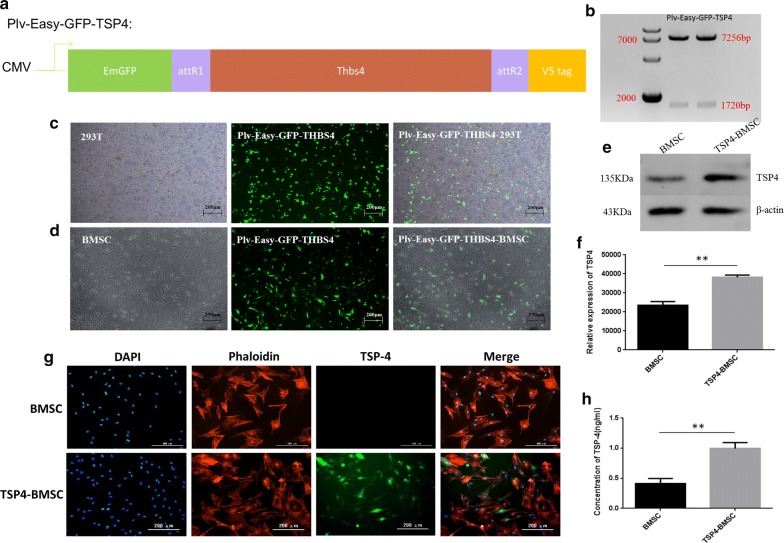
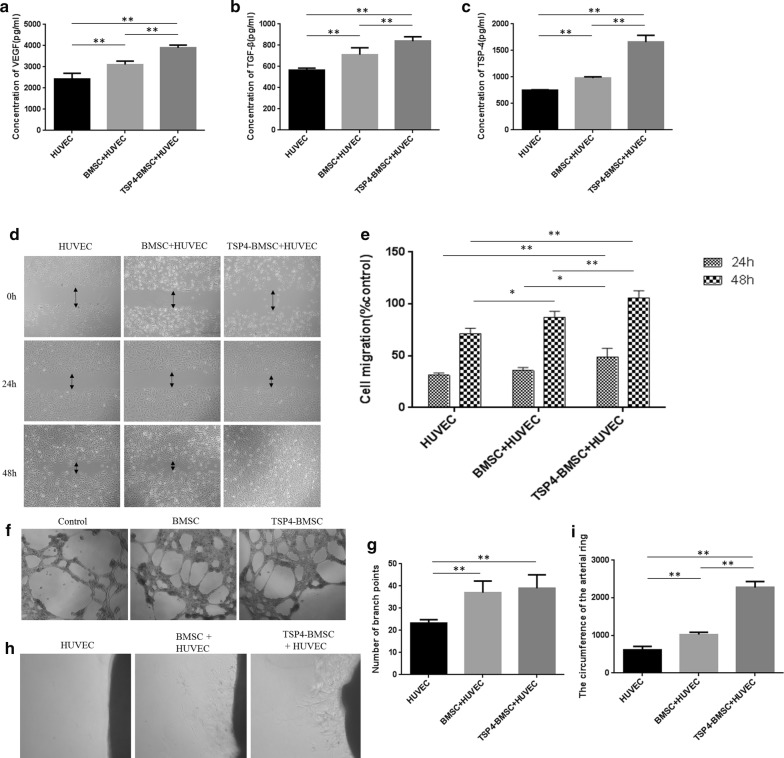
We subcloned the tsp4 gene into a lentivirus expression vector system and harvested the tsp4 lentivirus using 293FT cells. Primary BMSCs were then successfully infected by the tsp4 virus, and overexpression of GFP-fused TSP4 was confirmed by both western blot and immunofluorescence. In vitro, TSP4-overexpressing BMSCs and wild-type BMSCs were co-cultured with human umbilical vein endothelial cells (HUVECs). The expression level of TSP4, vascular endothelial growth factor (VEGF) and transforming growth factor-β (TGF-β) in the supernatant were detected by enzyme-linked immunosorbent assay (ELISA). Wound healing, tube formation and an arterial ring test were performed to estimate the ability of TSP4-overexpressing BMSCs to promote the angiogenesis of endothelial cells. Using a rat permanent middle cerebral artery occlusion (MCAO) model, the effect of TSP4-overexpressing BMSCs on the regeneration of blood vessels was systematically tested by the neurological function score, immunohistochemistry and immunofluorescence staining assays.
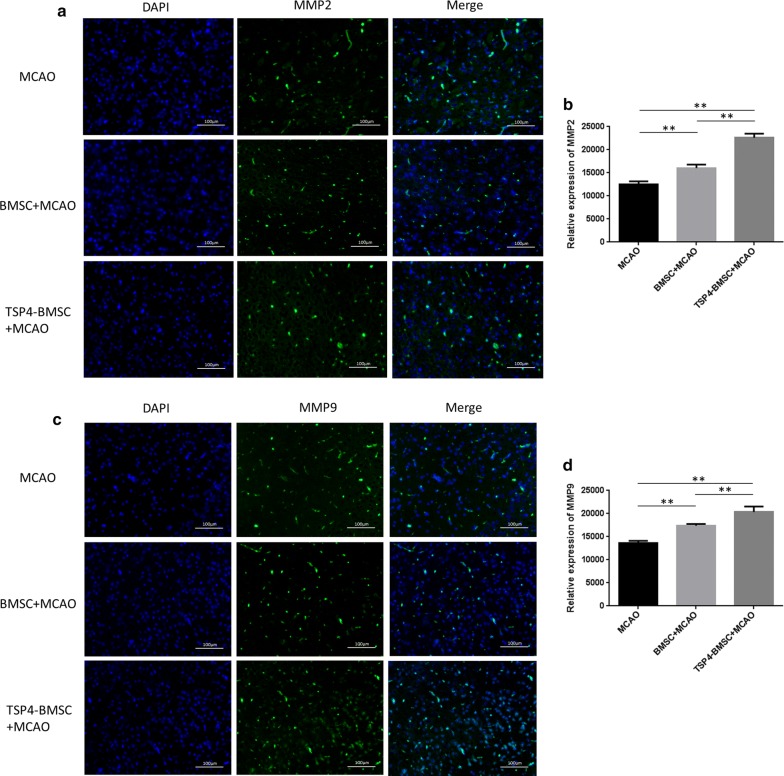
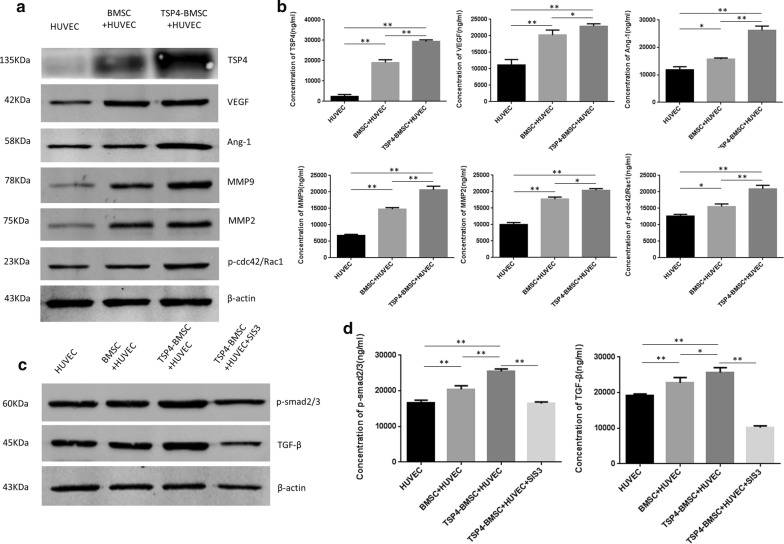
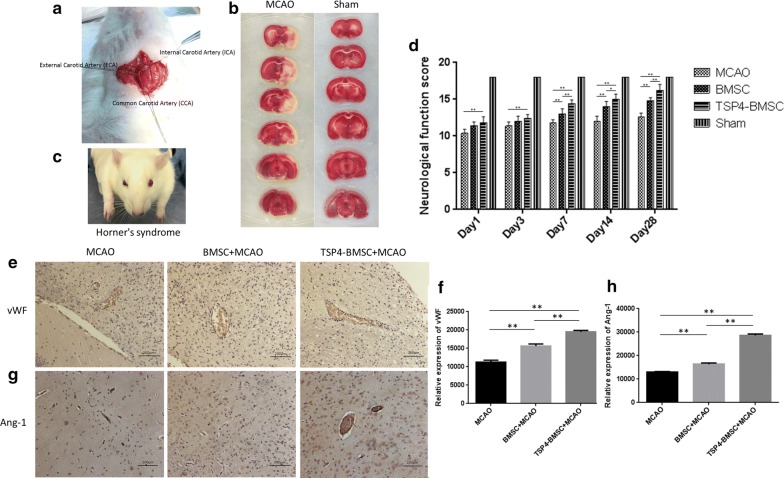
Our results demonstrated that TSP4-overexpressing BMSCs largely increased the expression of VEGF, angiopoietin-1 (Ang-1), matrix metalloprotein 9 (MMP9), matrix metalloprotein 2 (MMP2) and p-Cdc42/Rac1 in endothelial cells. TSP4-BMSC treatment notably up-regulated the TGF-β/Smad2/3 signalling pathway in HUVECs. In vivo, the TSP4-BMSC infusion improved the neurological function score of MCAO rats and expanded the expression of the von Willebrand factor (vWF), Ang-1, MMP2 and MMP9 proteins in cerebral ischemic penumbra.
Our data illustrate that TSP4-BMSCs can promote the proliferation and migration of endothelial cells and tube formation. We found that TSP4-BMSC infusion can promote the recovery of neural function post-stroke. The tsp4 gene-modified BMSCs provides a better therapeutic effect than that of wild-type BMSCs.
血管狭窄导致的中风预后往往较差。骨髓基质细胞(BMSC)广泛应用于血管再生。最近,血栓反应蛋白 4(TSP4)被报道可促进血管再生,并增强血管生成中内皮细胞的功能。在这项工作中,我们观察了过表达 TSP4 的 BMSC 对中风后血管生成的治疗效果。
我们将 tsp4 基因亚克隆到慢病毒表达载体系统中,并使用 293FT 细胞收获 tsp4 慢病毒。然后,原代 BMSC 被 tsp4 病毒成功感染,GFP 融合 TSP4 的过表达通过 Western blot 和免疫荧光染色得到证实。在体外,将过表达 TSP4 的 BMSC 和野生型 BMSC 与人脐静脉内皮细胞(HUVEC)共培养。通过酶联免疫吸附试验(ELISA)检测上清液中 TSP4、血管内皮生长因子(VEGF)和转化生长因子-β(TGF-β)的表达水平。进行划痕愈合、管形成和动脉环试验,以评估过表达 TSP4 的 BMSC 促进内皮细胞血管生成的能力。使用大鼠永久性大脑中动脉闭塞(MCAO)模型,通过神经功能评分、免疫组织化学和免疫荧光染色试验系统地测试过表达 TSP4 的 BMSC 对血管再生的影响。
我们的结果表明,过表达 TSP4 的 BMSC 显著增加了内皮细胞中 VEGF、血管生成素 1(Ang-1)、基质金属蛋白酶 9(MMP9)、基质金属蛋白酶 2(MMP2)和 p-Cdc42/Rac1 的表达。TSP4-BMSC 处理显著上调了 HUVEC 中 TGF-β/Smad2/3 信号通路。在体内,TSP4-BMSC 输注改善了 MCAO 大鼠的神经功能评分,并扩大了缺血半影区中血管性血友病因子(vWF)、Ang-1、MMP2 和 MMP9 蛋白的表达。
我们的数据表明,TSP4-BMSC 可促进内皮细胞的增殖和迁移以及管形成。我们发现 TSP4-BMSC 输注可促进中风后神经功能的恢复。与野生型 BMSC 相比,tsp4 基因修饰的 BMSC 提供了更好的治疗效果。