Richard T. Silver Myeloproliferative Neoplasm Center, Division of Hematology/Medical Oncology, Weill Cornell Medicine, New York, NY, USA
Haematologica. 2019 Nov;104(11):2200-2205. doi: 10.3324/haematol.2018.213108. Epub 2019 Apr 4.
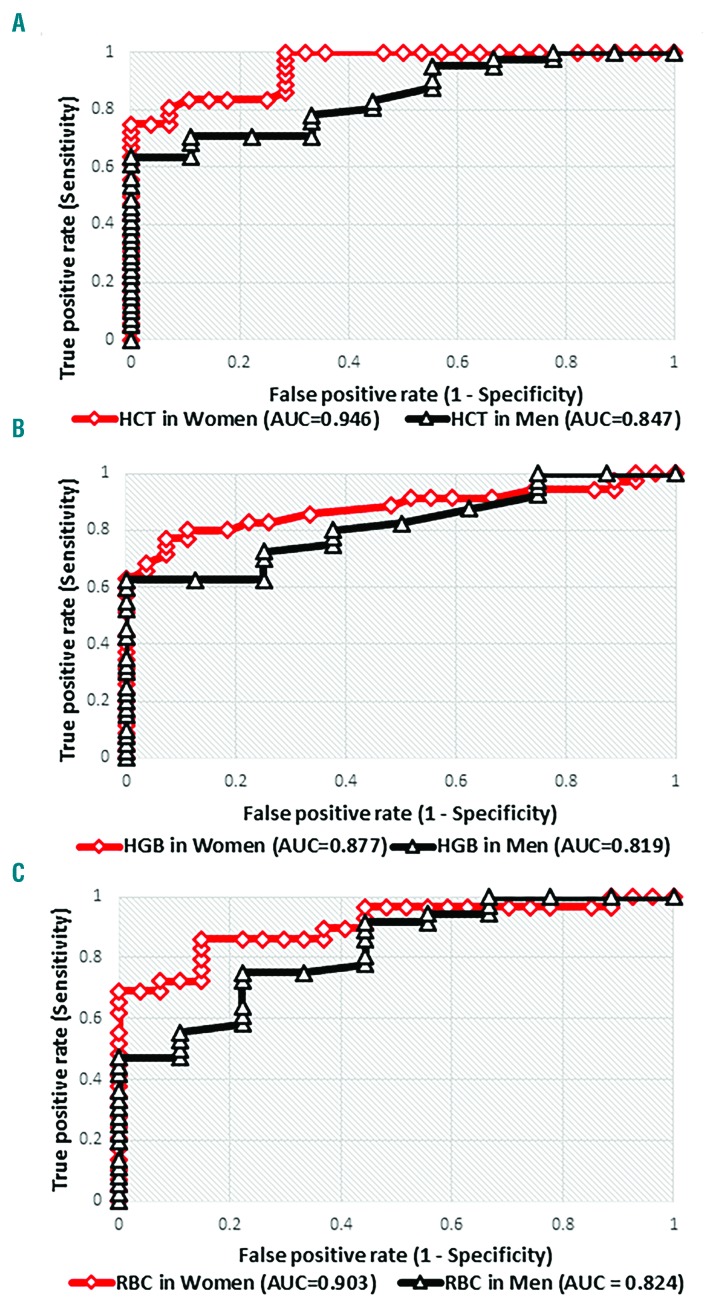
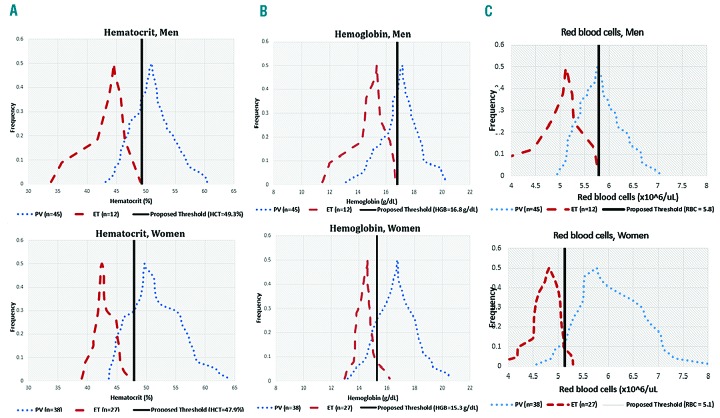
Distinguishing essential thrombocythemia V617F from polycythemia vera is difficult because of shared mutation and phenotypic characteristics. The World Health Organization suggested hemoglobin and hematocrit values to diagnose polycythemia vera (PV), but their sensitivity and specificity were not tested. Moreover, red cell values do not accurately predict red cell mass, which we use to discriminate essential thrombocythemia V617F from PV. Eighty-three PV and 39 essential thrombocythemia V617F patients were diagnosed based on V617F positivity, chromium-51 red cell mass, and marrow biopsy findings. Red cell values used to construct a receiver operating characteristic analysis determined optimal thresholds for distinguishing essential thrombocythemia V617F from PV. Red cell value frequencies were plotted determining if overlap existed. Chromium-51 red cell mass separated PV from essential thrombocythemia V617F, but red cell values overlapped in 25.0-54.7%. Our data indicate that a significant proportion of PV patients may be underdiagnosed by using only red cell values. A bone marrow biopsy was performed in 199 of 410 (48.5%) and a serum erythropoietin value was measured in 225 of 410 (54.9%) of potential PV patients at our institution. Without isotope studies, marrow biopsies and serum erythropoietin values should improve diagnostic accuracy and become mandatory, but clinical data suggest these tests have not been routinely performed. Therefore, the clinical hematologist must be aware of imperfect accuracy when using only red cell values for distinguishing essential thrombocythemia V617F from PV.
从共同的突变和表型特征来看,区分原发性血小板增多症 V617F 和真性红细胞增多症是很困难的。世界卫生组织建议使用血红蛋白和血细胞比容值来诊断真性红细胞增多症(PV),但并未对其敏感性和特异性进行测试。此外,红细胞值不能准确预测红细胞量,我们使用红细胞量来区分原发性血小板增多症 V617F 和 PV。根据 V617F 阳性、铬 51 红细胞量和骨髓活检结果,诊断了 83 例真性红细胞增多症和 39 例原发性血小板增多症 V617F 患者。用于构建受试者工作特征分析的红细胞值确定了区分原发性血小板增多症 V617F 和 PV 的最佳阈值。绘制红细胞值频率图以确定是否存在重叠。铬 51 红细胞量可将 PV 与原发性血小板增多症 V617F 区分开来,但红细胞值在 25.0-54.7%之间存在重叠。我们的数据表明,相当一部分 PV 患者可能因仅使用红细胞值而被漏诊。在我们机构,对 410 例潜在 PV 患者中的 199 例进行了骨髓活检,对 225 例进行了血清促红细胞生成素值测量。在没有同位素研究的情况下,骨髓活检和血清促红细胞生成素值应提高诊断准确性并成为强制性的,但临床数据表明这些检查并未常规进行。因此,临床血液学家在使用红细胞值来区分原发性血小板增多症 V617F 和 PV 时,必须意识到准确性存在缺陷。