Clinical Genetics Research Program, Centre for Addiction and Mental Health, Toronto, ON, Canada.
Department of Psychiatry, University of Toronto, Toronto, ON, Canada.
Genet Med. 2019 Oct;21(10):2328-2335. doi: 10.1038/s41436-019-0509-y. Epub 2019 Apr 5.
Given limited data available on long-term outcomes in 22q11.2 deletion syndrome (22q11.2DS), we investigated mortality risk in adults with this microdeletion syndrome.
We studied 309 well-characterized adults (age ≥17 years) with 22q11.2DS and their 1014 unaffected parents and siblings, using a prospective case-control design. We used Cox proportional hazards regression modeling and Kaplan-Meier curves to investigate effects of the 22q11.2 deletion and its associated features on all-cause mortality and survival.
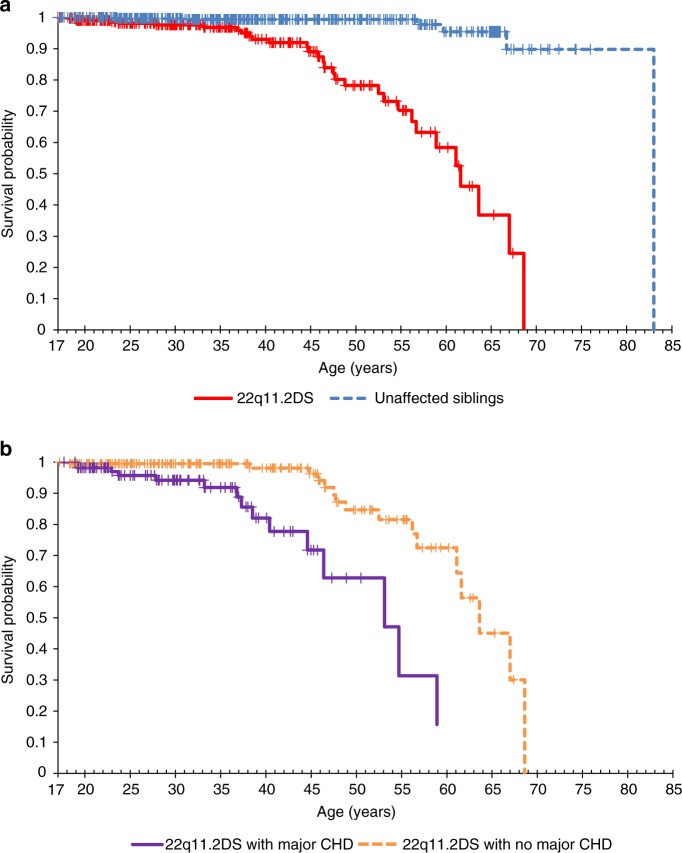
The 22q11.2 deletion (hazard ratio [HR] 8.86, 95% CI 2.87-27.37) and major congenital heart disease (CHD; HR 5.03, 95% CI 2.27-11.17), but not intellectual disability or psychotic illness, were significant independent predictors of mortality for adults with 22q11.2DS compared with their siblings. Amongst those with 22q11.2DS, there were 31 deaths that occurred at a median age of 46.4 (range 18.1-68.6) years; a substantial minority had outlived both parents. Probability of survival to age 45 years was approximately 72% for those with major CHD, and 95% for those with no major CHD (p < 0.0001).
For adults with 22q11.2DS, the 22q11.2 deletion and more severe forms of CHD both contribute to a lower life expectancy than family-based expectations. The results have implications for genetic counseling and anticipatory care.
鉴于 22q11.2 缺失综合征(22q11.2DS)的长期预后数据有限,我们研究了这种微缺失综合征成人的死亡风险。
我们使用前瞻性病例对照设计研究了 309 名特征明确的 22q11.2DS 成人(年龄≥17 岁)及其 1014 名未受影响的父母和兄弟姐妹。我们使用 Cox 比例风险回归模型和 Kaplan-Meier 曲线研究了 22q11.2 缺失及其相关特征对全因死亡率和生存的影响。
22q11.2 缺失(危险比[HR]8.86,95%置信区间[CI]2.87-27.37)和主要先天性心脏病(CHD;HR 5.03,95%CI 2.27-11.17),但不是智力残疾或精神病,是 22q11.2DS 成人与兄弟姐妹相比死亡的独立显著预测因素。在 22q11.2DS 患者中,有 31 例死亡发生于中位年龄 46.4 岁(范围 18.1-68.6);少数人已经超过父母双方的预期寿命。患有重大 CHD 的患者在 45 岁时的生存率约为 72%,而无重大 CHD 的患者为 95%(p<0.0001)。
对于 22q11.2DS 成人,22q11.2 缺失和更严重形式的 CHD 都会导致预期寿命短于基于家族的预期。结果对遗传咨询和预期护理具有重要意义。