Li Lixia, Li Yuanyuan, Fan Zhihao, Wang Xianghai, Li Zhenlin, Wen Jinkun, Deng Junyao, Tan Dandan, Pan Mengjie, Hu Xiaofang, Zhang Haowen, Lai Muhua, Guo Jiasong
Guangdong Provincial Key Laboratory of Construction and Detection in Tissue Engineering, Southern Medical University, Guangzhou, China.
Department of Histology and Embryology, Southern Medical University, Guangzhou, China.
Front Cell Neurosci. 2019 Mar 21;13:108. doi: 10.3389/fncel.2019.00108. eCollection 2019.
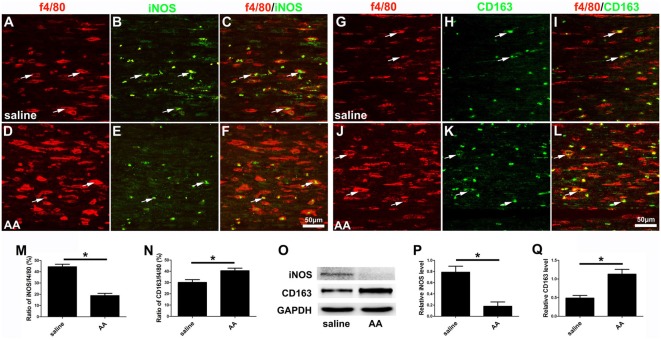
Ascorbic acid (AA) is an essential micronutrient that has been safely used in the clinic for many years. The present study indicates that AA has an unexpected function in facilitating nerve regeneration. Using a mouse model of sciatic nerve crush injury, we found that AA can significantly accelerate axonal regrowth in the early stage [3 days post-injury (dpi)], a finding that was revealed by immunostaining and Western blotting for antibodies against GAP-43 and SCG10. On day 28 post-injury, histomorphometric assessments demonstrated that AA treatment increased the density, size, and remyelination of regenerated axons in the injured nerve and alleviated myoatrophy in the gastrocnemius. Moreover, the results from various behavioral tests and electrophysiological assays revealed that nerve injury-derived functional defects in motor and sensory behavior as well as in nerve conduction were significantly attenuated by treatment with AA. The potential mechanisms of AA in nerve regeneration were further explored by investigating the effects of AA on three types of cells involved in this process [neurons, Schwann cells (SCs) and macrophages] through a series of experiments. Overall, the data illustrated that AA treatment in cultured dorsal root ganglionic neurons resulted in increased neurite growth and lower expression of RhoA, which is an important inhibitory factor in neural regeneration. In SCs, proliferation, phagocytosis, and neurotrophin expression were all enhanced by AA. Meanwhile, AA treatment also improved proliferation, migration, phagocytosis, and anti-inflammatory polarization in macrophages. In conclusion, this study demonstrated that treatment with AA can promote the morphological and functional recovery of injured peripheral nerves and that this effect is potentially due to AA's bioeffects on neurons, SCs and macrophages, three of most important types of cells involved in nerve injury and regeneration.
抗坏血酸(AA)是一种必需的微量营养素,多年来一直在临床上安全使用。本研究表明,AA在促进神经再生方面具有意想不到的功能。使用坐骨神经挤压损伤的小鼠模型,我们发现AA可以在早期阶段(损伤后3天)显著加速轴突再生,这一发现通过针对GAP - 43和SCG10抗体的免疫染色和蛋白质印迹得以揭示。损伤后第28天,组织形态计量学评估表明,AA治疗增加了受损神经中再生轴突的密度、大小和髓鞘再生,并减轻了腓肠肌的肌萎缩。此外,各种行为测试和电生理分析的结果表明,AA治疗显著减轻了神经损伤导致的运动和感觉行为以及神经传导方面的功能缺陷。通过一系列实验研究AA对参与这一过程的三种细胞类型(神经元、雪旺细胞和巨噬细胞)的影响,进一步探索了AA在神经再生中的潜在机制。总体而言,数据表明,在培养的背根神经节神经元中进行AA治疗可导致神经突生长增加以及RhoA表达降低,RhoA是神经再生中的一个重要抑制因子。在雪旺细胞中,AA增强了增殖、吞噬作用和神经营养因子表达。同时,AA治疗还改善了巨噬细胞的增殖、迁移、吞噬作用和抗炎极化。总之,本研究表明,AA治疗可以促进受损周围神经的形态和功能恢复,这种作用可能归因于AA对神经元、雪旺细胞和巨噬细胞这三种参与神经损伤和再生的最重要细胞类型的生物学效应。