Ren Xiao-Cang, Liu Yue-E, Li Jing, Lin Qiang
Department of Oncology, North China Petroleum Bureau General Hospital, Hebei Medical University, Renqiu 062552, Hebei Province, China.
World J Radiol. 2019 Mar 28;11(3):46-54. doi: 10.4329/wjr.v11.i3.46.
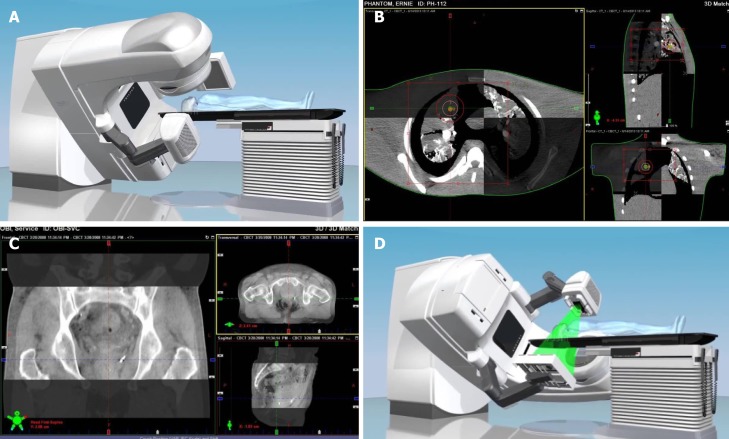
Lung cancer is one of the most common malignant tumors. It has the highest incidence and mortality rate of all cancers worldwide. Late diagnosis of non-small cell lung cancer (NSCLC) is very common in clinical practice, and most patients miss the chance for radical surgery. Thus, radiotherapy plays an indispensable role in the treatment of NSCLC. Radiotherapy technology has evolved from the classic two-dimensional approach to three-dimensional conformal and intensity-modulated radiotherapy. However, how to ensure delivery of an accurate dose to the tumor while minimizing the irradiation of normal tissues remains a huge challenge for radiation oncologists, especially due to the positioning error between fractions and the autonomous movement of organs. In recent years, image-guided radiotherapy (IGRT) has greatly increased the accuracy of tumor irradiation while reducing the irradiation dose delivered to healthy tissues and organs. This paper presents a brief review of the definition of IGRT and the various technologies and applications of IGRT. IGRT can help ensure accurate dosing of the target area and reduce radiation damage to the surrounding normal tissue. IGRT may increase the local control rate of tumors and reduce the incidence of radio-therapeutic complications.
肺癌是最常见的恶性肿瘤之一。它在全球所有癌症中发病率和死亡率最高。在临床实践中,非小细胞肺癌(NSCLC)的晚期诊断非常普遍,大多数患者错过根治性手术机会。因此,放射治疗在NSCLC治疗中发挥着不可或缺的作用。放射治疗技术已从经典的二维方法发展到三维适形和调强放射治疗。然而,如何在将正常组织受照剂量降至最低的同时确保向肿瘤准确输送剂量,对于放射肿瘤学家来说仍然是一个巨大的挑战,尤其是由于分次治疗间的定位误差以及器官的自主运动。近年来,图像引导放射治疗(IGRT)在提高肿瘤照射精度的同时,降低了输送至健康组织和器官的照射剂量。本文简要综述了IGRT的定义以及IGRT的各种技术和应用。IGRT有助于确保靶区准确给药,并减少对周围正常组织的辐射损伤。IGRT可能会提高肿瘤的局部控制率,并降低放射治疗并发症的发生率。