Makenga Geofrey, Bonoli Stefano, Montomoli Emanuele, Carrier Trent, Auerbach Joachim
Department of Molecular and Developmental Medicine, University of Siena, Siena, Italy.
GSK Vaccines, Siena, Italy.
Front Public Health. 2019 Mar 20;7:56. doi: 10.3389/fpubh.2019.00056. eCollection 2019.
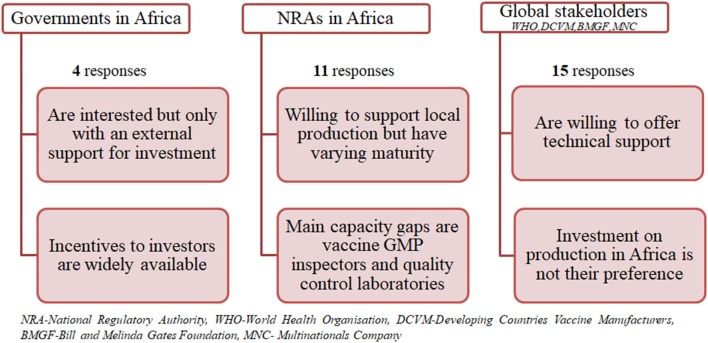
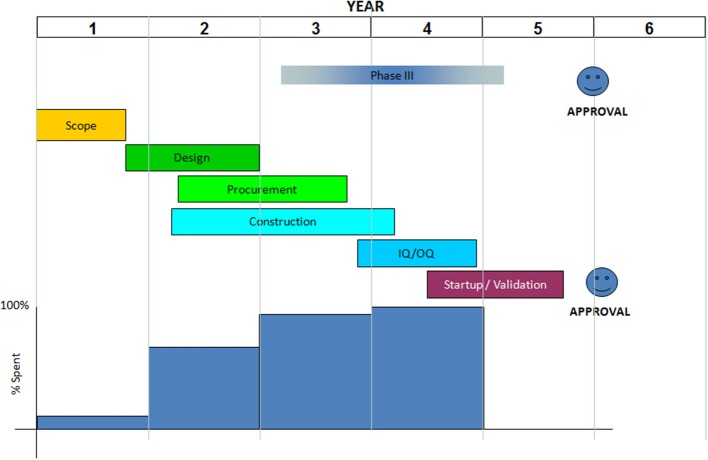
Africa has the highest incidence of mortality caused by infectious diseases, and remarkably does not have the capacity to manufacture vaccines that are essential to reduce mortality, improving life expectancy, and promoting economic growth. GAVI has significantly helped introduction of new vaccines in Africa but its sustainability is questionable, and new vaccines introduction post-graduation is rare. Conversely, Africa with its high population and economy growth is an increasing potential market for vaccines. This study aimed to investigate how investment for vaccine production in Africa could be triggered and in which way it could be affordable to most African governments or investors. The investigation was based on a literature review and supplemented by online questionnaires directed to global vaccine stakeholders, African governments and regulatory authorities. In-depth interviews with experts in manufacturing capacity implementation and regulatory capacity building in Africa complemented the study. We also developed business plan scenarios including facility costs calculations and a possible investment plan based on expert opinions and publicly available information from pertinent sources. We saw that, governments in Africa, show interest in vaccine production establishments but only with external support for investment. The common regulatory functionality gap was the quality control laboratories to test vaccine lots before regulatory release. The global vaccine stakeholders showed less preference in investment for vaccine production establishment in Africa. The diverse political ambitions among African governments make it difficult to predict and access the market, a prerequisite for competitive production. A feasible solution could be a small production facility that would use technologies with high yield at low costs of goods to cover the regional needs. A respective antigen production facility is estimated to cost USD 25 Million, an affordable dimension for investors or interested African governments. Attractiveness for the African market is deemed to be high when targeting diseases almost exclusively for Africa (e.g., malaria or invasive non-typhoidal salmonella). With a smart 5 years tangible implementation plan, marketing agreements within existing regional collaborations and with a strong political will, an African government alone or together with an investor could convince global vaccine stakeholders and investors to support.
非洲因传染病导致的死亡率最高,然而显著的是,它没有能力生产对于降低死亡率、提高预期寿命以及促进经济增长至关重要的疫苗。全球疫苗免疫联盟(GAVI)极大地助力了非洲引进新疫苗,但其可持续性存疑,且毕业后引入新疫苗的情况罕见。相反,非洲人口众多且经济增长迅速,正日益成为一个潜力巨大的疫苗市场。本研究旨在调查如何激发对非洲疫苗生产的投资,以及以何种方式能让大多数非洲政府或投资者负担得起。该调查基于文献综述,并辅以向全球疫苗利益相关者、非洲政府和监管机构发放的在线问卷。对非洲制造能力实施和监管能力建设方面的专家进行的深入访谈为该研究提供了补充。我们还制定了商业计划方案,包括设施成本计算以及基于专家意见和相关来源公开信息的可能投资计划。我们发现,非洲各国政府对疫苗生产企业表现出兴趣,但前提是要有外部投资支持。常见的监管功能差距在于缺乏在监管放行前检测疫苗批次的质量控制实验室。全球疫苗利益相关者对在非洲投资建设疫苗生产企业的偏好较低。非洲各国政府之间多样的政治抱负使得预测和进入市场变得困难,而这是竞争性生产的一个先决条件。一个可行的解决方案可能是一个小型生产设施,它将采用低成本高产量的技术来满足区域需求。一个相应的抗原生产设施估计成本为2500万美元,对于投资者或感兴趣的非洲政府来说是一个可承受的规模。当针对几乎仅在非洲流行的疾病(如疟疾或侵袭性非伤寒沙门氏菌)时,对非洲市场的吸引力被认为很高。凭借一个明智的5年切实可行的实施计划、现有区域合作内的营销协议以及强大的政治意愿,一个非洲政府单独或与投资者一起能够说服全球疫苗利益相关者和投资者提供支持。