Lagrue Clément
Department of Zoology, University of Otago, P.O. Box 56, Dunedin 9054, New Zealand.
Int J Parasitol Parasites Wildl. 2017 Apr 7;6(3):364-374. doi: 10.1016/j.ijppaw.2017.03.008. eCollection 2017 Dec.
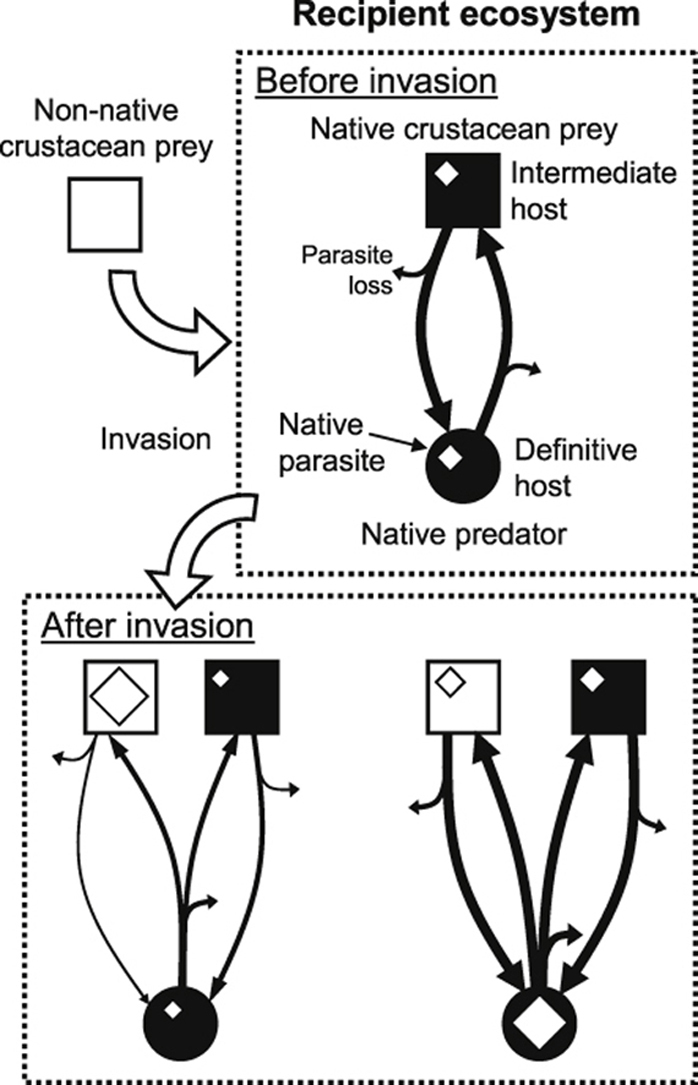
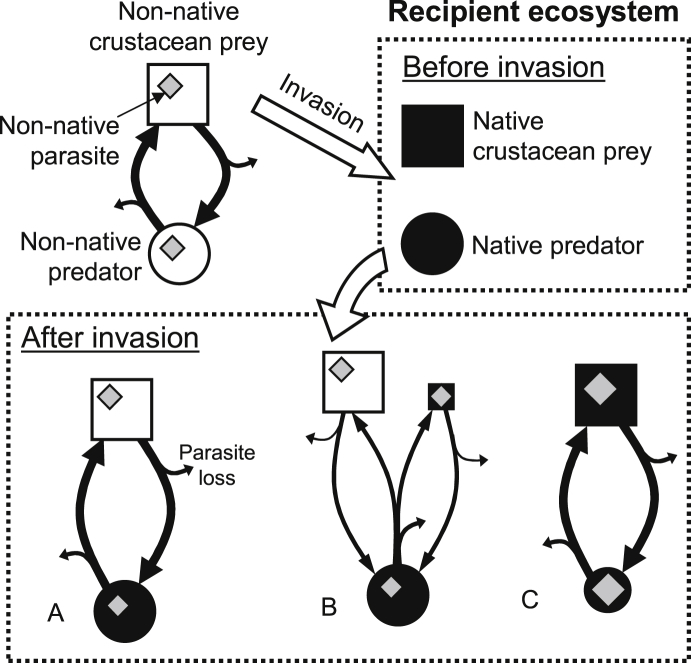
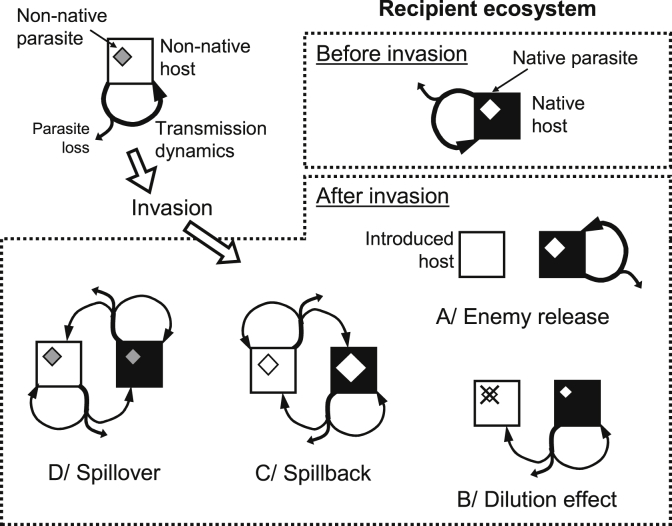
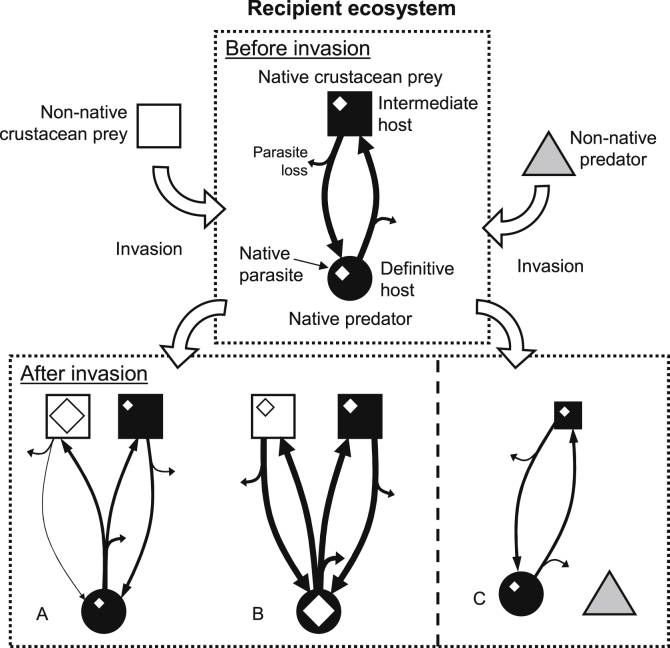
While there is considerable interest in, and good evidence for, the role that parasites play in biological invasions, the potential parallel effects of species introduction on parasite dynamics have clearly received less attention. Indeed, much effort has been focused on how parasites can facilitate or limit invasions, and positively or negatively impact native host species and recipient communities. Contrastingly, the potential consequences of biological invasions for the diversity and dynamics of both native and introduced parasites have been and are still mainly overlooked, although successful invasion by non-native host species may have large, contrasting and unpredictable effects on parasites. This review looks at the links between biological invasions and pathogens, and particularly at crustacean invasions in aquatic ecosystems and their potential effects on native and invasive parasites, and discusses what often remains unknown even from well-documented systems. Aquatic crustaceans are hosts to many parasites and are often invasive. Published studies show that crustacean invasion can have highly contrasting effects on parasite dynamics, even when invasive host and parasite species are phylogenetically close to their native counterparts. These effects seem to be dependent on multiple factors such as host suitability, parasite life-cycle or host-specific resistance to parasitic manipulation. Furthermore, introduced hosts can have drastically contrasting effects on parasite standing crop and transmission, two parameters that should be independently assessed before drawing any conclusion on the potential effects of novel hosts on parasites and the key processes influencing disease dynamics following biological invasions. I conclude by calling for greater recognition of biological invasions' effects on parasite dynamics, more parasite-focused studies and suggest some potential ways to assess these effects.
尽管人们对寄生虫在生物入侵中所起的作用有着浓厚兴趣且有充分证据,但物种引入对寄生虫动态的潜在类似影响显然受到的关注较少。事实上,很多努力都集中在寄生虫如何促进或限制入侵,以及对本地宿主物种和受纳群落产生正面或负面影响上。相比之下,生物入侵对本地和引入寄生虫的多样性及动态的潜在后果一直且仍主要被忽视,尽管非本地宿主物种的成功入侵可能对寄生虫产生巨大、截然不同且不可预测的影响。本综述着眼于生物入侵与病原体之间的联系,尤其关注水生生态系统中的甲壳类动物入侵及其对本地和入侵寄生虫的潜在影响,并讨论了即使在记录详尽的系统中仍常常未知的情况。水生甲壳类动物是许多寄生虫的宿主,且常常具有入侵性。已发表的研究表明,甲壳类动物入侵对寄生虫动态可能产生截然不同的影响,即使入侵的宿主和寄生虫物种在系统发育上与它们的本地对应物种相近。这些影响似乎取决于多个因素,如宿主适宜性、寄生虫生命周期或宿主对寄生操控的特异性抗性。此外,引入的宿主对寄生虫的现存量和传播可能产生截然不同的影响,在就新宿主对寄生虫的潜在影响以及生物入侵后影响疾病动态的关键过程得出任何结论之前,这两个参数应独立评估。我呼吁人们更多地认识到生物入侵对寄生虫动态的影响,开展更多以寄生虫为重点的研究,并提出一些评估这些影响的潜在方法作为总结。