Perkins Sarah E, White Tom A, Pascoe Emily L, Gillingham Emma L
School of Biosciences, Sir Martin Evans Building, Cardiff University, Museum Avenue, Cardiff, CF10 3AX, UK.
Lancaster Environment Centre, Lancaster University, Lancaster, LA1 4YQ, UK.
Int J Parasitol Parasites Wildl. 2017 Aug 4;6(3):412-419. doi: 10.1016/j.ijppaw.2017.07.005. eCollection 2017 Dec.
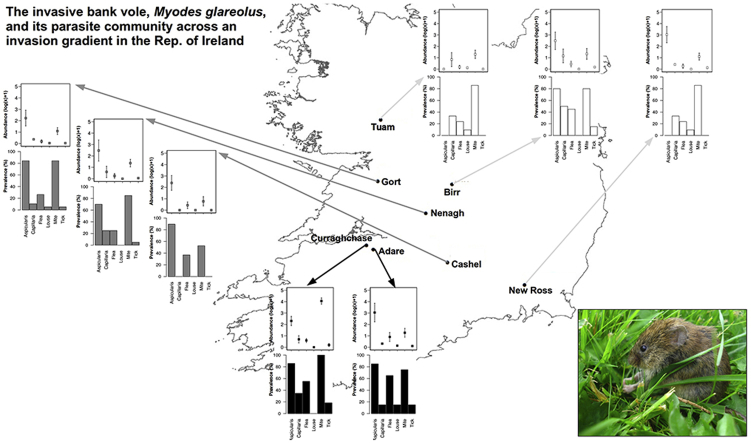
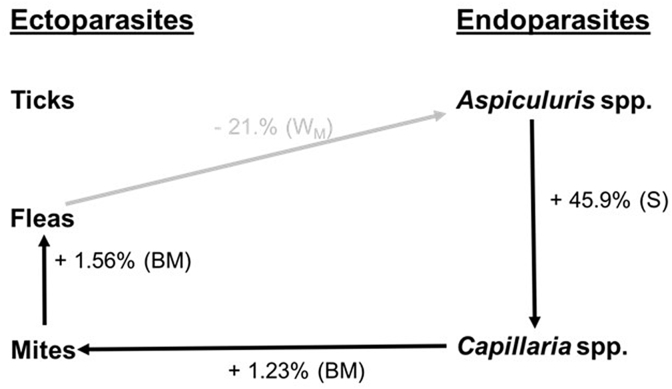
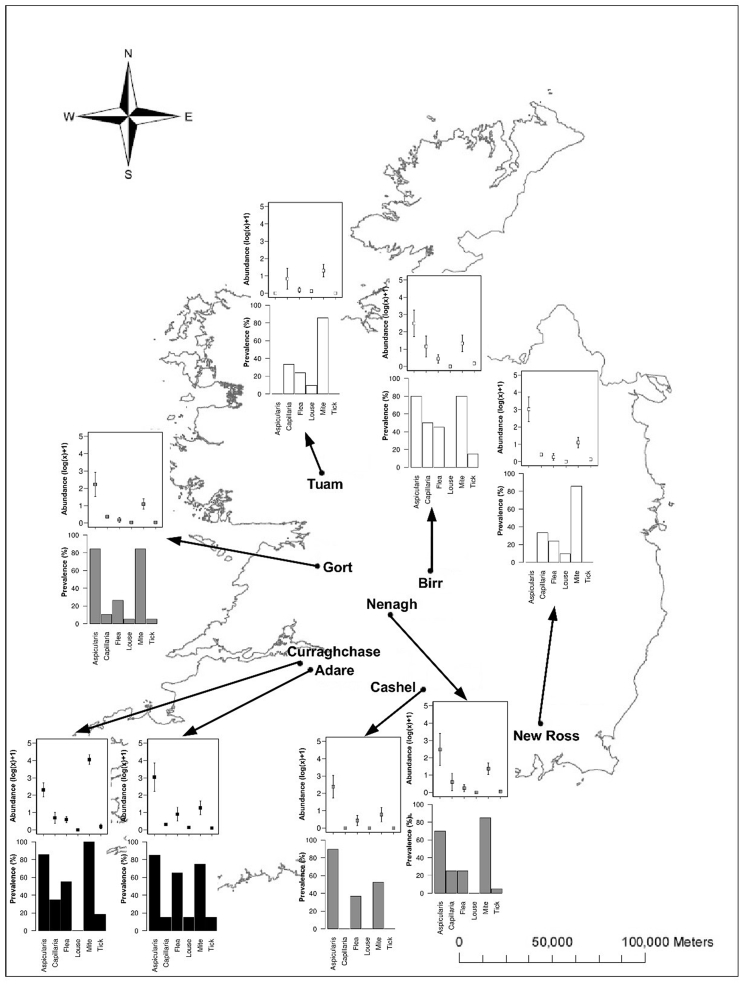
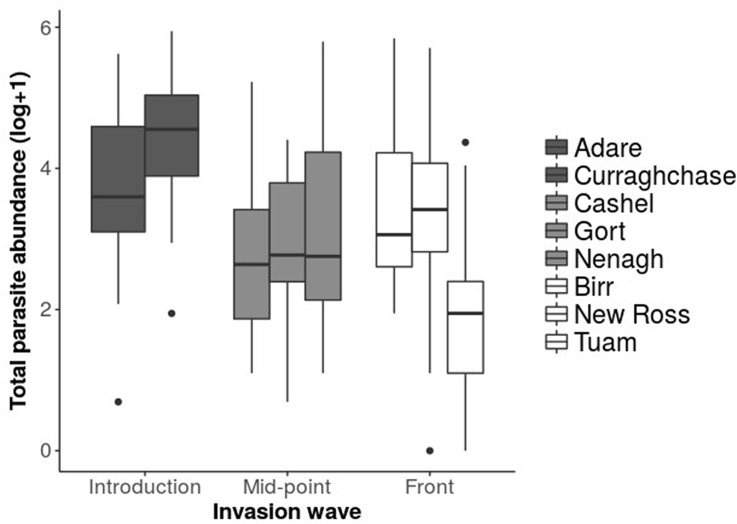
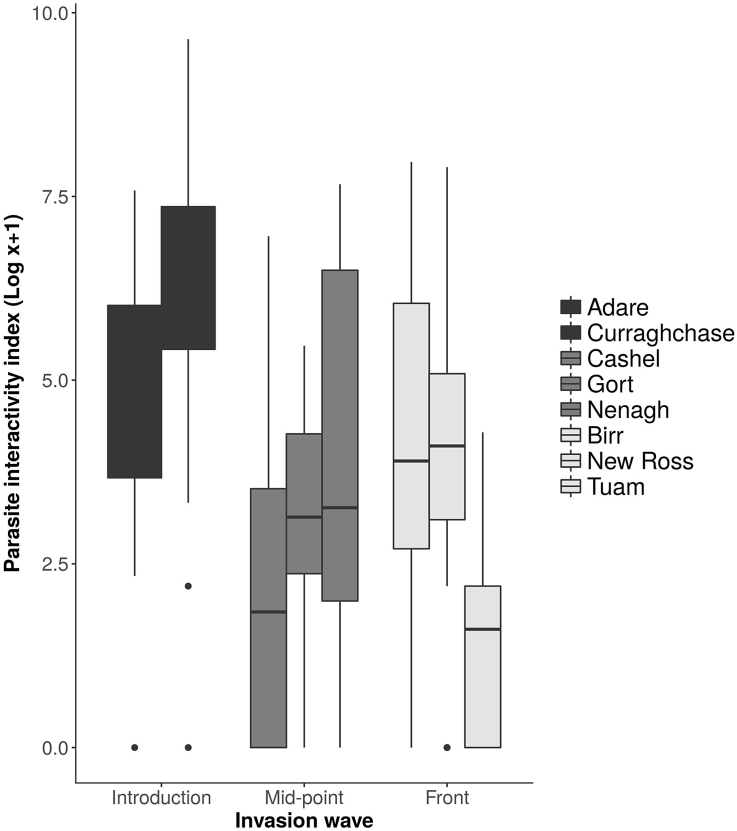
Multiple parasite species simultaneously infecting a host can interact with one another, which has the potential to influence host-parasite interactions. Invasive species typically lose members of their parasite community during the invasion process. Not only do the founding population escape their parasites, but the rapid range expansion of invaders once in the invaded range can lead to additional stochastic loss of parasites. As such, parasite community dynamics may change along an invasion gradient, with consequences for host invasion success. Here, we use the bank vole, , introduced as a small founding population at a point source in the Republic of Ireland in c.1920's and its ecto- and endoparasites to ask: i) how does the parasite community vary across an invasion gradient, and ii) are parasite community associations driven by host traits and/or distance from the point of host introduction? We sampled the parasite community of at the proposed focal site of introduction, at mid-wave and the invasion front, and used a parasite interactivity index and statistical models to determine the potential for the parasite community to interact. Bank voles harboured up to six different parasite taxa, with a significantly higher parasite interactivity index at the foci of introduction ( = 2.33, = 0.02) than elsewhere, suggesting the most established parasite community has greater opportunities to interact. All but one of four synergistic parasite community associations were driven by host traits; sex and body mass. The remaining parasite-parasite associations occurred at the mid-point of the invasion wave, suggesting that specific parasite-parasite interactions are not mediated by distance from a focal point of host introduction. We propose that host traits rather than location along an invasion gradient are more likely to determine parasite-parasite interactions in the invasive bank vole.
多种寄生虫物种同时感染一个宿主时,它们之间可能会相互作用,这有可能影响宿主与寄生虫之间的相互作用。入侵物种在入侵过程中通常会失去其寄生虫群落的一些成员。不仅最初的种群摆脱了它们的寄生虫,而且入侵者一旦进入被入侵区域后的快速范围扩张可能导致寄生虫的额外随机损失。因此,寄生虫群落动态可能会沿着入侵梯度发生变化,从而影响宿主入侵的成功。在这里,我们以1920年代左右在爱尔兰共和国一个点源处作为一个小的初始种群引入的田鼠及其体外和体内寄生虫为研究对象,来探讨:i)寄生虫群落在整个入侵梯度上如何变化,以及ii)寄生虫群落关联是由宿主特征和/或与宿主引入点的距离驱动的吗?我们在拟议的引入焦点地点、入侵波的中点和入侵前沿对田鼠的寄生虫群落进行了采样,并使用寄生虫相互作用指数和统计模型来确定寄生虫群落相互作用的可能性。田鼠体内携带多达六种不同的寄生虫分类群,在引入焦点处的寄生虫相互作用指数(= 2.33,= 0.02)显著高于其他地方,这表明最稳定的寄生虫群落有更大的相互作用机会。四个协同寄生虫群落关联中,除了一个之外,其他所有关联都是由宿主特征驱动的;性别和体重。其余的寄生虫 - 寄生虫关联发生在入侵波的中点,这表明特定的寄生虫 - 寄生虫相互作用不是由与宿主引入焦点的距离介导的。我们提出,在入侵的田鼠中,宿主特征而非沿着入侵梯度的位置更有可能决定寄生虫 - 寄生虫之间的相互作用。