State Key Laboratory of Geological Processes and Mineral Resources, China University of Geosciences, 430074, Wuhan, Hubei, China.
Department of Geology and Geophysics, Yale University, New Haven, CT, 06520-8109, USA.
Nat Commun. 2019 Apr 5;10(1):1563. doi: 10.1038/s41467-019-09620-0.
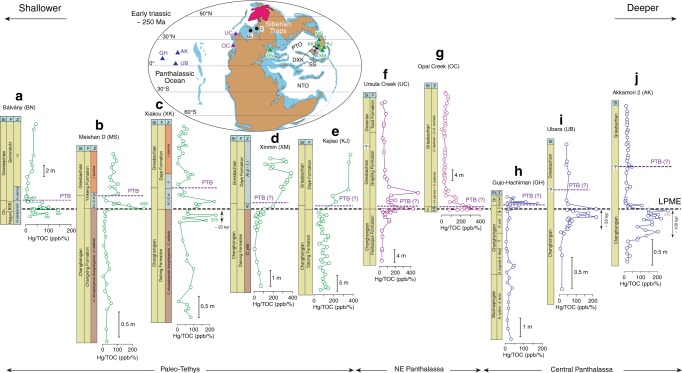
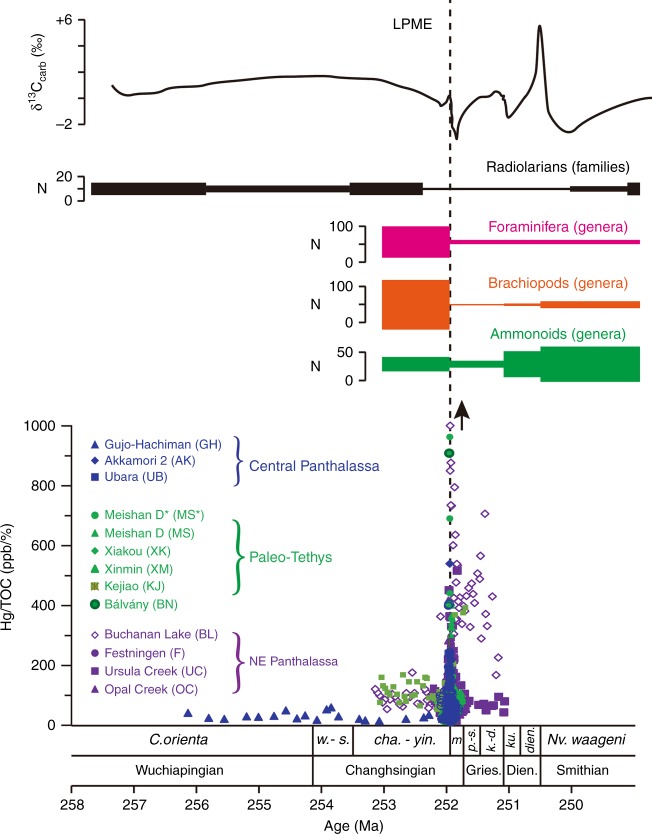
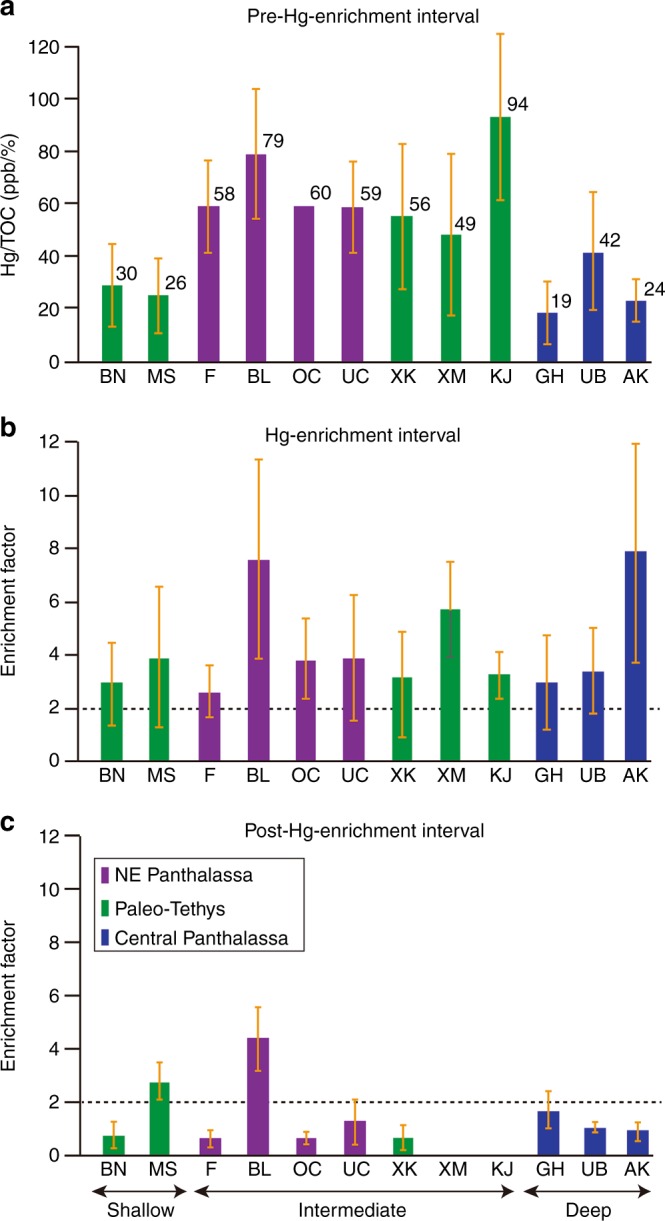
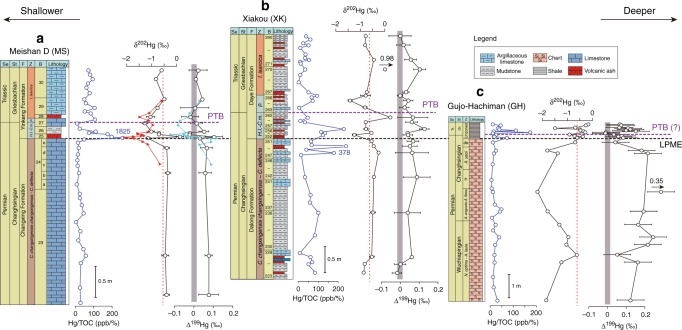
The latest Permian mass extinction, the most devastating biocrisis of the Phanerozoic, has been widely attributed to eruptions of the Siberian Traps Large Igneous Province, although evidence of a direct link has been scant to date. Here, we measure mercury (Hg), assumed to reflect shifts in volcanic activity, across the Permian-Triassic boundary in ten marine sections across the Northern Hemisphere. Hg concentration peaks close to the Permian-Triassic boundary suggest coupling of biotic extinction and increased volcanic activity. Additionally, Hg isotopic data for a subset of these sections provide evidence for largely atmospheric rather than terrestrial Hg sources, further linking Hg enrichment to increased volcanic activity. Hg peaks in shallow-water sections were nearly synchronous with the end-Permian extinction horizon, while those in deep-water sections occurred tens of thousands of years before the main extinction, possibly supporting a globally diachronous biotic turnover and protracted mass extinction event.
最新的二叠纪大灭绝是显生宙最具破坏性的生物危机之一,它被广泛归因于西伯利亚大火成岩省的喷发,尽管迄今为止,两者之间存在直接联系的证据还很少。在这里,我们在十个跨越北半球的海洋剖面上测量了汞(Hg),汞被认为可以反映火山活动的变化,这些剖面都位于二叠纪-三叠纪边界附近。Hg 浓度峰值接近于二叠纪-三叠纪边界,表明生物灭绝和火山活动增加之间存在耦合。此外,这些剖面中一部分的 Hg 同位素数据表明,Hg 主要来自大气而非陆地,这进一步将 Hg 富集与火山活动增加联系起来。浅水剖面的 Hg 峰值几乎与二叠纪末灭绝层同时发生,而深水剖面的 Hg 峰值则发生在主要灭绝之前数万年前,这可能支持了全球异步生物更替和漫长的大规模灭绝事件。