College of Psychology and Sociology, Shenzhen University, Shenzhen, China.
Shenzhen Key Laboratory of Affective and Social Cognitive Science, Shenzhen, China.
Sci Rep. 2019 Apr 5;9(1):5738. doi: 10.1038/s41598-019-42139-4.
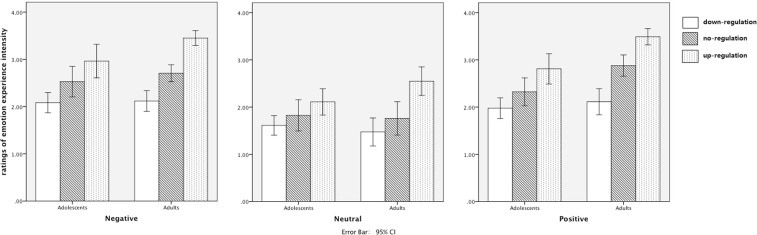
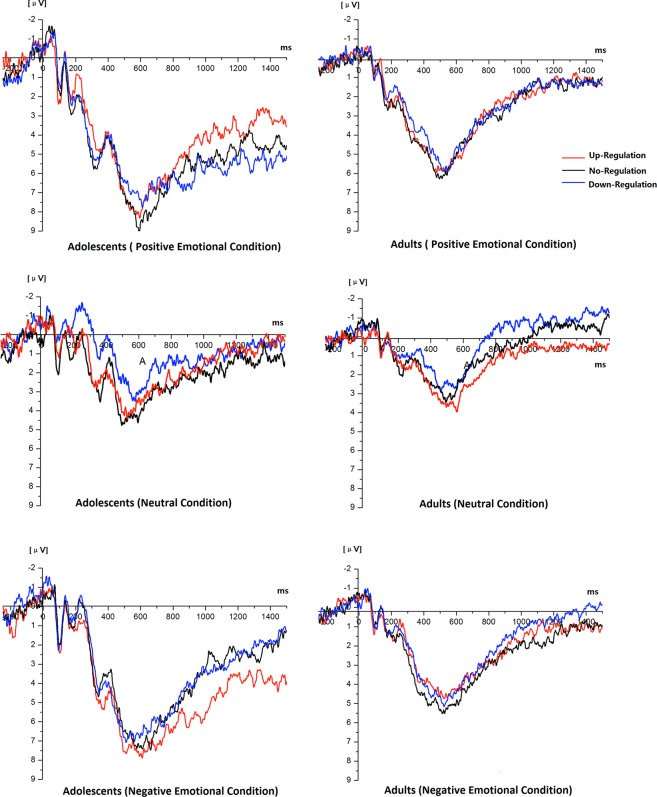
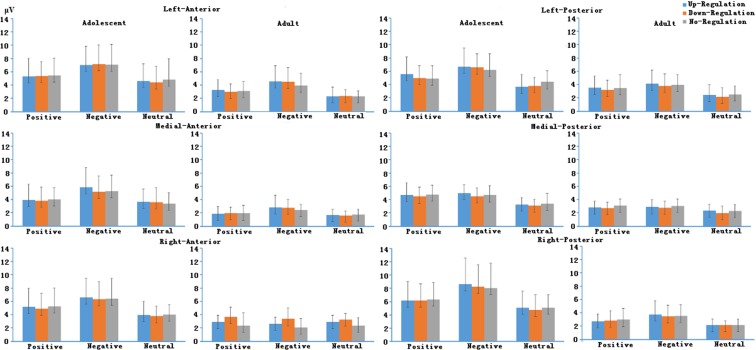
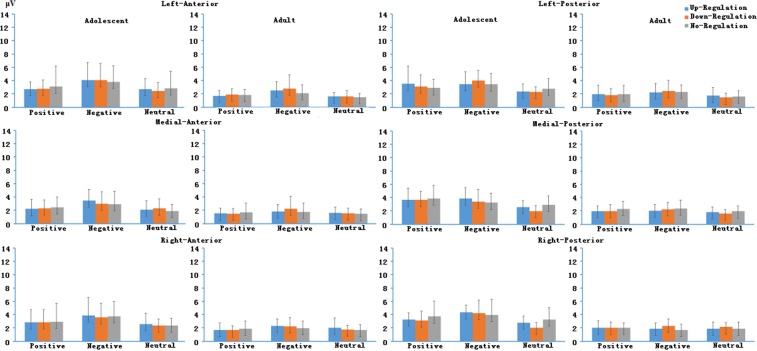
The late positive potential (LPP) has been well documented in predicting the effect of emotion regulation in previous developmental literature. However, few studies have examined age-related changes in emotion regulation from adolescence to adulthood using this biomarker. To test this, Reactivity and Regulation-Image Task was used to test 18 young adolescents and 22 adults to examine the modulation of LPP during emotion regulation. Results revealed that (a) on the behavioral level, adults reported higher intensity of emotional experience than adolescents when they were asked to use up-regulation. Down-regulation showed no age effect for self-reported rating; (b) adolescents showed higher amplitudes of LPP than adults when using different regulatory strategies in all windows; (c) In late time window, regulation effect was larger when using up-regulation strategy than down-regulation strategy for adolescents, while the difference between the two strategies was negligible for adults. (d) In early time window, reactivity effect was larger in negative conditions than in positive conditions for adolescents, while the difference between the two conditions was again negligible for adults. Differences in the amplitudes and time courses of LPP during emotion regulation between adolescents and adults suggested that age-related changes in emotion regulation may occur during adolescence.
晚正电位(LPP)在预测情绪调节效果方面在先前的发展文献中已有充分的记录。然而,很少有研究使用这种生物标志物来检查从青少年到成年的情绪调节中的与年龄相关的变化。为了检验这一点,使用反应性和调节-图像任务(Reactivity and Regulation-Image Task)测试了 18 名青少年和 22 名成年人,以检查情绪调节过程中 LPP 的调节。结果表明:(a)在行为层面上,当被要求使用上调策略时,成年人报告的情绪体验强度高于青少年。下调策略对自我报告的评分没有年龄效应;(b)青少年在所有窗口中使用不同的调节策略时,LPP 的振幅均高于成年人;(c)在晚期时间窗口中,与下调策略相比,上调策略时青少年的调节效果更大,而对于成年人来说,两种策略之间的差异可以忽略不计;(d)在早期时间窗口中,青少年在消极条件下的反应性效应大于积极条件下的反应性效应,而对于成年人来说,两种条件之间的差异再次可以忽略不计。青少年和成年人在情绪调节过程中 LPP 的幅度和时间进程上的差异表明,情绪调节的年龄相关变化可能发生在青少年时期。