Department of Neurodegenerative Diseases, UCL Institute of Neurology, London, UK; UK Dementia Research Institute (UK DRI) at UCL, London, UK.
UK Dementia Research Institute (UK DRI) at Cardiff, MRC Centre for Neuropsychiatric Genetics and Genomics, School of Medicine, Cardiff University, Cardiff, UK.
Neurobiol Dis. 2019 Jul;127:492-501. doi: 10.1016/j.nbd.2019.04.004. Epub 2019 Apr 3.
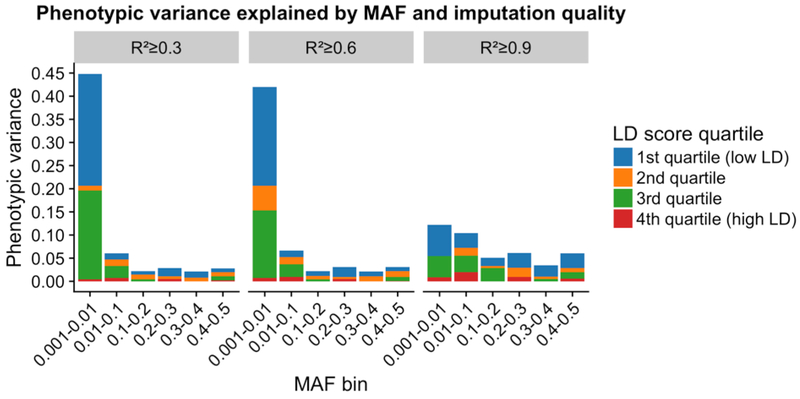
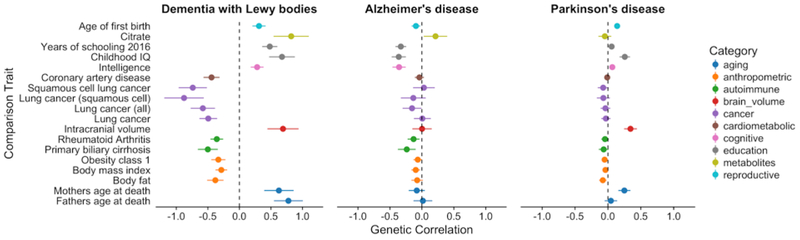
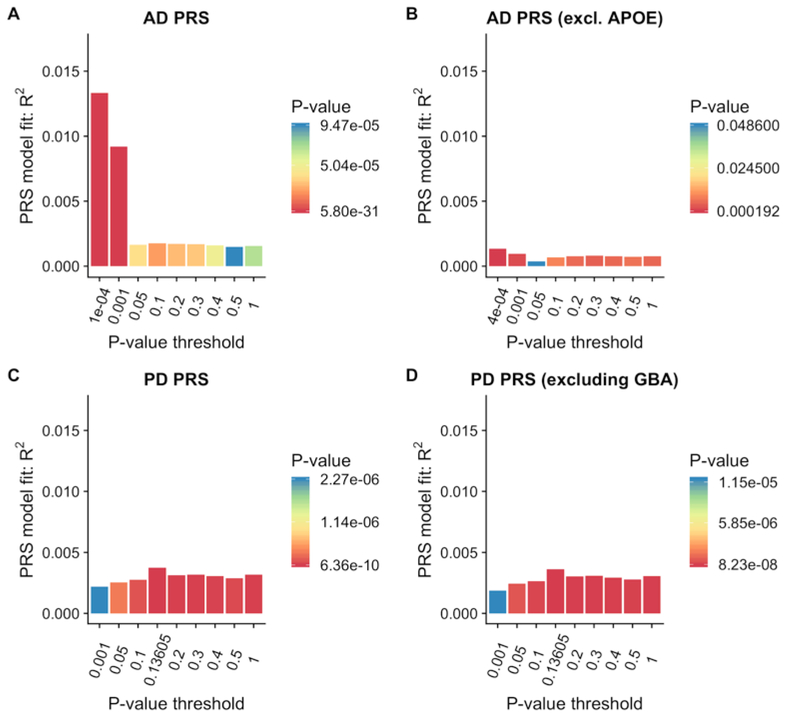
Recent large-scale genetic studies have allowed for the first glimpse of the effects of common genetic variability in dementia with Lewy bodies (DLB), identifying risk variants with appreciable effect sizes. However, it is currently well established that a substantial portion of the genetic heritable component of complex traits is not captured by genome-wide significant SNPs. To overcome this issue, we have estimated the proportion of phenotypic variance explained by genetic variability (SNP heritability) in DLB using a method that is unbiased by allele frequency or linkage disequilibrium properties of the underlying variants. This shows that the heritability of DLB is nearly twice as high as previous estimates based on common variants only (31% vs 59.9%). We also determine the amount of phenotypic variance in DLB that can be explained by recent polygenic risk scores from either Parkinson's disease (PD) or Alzheimer's disease (AD), and show that, despite being highly significant, they explain a low amount of variance. Additionally, to identify pleiotropic events that might improve our understanding of the disease, we performed genetic correlation analyses of DLB with over 200 diseases and biomedically relevant traits. Our data shows that DLB has a positive correlation with education phenotypes, which is opposite to what occurs in AD. Overall, our data suggests that novel genetic risk factors for DLB should be identified by larger GWAS and these are likely to be independent from known AD and PD risk variants.
最近的大规模遗传研究使人们首次能够了解路易体痴呆症 (DLB) 中常见遗传变异的影响,确定了具有明显效应大小的风险变异体。然而,目前已经明确,复杂性状遗传可遗传性的很大一部分不能通过全基因组显著 SNP 来捕获。为了解决这个问题,我们使用一种不受潜在变异等位基因频率或连锁不平衡特性影响的方法,估计了 DLB 中遗传变异(SNP 遗传力)解释表型方差的比例。这表明,DLB 的遗传力几乎是以前仅基于常见变异体估计的两倍(31%对 59.9%)。我们还确定了最近来自帕金森病 (PD) 或阿尔茨海默病 (AD) 的多基因风险评分可以解释 DLB 中多少表型方差,并且表明尽管它们具有高度显著性,但它们仅解释了很小一部分方差。此外,为了确定可能有助于我们更好地了解疾病的多效性事件,我们对 200 多种疾病和与生物医学相关的特征进行了与 DLB 的遗传相关性分析。我们的数据表明,DLB 与教育表型呈正相关,这与 AD 中的情况相反。总的来说,我们的数据表明,应该通过更大的 GWAS 来确定 DLB 的新的遗传风险因素,这些因素很可能与已知的 AD 和 PD 风险变异体独立。