McKeever Anna, Swann Peter, Malpetti Maura, Donaghy Paul C, Thomas Alan, Mak Elijah, Carter Stephen F, Tan Jerry H K, Hong Young T, Fryer Tim D, Heslegrave Amanda, Zetterberg Henrik, Su Li, Chouliaras Leonidas, Rowe James B, O'Brien John T
Department of Psychiatry, University of Cambridge School of Clinical Medicine, Cambridge Biomedical Campus, Cambridge, UK.
Cambridgeshire and Peterborough NHS Foundation Trust, Cambridge, UK.
Alzheimers Dement. 2025 Feb;21(2):e14381. doi: 10.1002/alz.14381. Epub 2025 Jan 24.
Lewy body dementia (LBD) shares genetic risk factors with Alzheimer's disease (AD), including apolipoprotein E (APOE), but is distinguishable at the genome-wide level. Polygenic risk scores (PRS) may therefore improve diagnostic classification.
We assessed diagnostic classification using AD-PRS excluding APOE (AD-PRS ), APOE risk score (APOE-RS), and plasma phosphorylated tau 181 (p-tau181), in 83 participants with LBD, 27 with positron emission tomography amyloid beta (Aβ)positive mild cognitive impairment or AD (MCI+/AD), and 57 controls.
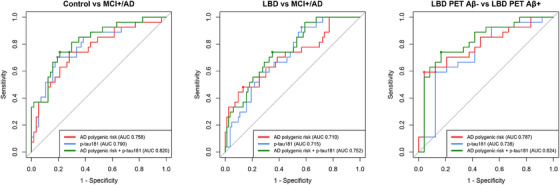
Together AD-PRS and APOE-RS performed similarly to p-tau181 in discriminating MCI+/AD from controls (area under the curve 76% vs. 79%) and LBD (71% vs. 72%). In LBD, Aβ positivity was significantly associated with APOE-RS, but not with AD-PRS , or p-tau181. Combining AD-PRS , APOE-RS, and p-tau181 improved the discrimination of MCI+/AD from controls (81%) and LBD (75%), and the detection of Aβ in LBD (82%).
Aβ deposition in LBD was associated with APOE, while MCI+/AD was also associated with AD-PRS beyond APOE. AD-PRS explains phenotypic variance not captured by APOE or p-tau181.
We investigated Alzheimer's disease (AD) polygenic risk score (PRS), apolipoprotein E (APOE), and plasma phosphorylated tau 181 (p-tau181) to classify AD and Lewy body dementia (LBD). AD-PRS with APOE achieved similar classification accuracy to p-tau181. AD-PRS without APOE significantly contributed to discriminating AD from LBD. Amyloid beta positivity in LBD was associated with APOE but not AD-PRS without APOE or p-tau181. Combining AD-PRS, APOE, and p-tau181 improved diagnostic classification accuracy.
路易体痴呆(LBD)与阿尔茨海默病(AD)具有共同的遗传风险因素,包括载脂蛋白E(APOE),但在全基因组水平上可区分。因此,多基因风险评分(PRS)可能会改善诊断分类。
我们使用排除APOE的AD-PRS、APOE风险评分(APOE-RS)和血浆磷酸化tau 181(p-tau181)对83名LBD患者、27名正电子发射断层扫描淀粉样β蛋白(Aβ)阳性的轻度认知障碍或AD(MCI+/AD)患者以及57名对照者进行诊断分类评估。
AD-PRS和APOE-RS在区分MCI+/AD与对照者(曲线下面积分别为76%和79%)以及LBD(71%和72%)方面表现与p-tau181相似。在LBD中,Aβ阳性与APOE-RS显著相关,但与AD-PRS或p-tau181无关。将AD-PRS、APOE-RS和p-tau181结合起来可提高区分MCI+/AD与对照者(81%)以及LBD(75%)的能力,以及检测LBD中Aβ的能力(82%)。
LBD中的Aβ沉积与APOE相关,而MCI+/AD除了与APOE相关外还与AD-PRS相关。AD-PRS解释了APOE或p-tau181未捕捉到的表型变异。
我们研究了阿尔茨海默病(AD)多基因风险评分(PRS)、载脂蛋白E(APOE)和血浆磷酸化tau 181(p-tau181)以对AD和路易体痴呆(LBD)进行分类。含APOE的AD-PRS与p-tau181具有相似的分类准确性。不含APOE的AD-PRS对区分AD与LBD有显著贡献。LBD中的淀粉样β蛋白阳性与APOE相关,但与不含APOE的AD-PRS或p-tau181无关。结合AD-PRS、APOE和p-tau181可提高诊断分类准确性。