Endocrinology Division, The Second Hospital of ShanXi Medical University, TaiYuan, 030001, ShanXi, China.
Diabetes Division, University of Texas Health Science Center, San Antonio, TX, USA.
Lipids Health Dis. 2019 Apr 6;18(1):89. doi: 10.1186/s12944-019-1026-3.
Elevation of exogenous free fatty acid (FFA) level leads to insulin resistance (IR) in liver, IR is manifested by elevated hepatic glucose production. We aim to study whether inhibition of endogenous fatty acid synthesis could decrease hepatic glucose production.
Low-passage HepG2 cells derived from human liver tissue were cultured in medium supplemented with FFA to induce IR, the influences of sterol regulatory element binding protein-1c (SREBP-1c) silencing on glucose production of HepG2 cells were investigated, and genes responsible for fatty acid and glucose metabolism were detected by real-time PCR.
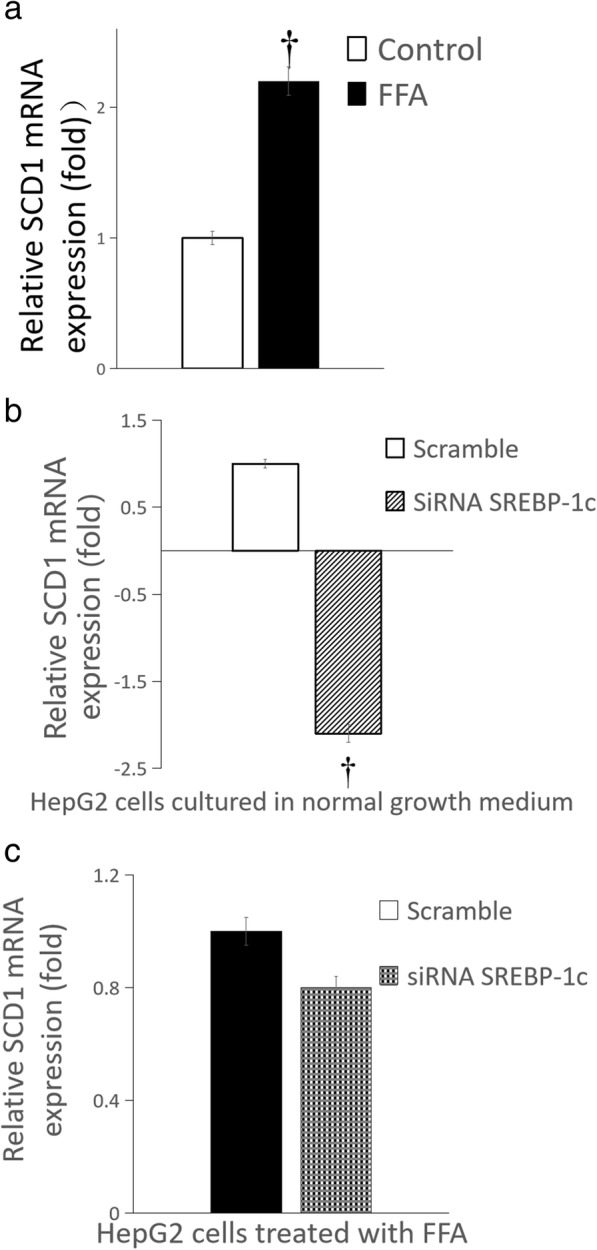
Compared with HepG2 cells cultured in normal growth medium, glucose production of HepG2 cells treated by FFA was significantly increased {[(0.28 ± 0.01) vs (0.83 ± 0.02)] umol.ug protein, n = 6 wells, P < 0.01}; the mRNA expression of phosphoenolpyruvate carboxylase kinase (PEPCK) and glucose-6-phosphatase (G6PC) in HepG2 cells increased by more than 5-fold and 3-fold, respectively; the mRNA expression of fatty acid synthase (FAS) and stearoyl-CoA desaturase-1 (SCD1) increased by approximately 4-fold and 1.1-fold, respectively; the mRNA expression of carnitine palmitoyltransferase-1 (CPT-1) changed slightly. Compared with the scrambled siRNA control, glucose production of HepG2 cells treated by FFA significantly increased after SREBP-1c silencing {[(0.018 ± 0.001) vs (0.028 ± 0.002)] umol.ug protein, n = 6 wells, P < 0.01}; the mRNA expression of PEPCK and G6PC increased by approximately 1.5-fold and 5-fold, respectively, but the mRNA expression of FAS, SCD1 and CPT-1 changed slightly.
SREBP-1c silencing further augmented glucose production of HepG2 cells treated by FFA significantly, genes responsible for fatty acid synthesis and gluconeogenesis played an important role in this process. SREBP-1c functions not only as a lipid regulator but also plays an important role in regulation of glucose metabolism.
外源性游离脂肪酸(FFA)水平的升高可导致肝脏胰岛素抵抗(IR),IR 的表现为肝葡萄糖生成增加。我们旨在研究内源性脂肪酸合成的抑制是否可以减少肝葡萄糖生成。
用 FFA 培养低传代 HepG2 细胞,诱导 IR,研究固醇调节元件结合蛋白-1c(SREBP-1c)沉默对 HepG2 细胞葡萄糖生成的影响,并通过实时 PCR 检测负责脂肪酸和葡萄糖代谢的基因。
与在正常生长培养基中培养的 HepG2 细胞相比,FFA 处理的 HepG2 细胞的葡萄糖生成明显增加{[(0.28±0.01) vs (0.83±0.02)] umol.ug protein,n=6 个孔,P<0.01};HepG2 细胞中磷酸烯醇丙酮酸羧激酶(PEPCK)和葡萄糖-6-磷酸酶(G6PC)的 mRNA 表达分别增加了 5 倍以上和 3 倍以上;脂肪酸合酶(FAS)和硬脂酰辅酶 A 去饱和酶-1(SCD1)的 mRNA 表达分别增加了约 4 倍和 1.1 倍;肉碱棕榈酰转移酶-1(CPT-1)的 mRNA 表达变化不大。与 scrambled siRNA 对照相比,FFA 处理的 HepG2 细胞中 SREBP-1c 沉默后葡萄糖生成明显增加{[(0.018±0.001) vs (0.028±0.002)] umol.ug protein,n=6 个孔,P<0.01};PEPCK 和 G6PC 的 mRNA 表达分别增加了约 1.5 倍和 5 倍,但 FAS、SCD1 和 CPT-1 的 mRNA 表达变化不大。
SREBP-1c 沉默进一步显著增加了 FFA 处理的 HepG2 细胞的葡萄糖生成,负责脂肪酸合成和糖异生的基因在这一过程中起重要作用。SREBP-1c 的功能不仅是作为脂质调节剂,而且在调节葡萄糖代谢中也起着重要作用。