Stanford Blood Center, Stanford University School of Medicine, Palo Alto, CA 94304, USA; Department of Biology, University of Crete, Heraklion, Crete 71003, Greece.
Stanford Genome Technology Center, Stanford University School of Medicine, Palo Alto, CA 94304, USA.
Hum Immunol. 2019 Jul;80(7):437-448. doi: 10.1016/j.humimm.2019.04.001. Epub 2019 Apr 5.
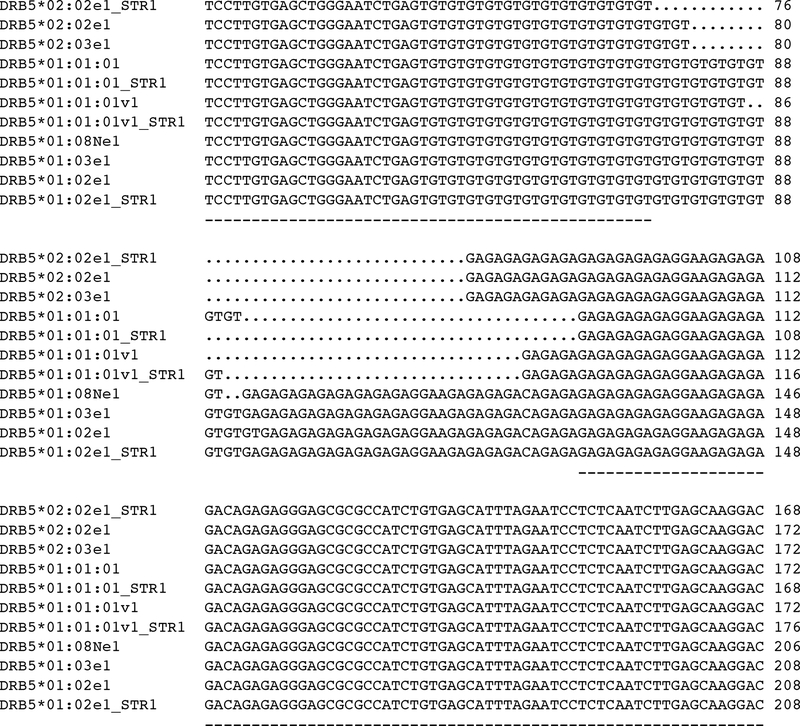
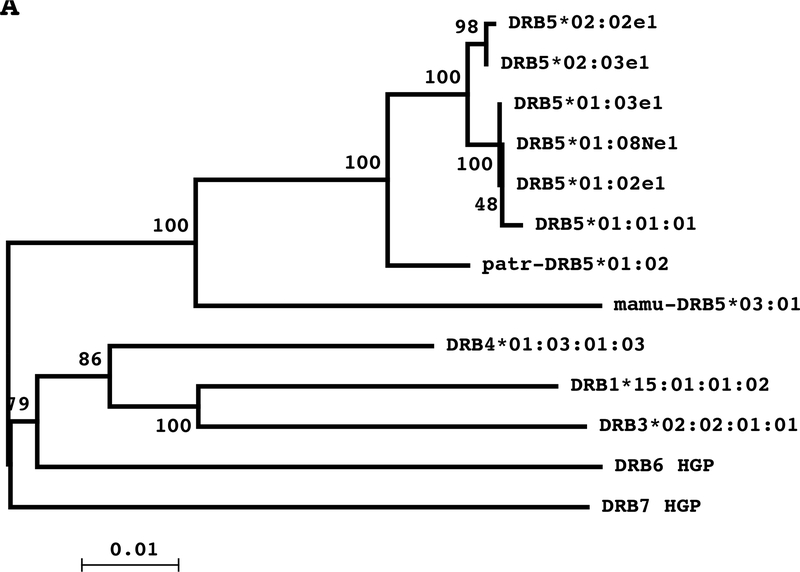
Next Generation Sequencing allows for testing and typing of entire genes of the HLA region. A better and comprehensive sequence assessment can be achieved by the inclusion of full gene sequences of all the common alleles at a given locus. The common alleles of DRB5 are under-characterized with the full exon-intron sequence of two alleles available. In the present study the DRB5 genes from 18 subjects alleles were cloned and sequenced; haplotype analysis showed that 17 of them had a single copy of DRB5 and one consanguineous subject was homozygous at all HLA loci. Methodological approaches including robust and efficient long-range PCR amplification, molecular cloning, nucleotide sequencing and de novo sequence assembly were combined to characterize DRB5 alleles. DRB5 sequences covering from 5'UTR to the end of intron 5 were obtained for DRB501:01, 01:02 and 02:02; partial coverage including a segment spanning exon 2 to exon 6 was obtained for DRB501:03, 01:08N and 02:03. Phylogenetic analysis of the generated sequences showed that the DRB5 alleles group together and have distinctive differences with other DRB loci. Novel intron variants of DRB5*01:01:01, 01:02 and 02:02 were identified. The newly characterized DRB5 intron variants of each DRB5 allele were found in subjects harboring distinct associations with alleles of DRB1, B and/or ethnicity. The new information provided by this study provides reference sequences for HLA typing methodologies. Extending sequence coverage may lead to identify the disease susceptibility factors of DRB5 containing haplotypes while the unexpected intron variations may shed light on understanding of the evolution of the DRB region.
下一代测序允许测试和键入整个 HLA 区域的基因。通过包括给定基因座所有常见等位基因的完整基因序列,可以实现更好和更全面的序列评估。DRB5 的常见等位基因的特征描述不足,仅有两个等位基因的完整外显子-内含子序列可用。在本研究中,从 18 个个体等位基因中克隆和测序了 DRB5 基因;单体型分析表明,其中 17 个具有单个 DRB5 拷贝,一个近亲个体在所有 HLA 基因座上均为纯合子。包括稳健和高效的长距离 PCR 扩增、分子克隆、核苷酸测序和从头序列组装在内的方法学方法被组合使用以表征 DRB5 等位基因。获得了 DRB501:01、01:02 和 02:02 的 5'UTR 到内含子 5 末端的 DRB5 序列;获得了包括跨越外显子 2 到外显子 6 的一段的部分覆盖的 DRB501:03、01:08N 和 02:03。生成序列的系统发育分析表明,DRB5 等位基因聚集在一起,与其他 DRB 基因座具有明显的差异。鉴定出 DRB5*01:01:01、01:02 和 02:02 的新型内含子变异。在携带与 DRB1、B 和/或种族相关的等位基因具有独特关联的个体中发现了每个 DRB5 等位基因的新表征的 DRB5 内含子变异。本研究提供的新信息为 HLA 分型方法学提供了参考序列。扩展序列覆盖范围可能导致确定含有 DRB5 单倍型的疾病易感性因素,而意外的内含子变异可能有助于理解 DRB 区域的进化。