Prosperini Luca, Kinkel Revere P, Miravalle Augusto A, Iaffaldano Pietro, Fantaccini Simone
Department of Neurosciences, S. Camillo-Forlanini Hospital, Circonvallazione Gianicolense, 87, 00152 Rome, Italy.
Department of Neurosciences, University of California San Diego, La Jolla, CA, USA.
Ther Adv Neurol Disord. 2019 Mar 29;12:1756286419837809. doi: 10.1177/1756286419837809. eCollection 2019.
Natalizumab (NTZ) is sometimes discontinued in patients with multiple sclerosis, mainly due to concerns about the risk of progressive multifocal leukoencephalopathy. However, NTZ interruption may result in recrudescence of disease activity.
The objective of this study was to summarize the available evidence about NTZ discontinuation and to identify which patients will experience post-NTZ disease reactivation through meta-analysis of existing literature data.
PubMed was searched for articles reporting the effects of NTZ withdrawal in adult patients (⩾18 years) with relapsing-remitting multiple sclerosis (RRMS). Definition of disease activity following NTZ discontinuation, proportion of patients who experienced post-NTZ disease reactivation, and timing to NTZ discontinuation to disease reactivation were systematically reviewed. A generic inverse variance with random effect was used to calculate the weighted effect of patients' clinical characteristics on the risk of post-NTZ disease reactivation, defined as the occurrence of at least one relapse.
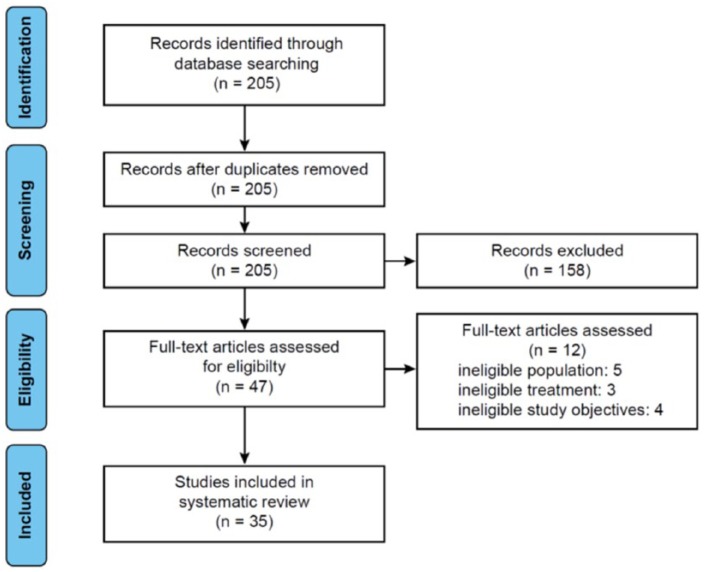
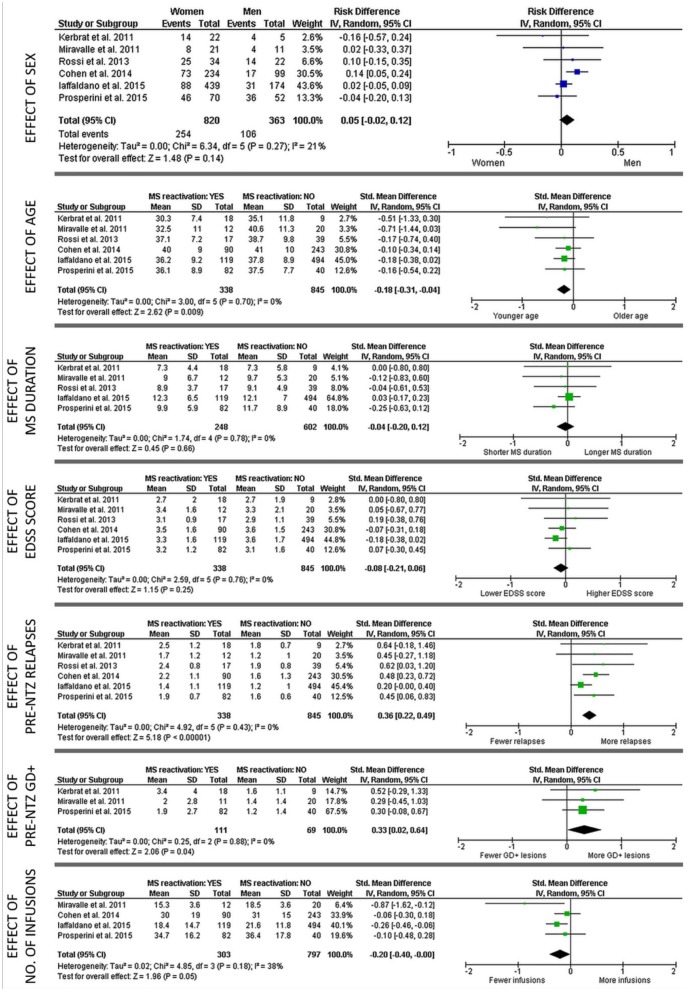
The original search identified 205 publications. Thirty-five articles were included in the systematic review. We found a high level of heterogeneity across studies in terms of sample size (10 to 1866 patients), baseline patient characteristics, follow up (1-24 months), outcome measures (clinical and/or radiological), and definition of post-NTZ disease reactivation or rebound. Clinical relapses were observed in 9-80% of patients and peaked at 4-7 months, whereas radiological disease activity was observed in 7-87% of patients starting at 6 weeks following NTZ discontinuation. The meta-analysis of six articles, yielding a total of 1183 patients, revealed that younger age, higher number of relapses and gadolinium-enhanced lesions before treatment start, and fewer NTZ infusions were associated with increased risk for post-NTZ disease reactivation ( ⩽ 0.05).
Results from the present review and meta-analysis can help to profile patients who are at greater risk of post-NTZ disease reactivation. However, potential reporting bias and variability in selected studies should be taken into account when interpreting our data.
那他珠单抗(NTZ)有时会在多发性硬化症患者中停用,主要是因为担心进行性多灶性白质脑病的风险。然而,NTZ中断可能导致疾病活动复发。
本研究的目的是通过对现有文献数据进行荟萃分析,总结有关NTZ停药的现有证据,并确定哪些患者会出现NTZ停药后疾病再激活。
在PubMed上搜索报告NTZ撤药对复发缓解型多发性硬化症(RRMS)成年患者(≥18岁)影响的文章。系统回顾了NTZ停药后疾病活动的定义、经历NTZ停药后疾病再激活的患者比例以及从NTZ停药到疾病再激活的时间。使用具有随机效应的通用逆方差来计算患者临床特征对NTZ停药后疾病再激活风险的加权效应,NTZ停药后疾病再激活风险定义为至少发生一次复发。
最初的搜索识别出205篇出版物。35篇文章纳入系统评价。我们发现,在样本量(10至1866例患者)、基线患者特征、随访时间(1至24个月)、结局指标(临床和/或影像学)以及NTZ停药后疾病再激活或反弹的定义等方面,各研究之间存在高度异质性。9%至80%的患者出现临床复发,在4至7个月时达到峰值,而在NTZ停药后6周开始,7%至87%的患者出现影像学疾病活动。对6篇文章(共1183例患者)的荟萃分析显示,年龄较小、治疗开始前复发和钆增强病灶数量较多以及接受NTZ输注较少与NTZ停药后疾病再激活风险增加相关(P≤0.05)。
本综述和荟萃分析的结果有助于确定NTZ停药后疾病再激活风险较高的患者。然而,在解释我们的数据时应考虑所选研究中潜在的报告偏倚和变异性。