Ochaya Stephen, Franzén Oscar, Buhwa Doreen Asiimwe, Foyn Håvard, Butler Claire E, Stove Svein Isungset, Tyler Kevin M, Arnesen Thomas, Matovu Enock, Åslund Lena, Andersson Björn
Department of Cell and Molecular Biology, Karolinska Institutet, Box 285, 171 77 Stockholm, Sweden.
Department of Immunology and Microbiology, Gulu University, P.O. Box, 166 Gulu, Uganda.
J Parasitol Res. 2019 Mar 6;2019:6594212. doi: 10.1155/2019/6594212. eCollection 2019.
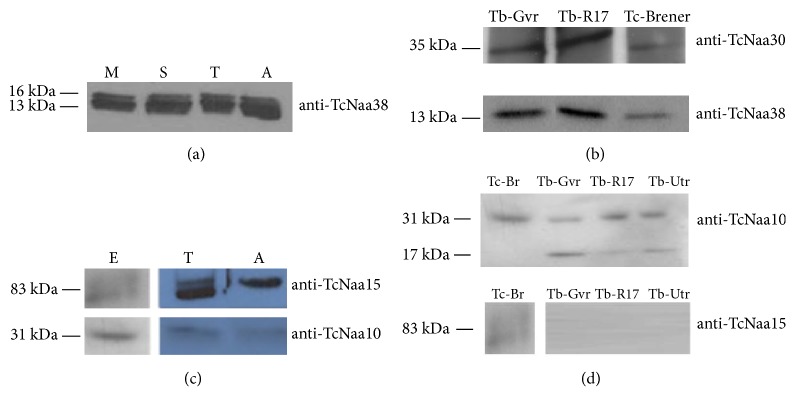
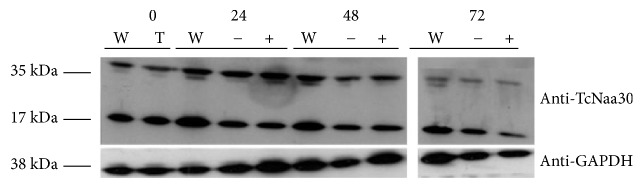
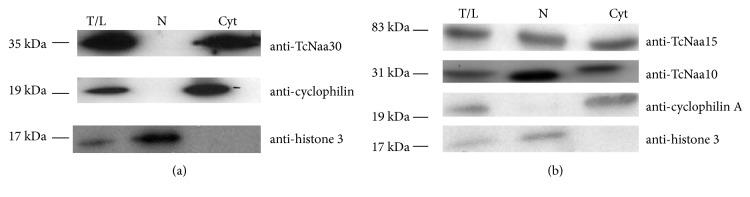
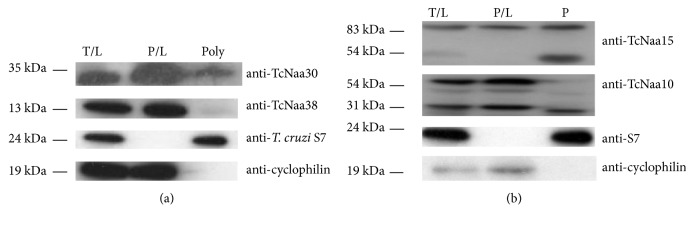
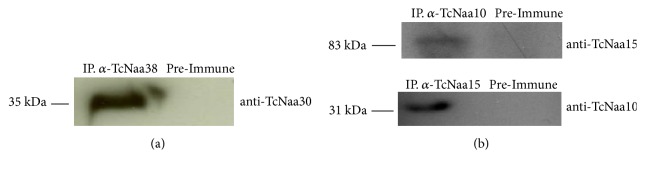
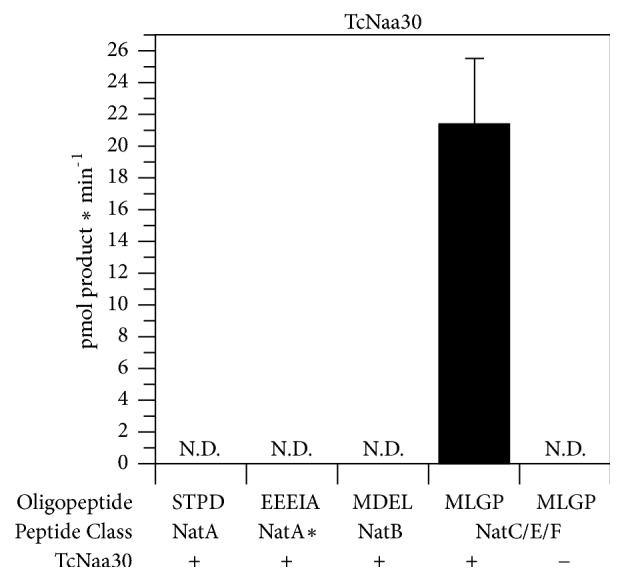
Protein N-terminal acetylation is a co- and posttranslational modification, conserved among eukaryotes. It determines the functional fate of many proteins including their stability, complex formation, and subcellular localization. N-terminal acetyltransferases (NATs) transfer an acetyl group to the N-termini of proteins, and the major NATs in yeast and humans are NatA, NatB, and NatC. In this study, we characterized the ( NatC and NatA protein complexes, each consisting of one catalytic subunit and predicted auxiliary subunits. The proteins were found to be expressed in the three main life cycle stages of the parasite, formed stable complexes , and partially cosedimented with the ribosome in agreement with a cotranslational function. An acetylation assay clearly demonstrated that the acetylated substrates of the NatC catalytic subunit from were similar to those of yeast and human NatC, suggesting evolutionary conservation of function. An RNAi knockdown of the () NatC catalytic subunit indicated that reduced NatC-mediated N-terminal acetylation of target proteins reduces parasite growth.
蛋白质N端乙酰化是一种在真核生物中保守的共翻译和翻译后修饰。它决定了许多蛋白质的功能命运,包括它们的稳定性、复合物形成和亚细胞定位。N端乙酰转移酶(NATs)将乙酰基转移到蛋白质的N端,酵母和人类中的主要NATs是NatA、NatB和NatC。在本研究中,我们对(NatC和NatA蛋白复合物进行了表征,每个复合物由一个催化亚基和预测的辅助亚基组成。发现这些蛋白质在寄生虫的三个主要生命周期阶段表达,形成稳定的复合物,并与核糖体部分共沉降,这与共翻译功能一致。乙酰化分析清楚地表明,来自()的NatC催化亚基的乙酰化底物与酵母和人类NatC的相似,表明功能具有进化保守性。对()NatC催化亚基的RNAi敲低表明,NatC介导的靶蛋白N端乙酰化减少会降低寄生虫的生长。