Tetsi Liliane, Charles Anne-Laure, Georg Isabelle, Goupilleau Fabienne, Lejay Anne, Talha Samy, Maumy-Bertrand Myriam, Lugnier Claire, Geny Bernard
Unistra, Fédération de Médecine Translationnelle, Equipe d'Accueil 3072, « Mitochondrie, Stress oxydant et Protection Musculaire », Institut de Physiologie, 67000 CEDEX, France.
Hôpitaux Universitaires de Strasbourg, Service de Physiologie et d'Explorations Fonctionnelles, 67000 Strasbourg, France.
Antioxidants (Basel). 2019 Apr 7;8(4):93. doi: 10.3390/antiox8040093.
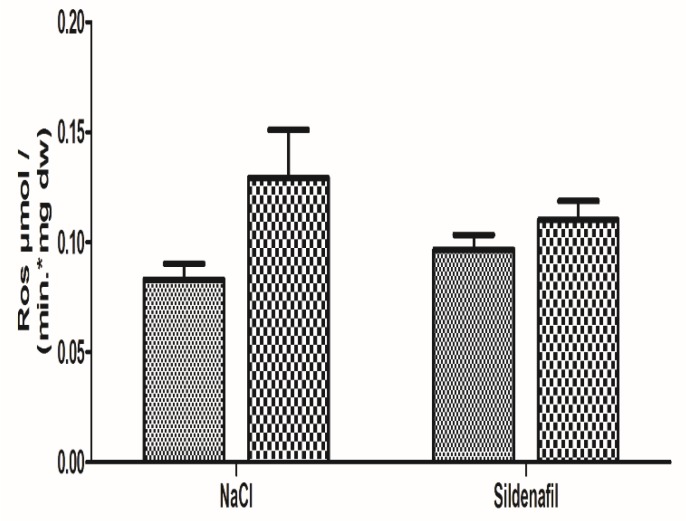
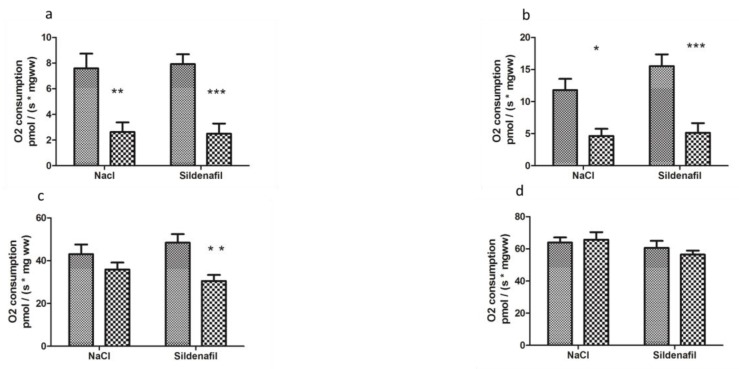
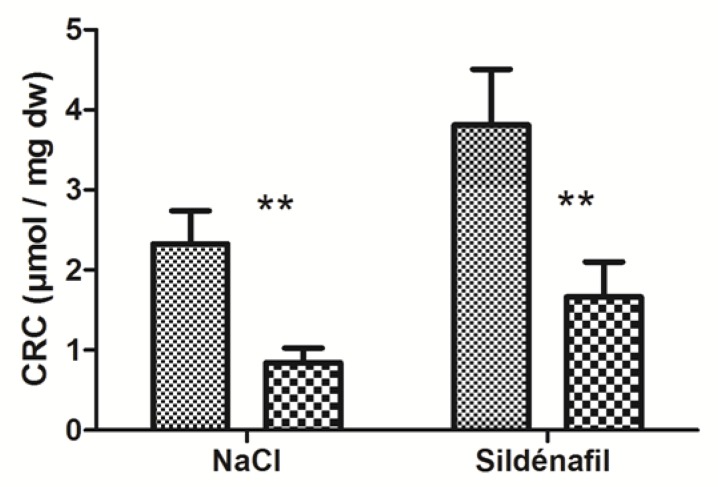
Lower-limb ischemia-reperfusion (IR) is frequent and associated with significant morbidity and mortality. Phosphodiesterase 5 inhibitors demonstrated antioxidant and beneficial effects in several organs submitted to IR, but their effects on muscle mitochondrial functions after lower-limb IR are unknown. Unilateral hindlimb IR (2 h tourniquet followed by 2 h reperfusion) without or with sildenafil (1mg/kg ip 30 minutes before ischemia) was performed in 18 mice. Maximal oxidative capacity (V), relative contribution of the mitochondrial respiratory chain complexes, calcium retention capacity (CRC)-a marker of apoptosis-and reactive oxygen species (ROS) production were determined using high-resolution respirometry, spectrofluorometry, and electron paramagnetic resonance in gastrocnemius muscles from both hindlimbs. IR significantly reduced mitochondrial V (from 11.79 ± 1.74 to 4.65 ± 1.11 pmol/s*mg wet weight (ww), < 0.05, -50.2 ± 16.3%) and CRC (from 2.33 ± 0.41 to 0.84 ± 0.18 µmol/mg dry weight (dw), < 0.05; -61.1 ± 6.8%). ROS tended to increase in the ischemic limb (+64.3 ± 31.9%, = 0.08). Although tending to reduce IR-related ROS production (-42.4%), sildenafil failed to reduce muscle mitochondrial dysfunctions (-63.3 ± 9.2%, < 0.001 and -55.2 ± 7.6% < 0.01 for V and CRC, respectively). In conclusion, lower limb IR impaired skeletal muscle mitochondrial function, but, despite tending to reduce ROS production, pharmacological preconditioning with sildenafil did not show protective effects.
下肢缺血再灌注(IR)很常见,且与显著的发病率和死亡率相关。磷酸二酯酶5抑制剂在多个遭受IR的器官中显示出抗氧化和有益作用,但其对下肢IR后肌肉线粒体功能的影响尚不清楚。对18只小鼠进行单侧后肢IR(扎止血带2小时,随后再灌注2小时),缺血前30分钟腹腔注射西地那非(1mg/kg)或不注射。使用高分辨率呼吸测定法、荧光分光光度法和电子顺磁共振测定双侧后肢腓肠肌的最大氧化能力(V)、线粒体呼吸链复合物的相对贡献、钙保留能力(CRC,凋亡标志物)和活性氧(ROS)生成。IR显著降低线粒体V(从11.79±1.74降至4.65±1.11 pmol/s*mg湿重(ww),P<0.05,-50.2±16.3%)和CRC(从2.33±0.41降至0.84±0.18 µmol/mg干重(dw),P<0.05;-61.1±6.8%)。缺血肢体中的ROS有增加趋势(+64.3±31.9%,P = 0.08)。尽管西地那非有降低IR相关ROS生成的趋势(-42.4%),但未能减轻肌肉线粒体功能障碍(V和CRC分别为-63.3±9.2%,P<0.001和-55.2±7.6%,P<0.01)。总之,下肢IR损害骨骼肌线粒体功能,尽管西地那非有降低ROS生成的趋势,但药物预处理未显示出保护作用。