Department of Health Sciences and Technology, GAIHST, Gachon University, Incheon, 21999, Republic of Korea; Department of Molecular Medicine, School of Medicine, Gachon University, Incheon 406-840, Republic of Korea.
Department of Biomedical Science, Jungwon University, 85 Goesan-eup, Munmu-ro, Goesan-gun, Chungcheongbuk-do 367-700, Republic of Korea.
Mol Ther. 2019 Jun 5;27(6):1087-1100. doi: 10.1016/j.ymthe.2019.03.010. Epub 2019 Mar 19.
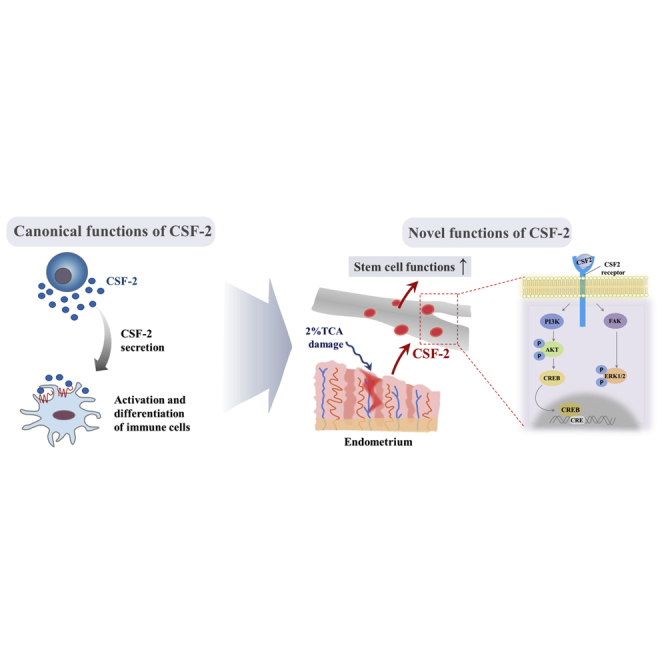
The major challenges of current mesenchymal stem cell (MSC)-based therapeutics are their low differentiation potential into specialized cell types and their homing ability to sites of injury. Therefore, many researchers have directed their efforts toward finding a novel stimulatory factor that can significantly enhance the therapeutic effects of MSCs. Colony-stimulating factor 2 (CSF-2) is previously known as a hematopoietic growth factor involved in the differentiation of various myeloid cells from hematopoietic progenitor cells. In addition to this canonical hematopoietic function, we identified for the first time that CSF-2 is actively secreted by stem cells, in response to various types of injuries, as an endogenous damage signal that promotes the therapeutic effects of MSCs by enhancing their multi-lineage differentiation and migratory capacities, possibly through its receptor CD116. Our results also revealed that CSF-2 exerts its stimulatory effects on MSCs via PI3K/Akt- and/or FAK/ERK1/2-signaling pathways. More importantly, we also found that MSCs stimulated with CSF-2 show markedly enhanced differentiation and migratory capacities and subsequent in vivo therapeutic effects in an endometrial ablation animal model. Collectively, our findings provide compelling evidence for a novel non-hematopoietic function of CSF-2 in promoting multiple beneficial functions of MSCs via a non-canonical mechanism as an endogenous damage signal.
目前间充质干细胞(MSC)治疗的主要挑战是其向特定细胞类型分化的潜力较低,以及向损伤部位归巢的能力较低。因此,许多研究人员致力于寻找一种新型刺激因子,以显著增强 MSC 的治疗效果。集落刺激因子 2(CSF-2)以前被称为造血生长因子,参与各种髓样细胞从造血祖细胞的分化。除了这种经典的造血功能外,我们首次发现 CSF-2 是由干细胞主动分泌的,作为一种内源性损伤信号,响应各种类型的损伤,通过增强其多谱系分化和迁移能力来促进 MSC 的治疗效果,可能通过其受体 CD116 实现。我们的研究结果还揭示了 CSF-2 通过 PI3K/Akt-和/或 FAK/ERK1/2 信号通路对 MSC 发挥刺激作用。更重要的是,我们还发现,用 CSF-2 刺激的 MSC 在子宫内膜消融动物模型中显示出明显增强的分化和迁移能力以及随后的体内治疗效果。总之,我们的研究结果为 CSF-2 通过非经典机制作为内源性损伤信号促进 MSC 的多种有益功能提供了令人信服的证据,证明了 CSF-2 的一种新的非造血功能。