Department of Pathophysiology, Key Laboratory of State Administration of Traditional Chinese Medicine of the People's Republic of China, School of Medicine, Jinan University, Guangzhou, Guangdong, China.
Department of Neurology, The First Affiliated Hospital, Jinan University, Guangzhou, Guangdong, China.
Sci Rep. 2019 Apr 8;9(1):5790. doi: 10.1038/s41598-019-42286-8.
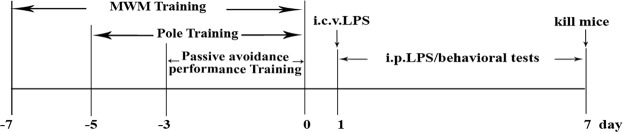
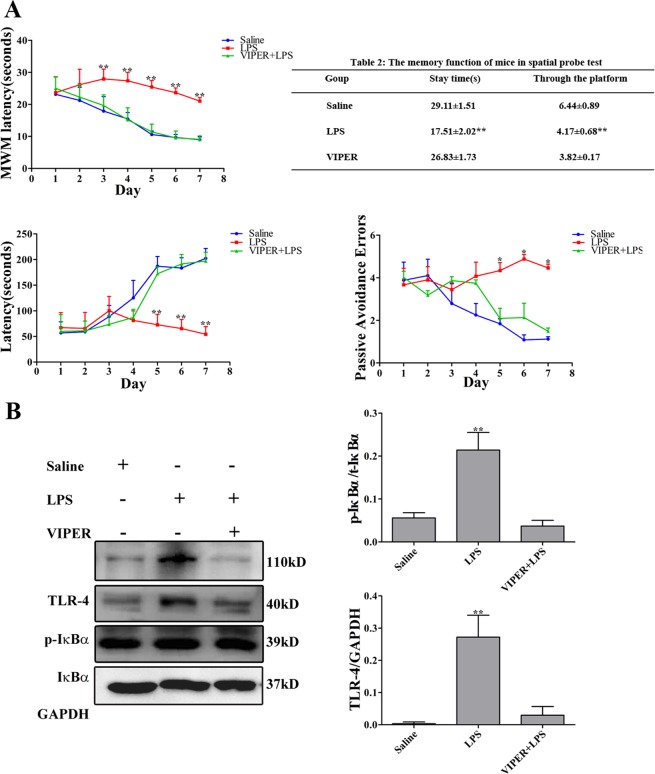
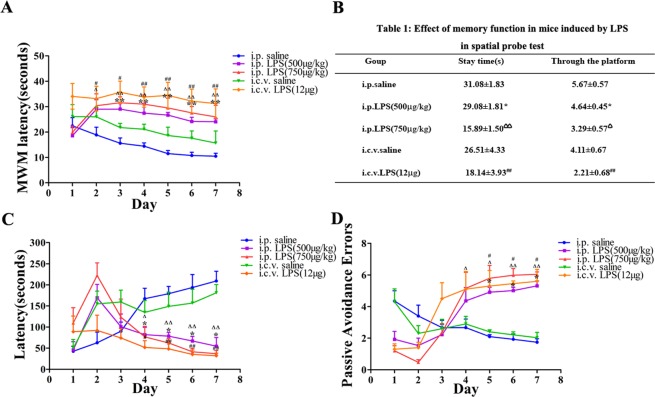
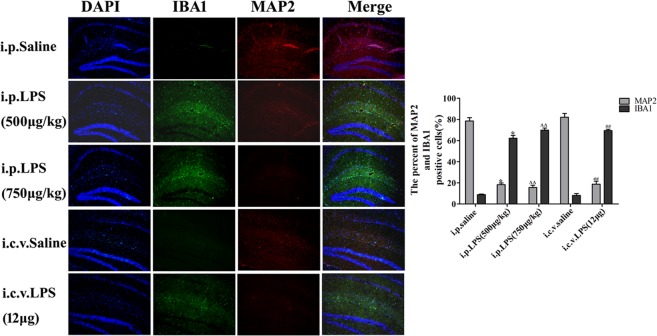
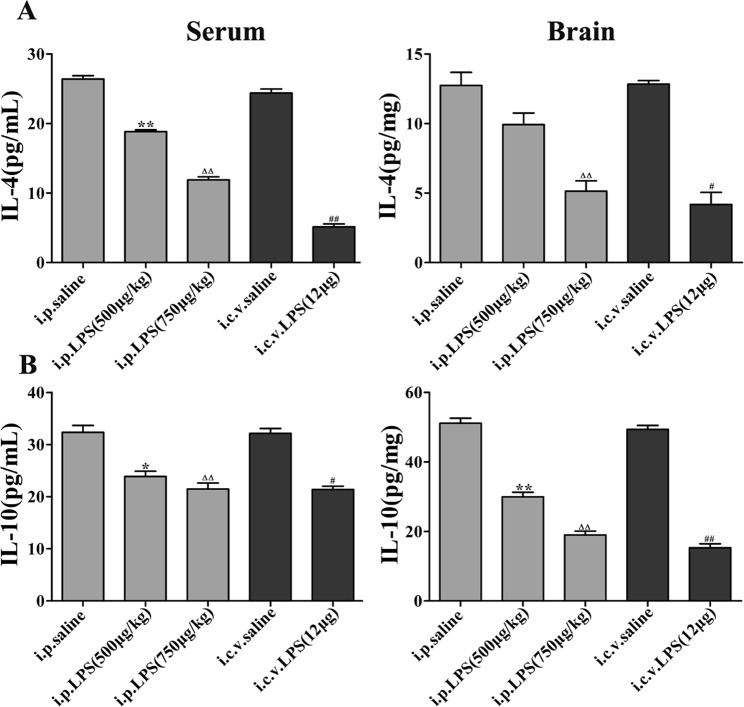
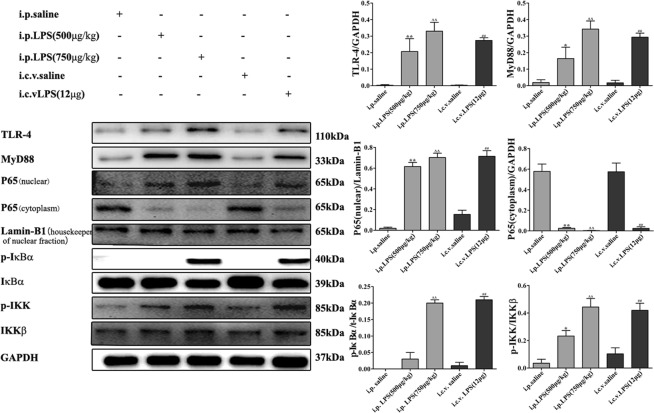
In this study, we investigated lipopolysaccharide (LPS)-induced cognitive impairment and neuroinflammation in C57BL/6J mice by using behavioral tests, immunofluorescence, enzyme-linked immunosorbent assay (ELISA) and Western blot. We found that LPS treatment leads to sickness behavior and cognitive impairment in mice as shown in the Morris water maze and passive avoidance test, and these effects were accompanied by microglia activation (labeled by ionized calcium binding adaptor molecule-1, IBA-1) and neuronal cell loss (labeled by microtubule-associated protein 2, MAP-2) in the hippocampus. The levels of interleukin-4 (IL-4) and interleukin-10 (IL-10) in the serum and brain homogenates were reduced by the LPS treatment, while the levels of tumor necrosis factor-α (TNF-α), interleukin-1β (IL-1β), prostaglandin E2 (PGE) and nitric oxide (NO) were increased. In addition, LPS promoted the expression of cyclooxygenase-2 (COX-2) and inducible nitric oxide synthase (iNOS) in the brain homogenates. The Western blot analysis showed that the nuclear factor kappa B (NF-κB) signaling pathway was activated in the LPS groups. Furthermore, VIPER, which is a TLR-4-specific inhibitory peptide, prevented the LPS-induced neuroinflammation and cognitive impairment. These data suggest that LPS induced cognitive impairment and neuroinflammation via microglia activation by activating the NF-kB signaling pathway; furthermore, we compared the time points, doses, methods and outcomes of LPS administration between intraperitoneal and intracerebroventricular injections of LPS in LPS-induced neuroinflammation and cognitive impairment, and these data may provide additional insight for researchers performing neuroinflammation research.
在这项研究中,我们通过行为测试、免疫荧光、酶联免疫吸附测定(ELISA)和 Western blot 研究了脂多糖(LPS)诱导的 C57BL/6J 小鼠认知障碍和神经炎症。我们发现 LPS 处理导致小鼠出现病态行为和认知障碍,如在 Morris 水迷宫和被动回避测试中所示,这些效应伴随着海马区小胶质细胞激活(由离子钙结合接头蛋白 1,IBA-1 标记)和神经元细胞丢失(由微管相关蛋白 2,MAP-2 标记)。LPS 处理降低了血清和脑匀浆中白细胞介素 4(IL-4)和白细胞介素 10(IL-10)的水平,而肿瘤坏死因子-α(TNF-α)、白细胞介素 1β(IL-1β)、前列腺素 E2(PGE)和一氧化氮(NO)的水平增加。此外,LPS 促进了脑匀浆中环氧化酶 2(COX-2)和诱导型一氧化氮合酶(iNOS)的表达。Western blot 分析显示 LPS 组中核因子 kappa B(NF-κB)信号通路被激活。此外,TLR-4 特异性抑制肽 VIPER 预防了 LPS 诱导的神经炎症和认知障碍。这些数据表明 LPS 通过激活 NF-κB 信号通路诱导小胶质细胞激活导致认知障碍和神经炎症;此外,我们比较了 LPS 诱导的神经炎症和认知障碍中 LPS 腹腔内和脑室内注射的时间点、剂量、方法和结果,这些数据可能为进行神经炎症研究的研究人员提供更多的见解。