• 文献检索
  • 文档翻译
  • 深度研究
  • 学术资讯
  • Suppr Zotero 插件Zotero 插件
  • 邀请有礼
  • 套餐&价格
  • 历史记录
应用&插件
Suppr Zotero 插件Zotero 插件浏览器插件Mac 客户端Windows 客户端微信小程序
定价
高级版会员购买积分包购买API积分包
服务
文献检索文档翻译深度研究API 文档MCP 服务
关于我们
关于 Suppr公司介绍联系我们用户协议隐私条款
关注我们

Suppr 超能文献

核心技术专利:CN118964589B侵权必究
粤ICP备2023148730 号-1Suppr @ 2026

文献检索

告别复杂PubMed语法,用中文像聊天一样搜索,搜遍4000万医学文献。AI智能推荐,让科研检索更轻松。

立即免费搜索

文件翻译

保留排版,准确专业,支持PDF/Word/PPT等文件格式,支持 12+语言互译。

免费翻译文档

深度研究

AI帮你快速写综述,25分钟生成高质量综述,智能提取关键信息,辅助科研写作。

立即免费体验

院外心脏骤停后脑死亡进展的危险因素。

Risk factors for progression toward brain death after out-of-hospital cardiac arrest.

作者信息

Cour Martin, Turc Jean, Madelaine Thomas, Argaud Laurent

机构信息

Hospices Civils de Lyon, Hôpital Edouard Herriot, Service de Médecine Intensive-Réanimation, 5, Place d'Arsonval, 69437, Lyon Cedex 03, France.

Faculté de médecine Lyon-Est, Université Claude Bernard Lyon 1, Université de Lyon, 69373, Lyon, France.

出版信息

Ann Intensive Care. 2019 Apr 8;9(1):45. doi: 10.1186/s13613-019-0520-0.

DOI:10.1186/s13613-019-0520-0
PMID:30963296
原文链接:https://pmc.ncbi.nlm.nih.gov/articles/PMC6453982/
Abstract

BACKGROUND

Successfully resuscitated out-of-hospital cardiac arrest (OHCA) may lead to brain death (BD) and good-quality transplantable organs. We aimed to determine risk factors for evolution toward BD after OHCA. We analyzed adult patients admitted to an intensive care unit (ICU) who survived at least 24 h after an OHCA between 2005 and 2015. BD was defined according to international guidelines. Multivariate logistic regression was used to identify potential risk factors for BD available 24 h after OHCA.

RESULTS

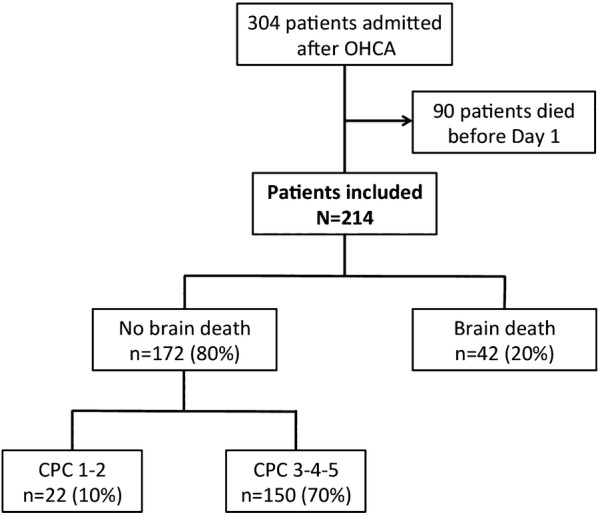
A total of 214 patients were included (median age 68 years; sex ratio 1.25; non-shockable OHCA: 88%). Among these, 42 (19.6%) developed BD, while 22 (10.3%) were alive at 1 year with a good neurological outcome. Independent risk factors for BD were age (OR per year 0.95; 95% CI [0.92-0.98]), female gender (OR 2.34; 95% CI [1.02-5.35]), neurological cause of OHCA (OR 14.72; 95% CI [3.03-71.37]), duration of the low-flow period > 16 min (OR 2.94, 95% CI [1.21-7.16]) and need of vasoactive drugs at 24 h (OR 6.20, 95% CI [2.41-15.93]).

CONCLUSIONS

The study identified, in a population of OHCA with predominantly non-shockable initial rhythms, five simple risk factors independently associated with progression toward BD.

摘要

背景

成功复苏的院外心脏骤停(OHCA)可能导致脑死亡(BD)以及高质量的可移植器官。我们旨在确定OHCA后发展为BD的危险因素。我们分析了2005年至2015年间入住重症监护病房(ICU)且在OHCA后至少存活24小时的成年患者。BD根据国际指南定义。采用多因素逻辑回归来识别OHCA后24小时时BD的潜在危险因素。

结果

共纳入214例患者(中位年龄68岁;性别比1.25;不可电击心律的OHCA:88%)。其中,42例(19.6%)发展为BD,而22例(10.3%)在1年时存活且神经功能良好。BD的独立危险因素为年龄(每年OR 0.95;95%CI[0.92 - 0.98])、女性(OR 2.34;95%CI[1.02 - 5.35])、OHCA的神经病因(OR 14.72;95%CI[3.03 - 71.37])、低血流期持续时间>16分钟(OR 2.94,95%CI[1.21 - 7.16])以及24小时时需要血管活性药物(OR 6.20,95%CI[2.41 - 15.93])。

结论

该研究在以不可电击初始心律为主的OHCA人群中,确定了五个与发展为BD独立相关的简单危险因素。
https://cdn.ncbi.nlm.nih.gov/pmc/blobs/7754/6453982/fdc1e115b6b4/13613_2019_520_Fig1_HTML.jpg

相似文献

1
Risk factors for progression toward brain death after out-of-hospital cardiac arrest.院外心脏骤停后脑死亡进展的危险因素。
Ann Intensive Care. 2019 Apr 8;9(1):45. doi: 10.1186/s13613-019-0520-0.
2
Prediction of Brain Death After Out-of-Hospital Cardiac Arrest: Development and Validation of the Brain Death After Cardiac Arrest Score.院外心搏骤停后脑死亡预测:心搏骤停后脑死亡评分的制定与验证。
Chest. 2021 Jul;160(1):139-147. doi: 10.1016/j.chest.2021.01.056. Epub 2021 Jun 8.
3
Organ donation after out-of-hospital cardiac arrest: a population-based study of data from the Paris Sudden Death Expertise Center.院外心脏骤停后的器官捐献:一项基于巴黎猝死专家中心数据的人群研究。
Ann Intensive Care. 2022 Jun 6;12(1):48. doi: 10.1186/s13613-022-01023-7.
4
Early prediction model of brain death in out-of-hospital cardiac arrest patients: a single-center retrospective and internal validation analysis.院外心脏骤停患者脑死亡的早期预测模型:单中心回顾性和内部验证分析。
BMC Emerg Med. 2022 Nov 4;22(1):177. doi: 10.1186/s12873-022-00734-1.
5
Early identified risk factors and their predictive performance of brain death in out-of-hospital cardiac arrest survivors.院外心脏骤停幸存者脑死亡的早期识别风险因素及其预测性能。
Am J Emerg Med. 2022 Jun;56:117-123. doi: 10.1016/j.ajem.2022.03.054. Epub 2022 Apr 1.
6
Conversion to shockable rhythms during resuscitation and survival for out-of hospital cardiac arrest.院外心脏骤停复苏期间转为可电击心律与生存情况
Am J Emerg Med. 2017 Feb;35(2):206-213. doi: 10.1016/j.ajem.2016.10.042. Epub 2016 Oct 25.
7
Lower-dose epinephrine administration and out-of-hospital cardiac arrest outcomes.低剂量肾上腺素给药与院外心脏骤停结局。
Resuscitation. 2018 Mar;124:43-48. doi: 10.1016/j.resuscitation.2018.01.004. Epub 2018 Jan 3.
8
[Investigation of out-of-hospital cardiac arrest in Zhengzhou City and the risk factors of prognosis of cardiopulmonary resuscitation: case analysis for 2016-2018].[郑州市院外心脏骤停及心肺复苏预后危险因素调查:2016 - 2018年病例分析]
Zhonghua Wei Zhong Bing Ji Jiu Yi Xue. 2019 Apr;31(4):439-443. doi: 10.3760/cma.j.issn.2095-4352.2019.04.013.
9
Incidence of cardiac interventions and associated cardiac arrest outcomes in patients with nonshockable initial rhythms and no ST elevation post resuscitation.非心搏骤停初始节律且复苏后无 ST 段抬高患者的心脏介入治疗发生率及相关心脏骤停转归。
Resuscitation. 2021 Oct;167:188-197. doi: 10.1016/j.resuscitation.2021.08.026. Epub 2021 Aug 23.
10
Hypoxic hepatitis after out-of-hospital cardiac arrest: Incidence, determinants and prognosis.院外心脏骤停后缺氧性肝炎:发病率、决定因素及预后
Resuscitation. 2016 Jun;103:60-65. doi: 10.1016/j.resuscitation.2016.03.021. Epub 2016 Apr 8.

引用本文的文献

1
Association of targeted temperature management on progression to brain death after severe anoxic brain injury following cardiac arrest: an observational study.目标温度管理与心脏骤停后严重缺氧性脑损伤进展至脑死亡的相关性:一项观察性研究。
BMJ Open. 2025 Feb 26;15(2):e085851. doi: 10.1136/bmjopen-2024-085851.
2
Guidelines for Neuroprognostication in Comatose Adult Survivors of Cardiac Arrest.昏迷的心脏骤停后成年幸存者神经预后指南。
Neurocrit Care. 2023 Jun;38(3):533-563. doi: 10.1007/s12028-023-01688-3. Epub 2023 Mar 22.
3
Prevalence, Outcomes, and Risk Factors for Cardiorespiratory Arrest in the Intensive Care Unit: An Observational Study.

本文引用的文献

1
Hanging and asphyxia: Interventions, patient outcomes and resource utilisation in a UK tertiary intensive care unit.绞杀与窒息:英国一家三级重症监护病房的干预措施、患者预后及资源利用情况
J Intensive Care Soc. 2018 Aug;19(3):201-208. doi: 10.1177/1751143717742067. Epub 2017 Dec 12.
2
Early detection of brain death using the Bispectral Index (BIS) in patients treated by extracorporeal cardiopulmonary resuscitation (E-CPR) for refractory cardiac arrest.应用脑电双频指数(BIS)对行体外心肺复苏(E-CPR)治疗的难治性心脏停搏患者进行脑死亡的早期检测。
Resuscitation. 2017 Nov;120:8-13. doi: 10.1016/j.resuscitation.2017.08.217. Epub 2017 Aug 24.
3
重症监护病房中心搏呼吸骤停的患病率、结局及危险因素:一项观察性研究
Indian J Crit Care Med. 2022 Jun;26(6):704-709. doi: 10.5005/jp-journals-10071-24201.
4
Organ donation after out-of-hospital cardiac arrest: a population-based study of data from the Paris Sudden Death Expertise Center.院外心脏骤停后的器官捐献:一项基于巴黎猝死专家中心数据的人群研究。
Ann Intensive Care. 2022 Jun 6;12(1):48. doi: 10.1186/s13613-022-01023-7.
5
Brain Death and Its Prediction in Out-of-Hospital Cardiac Arrest Patients Treated with Targeted Temperature Management.院外心脏骤停患者接受目标温度管理时的脑死亡及其预测
Diagnostics (Basel). 2022 May 10;12(5):1190. doi: 10.3390/diagnostics12051190.
6
Neuron-Specific Enolase (NSE) Predicts Long-Term Mortality in Adult Patients after Cardiac Arrest: Results from a Prospective Trial.神经元特异性烯醇化酶(NSE)预测心脏骤停成年患者的长期死亡率:一项前瞻性试验的结果
Medicines (Basel). 2021 Nov 17;8(11):72. doi: 10.3390/medicines8110072.
7
Combined Therapy With Polyethylene Glycol-20k and MCC950 Preserves Post-Resuscitated Myocardial Function in a Rat Model of Cardiac Arrest and Cardiopulmonary Resuscitation.聚乙二醇 20k 和 MCC950 联合治疗在心肺复苏后心跳骤停大鼠模型中保留心肌功能。
J Am Heart Assoc. 2021 May 4;10(9):e019177. doi: 10.1161/JAHA.120.019177. Epub 2021 Apr 22.
8
Post-resuscitation shock: recent advances in pathophysiology and treatment.复苏后休克:病理生理学与治疗的最新进展
Ann Intensive Care. 2020 Dec 14;10(1):170. doi: 10.1186/s13613-020-00788-z.
9
Duration and clinical features of cardiac arrest predict early severe cerebral edema.心脏骤停的持续时间和临床特征可预测早期严重脑水肿。
Resuscitation. 2020 Aug;153:111-118. doi: 10.1016/j.resuscitation.2020.05.049. Epub 2020 Jun 23.
The rate of brain death and organ donation in patients resuscitated from cardiac arrest: a systematic review and meta-analysis.
心脏骤停复苏患者的脑死亡和器官捐献率:一项系统评价和荟萃分析。
Intensive Care Med. 2016 Nov;42(11):1661-1671. doi: 10.1007/s00134-016-4549-3. Epub 2016 Oct 3.
4
Effect of Cyclosporine in Nonshockable Out-of-Hospital Cardiac Arrest: The CYRUS Randomized Clinical Trial.环孢素对非心搏骤停院外心脏骤停的影响:CYRUS 随机临床试验。
JAMA Cardiol. 2016 Aug 1;1(5):557-65. doi: 10.1001/jamacardio.2016.1701.
5
Neurological prognostication of outcome in patients in coma after cardiac arrest.心脏骤停后昏迷患者的神经预后预测。
Lancet Neurol. 2016 May;15(6):597-609. doi: 10.1016/S1474-4422(16)00015-6. Epub 2016 Mar 24.
6
SOFA score to assess the severity of the post-cardiac arrest syndrome.采用序贯器官衰竭评估(SOFA)评分来评估心脏骤停后综合征的严重程度。
Resuscitation. 2016 May;102:110-5. doi: 10.1016/j.resuscitation.2016.03.001. Epub 2016 Mar 7.
7
Decreased Monocyte HLA-DR Expression in Patients After Non-Shockable out-of-Hospital Cardiac Arrest.非可电击心律型院外心脏骤停患者单核细胞 HLA-DR 表达降低
Shock. 2016 Jul;46(1):33-6. doi: 10.1097/SHK.0000000000000561.
8
Heart Disease and Stroke Statistics-2016 Update: A Report From the American Heart Association.《2016年心脏病和中风统计数据更新:美国心脏协会报告》
Circulation. 2016 Jan 26;133(4):e38-360. doi: 10.1161/CIR.0000000000000350. Epub 2015 Dec 16.
9
Out-of-hospital cardiac arrest from brain cause: epidemiology, clinical features, and outcome in a multicenter cohort*.脑源性院外心脏骤停:一项多中心队列研究的流行病学、临床特征和结局*。
Crit Care Med. 2015 Feb;43(2):453-60. doi: 10.1097/CCM.0000000000000722.
10
Out-of-hospital traumatic cardiac arrest: an underrecognized source of organ donors.院外创伤性心搏骤停:器官供体的一个未被充分认识的来源。
Transpl Int. 2014 Jan;27(1):42-8. doi: 10.1111/tri.12196. Epub 2013 Oct 24.