• 文献检索
  • 文档翻译
  • 深度研究
  • 学术资讯
  • Suppr Zotero 插件Zotero 插件
  • 邀请有礼
  • 套餐&价格
  • 历史记录
应用&插件
Suppr Zotero 插件Zotero 插件浏览器插件Mac 客户端Windows 客户端微信小程序
定价
高级版会员购买积分包购买API积分包
服务
文献检索文档翻译深度研究API 文档MCP 服务
关于我们
关于 Suppr公司介绍联系我们用户协议隐私条款
关注我们

Suppr 超能文献

核心技术专利:CN118964589B侵权必究
粤ICP备2023148730 号-1Suppr @ 2026

文献检索

告别复杂PubMed语法,用中文像聊天一样搜索,搜遍4000万医学文献。AI智能推荐,让科研检索更轻松。

立即免费搜索

文件翻译

保留排版,准确专业,支持PDF/Word/PPT等文件格式,支持 12+语言互译。

免费翻译文档

深度研究

AI帮你快速写综述,25分钟生成高质量综述,智能提取关键信息,辅助科研写作。

立即免费体验

院外心脏骤停后的器官捐献:一项基于巴黎猝死专家中心数据的人群研究。

Organ donation after out-of-hospital cardiac arrest: a population-based study of data from the Paris Sudden Death Expertise Center.

作者信息

Renaudier M, Binois Y, Dumas F, Lamhaut L, Beganton F, Jost D, Charpentier J, Lesieur O, Marijon E, Jouven X, Cariou A, Bougouin W

机构信息

Paris Cardiovascular Research Center (PARCC), INSERM Unit 970, Paris, France.

Paris Sudden Death Expertise Center, Paris, France.

出版信息

Ann Intensive Care. 2022 Jun 6;12(1):48. doi: 10.1186/s13613-022-01023-7.

DOI:10.1186/s13613-022-01023-7
PMID:35666323
原文链接:https://pmc.ncbi.nlm.nih.gov/articles/PMC9170852/
Abstract

BACKGROUND

Organ shortage is a major public health issue, and patients who die after out-of-hospital cardiac arrest (OHCA) could be a valuable source of organs. Here, our objective was to identify factors associated with organ donation after brain death complicating OHCA, in unselected patients entered into a comprehensive real-life registry covering a well-defined geographic area.

METHODS

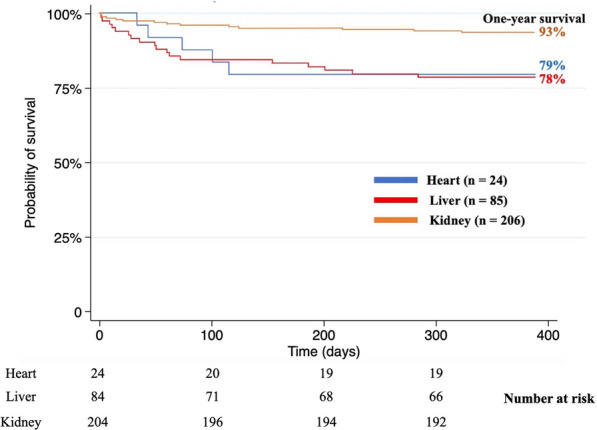
We prospectively analyzed consecutive adults with OHCA who were successfully resuscitated, but died in intensive care units in the Paris region in 2011-2018. The primary outcome was organ donation after brain death. Independent risk factors were identified using logistic regression analysis. One-year graft survival was assessed using Cox and log-rank tests.

RESULTS

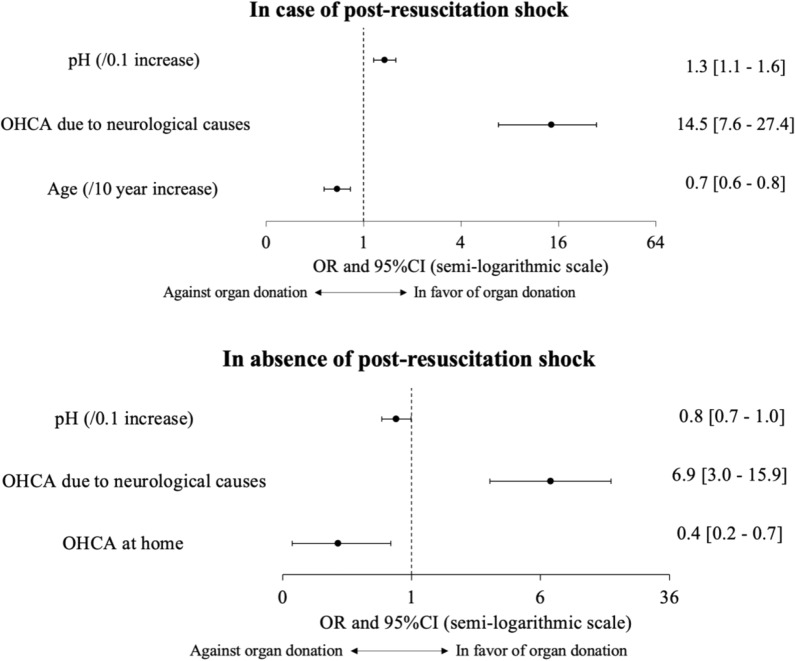
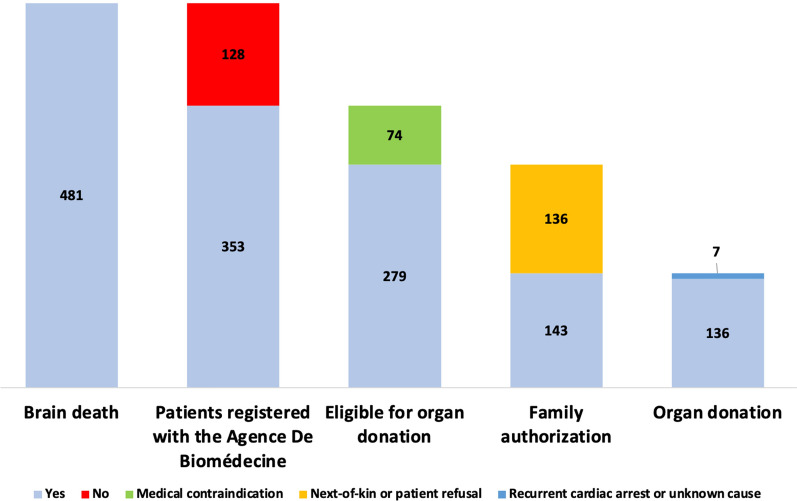
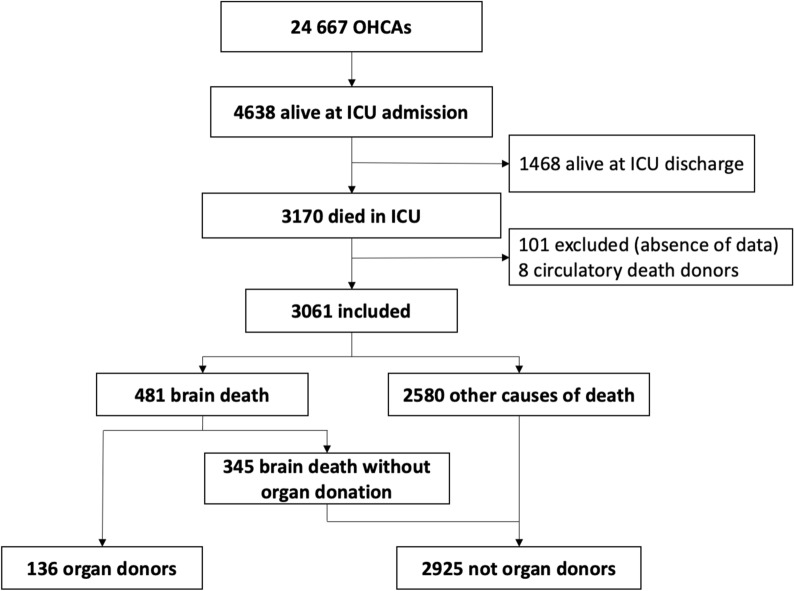
Of the 3061 included patients, 136 (4.4%) became organ donors after brain death, i.e., 28% of the patients with brain death. An interaction between admission pH and post-resuscitation shock was identified. By multivariate analysis, in patients with post-resuscitation shock, factors associated with organ donation were neurological cause of OHCA (odds ratio [OR], 14.5 [7.6-27.4], P < 0.001), higher pH (OR/0.1 increase, 1.3 [1.1-1.6], P < 0.001); older age was negatively associated with donation (OR/10-year increase, 0.7 [0.6-0.8], P < 0.001). In patients without post-resuscitation shock, the factor associated with donation was neurological cause of OHCA (OR, 6.9 [3.0-15.9], P < 0.001); higher pH (OR/0.1 increase, 0.8 [0.7-1.0], P = 0.04) and OHCA at home (OR, 0.4 [0.2-0.7], P = 0.006) were negatively associated with organ donation. One-year graft survival did not differ according to Utstein characteristics of the donor.

CONCLUSIONS

4% of patients who died in ICU after OHCA led to organ donation. Patients with OHCA constitute a valuable source of donated organs, and special attention should be paid to young patients with OHCA of neurological cause.

摘要

背景

器官短缺是一个重大的公共卫生问题,院外心脏骤停(OHCA)后死亡的患者可能是宝贵的器官来源。在此,我们的目标是在纳入一个涵盖明确地理区域的综合现实生活登记系统的未经过筛选的患者中,确定与OHCA并发脑死亡后器官捐献相关的因素。

方法

我们对2011年至2018年在巴黎地区重症监护病房成功复苏但最终死亡的连续性OHCA成年患者进行了前瞻性分析。主要结局是脑死亡后的器官捐献。使用逻辑回归分析确定独立危险因素。使用Cox和对数秩检验评估一年移植物存活率。

结果

在纳入的3061例患者中,136例(4.4%)在脑死亡后成为器官捐献者,即脑死亡患者中的28%。确定了入院时的pH值与复苏后休克之间的相互作用。通过多变量分析,在复苏后休克的患者中,与器官捐献相关的因素包括OHCA的神经学病因(比值比[OR],14.5[7.6 - 27.4],P < 0.001)、较高的pH值(OR/每增加0.1,1.3[1.1 - 1.6],P < 0.001);年龄较大与捐献呈负相关(OR/每增加10岁,0.7[0.6 - 0.8],P < 0.001)。在没有复苏后休克的患者中,与捐献相关的因素是OHCA的神经学病因(OR,6.9[3.0 - 15.9],P < 0.001);较高的pH值(OR/每增加0.1,0.8[0.7 - 1.0],P = 0.04)和在家中发生的OHCA(OR,0.4[0.2 - 0.7],P = 0.006)与器官捐献呈负相关。根据捐献者的Utstein特征,一年移植物存活率没有差异。

结论

OHCA后在重症监护病房死亡的患者中有4%实现了器官捐献。OHCA患者是宝贵的器官捐献来源,应特别关注神经学病因的年轻OHCA患者。
https://cdn.ncbi.nlm.nih.gov/pmc/blobs/3303/9170852/db48cc7f84c4/13613_2022_1023_Fig4_HTML.jpg
https://cdn.ncbi.nlm.nih.gov/pmc/blobs/3303/9170852/04b17781b0df/13613_2022_1023_Fig1_HTML.jpg
https://cdn.ncbi.nlm.nih.gov/pmc/blobs/3303/9170852/5397dd75e7d7/13613_2022_1023_Fig2_HTML.jpg
https://cdn.ncbi.nlm.nih.gov/pmc/blobs/3303/9170852/d02c0a73ce8c/13613_2022_1023_Fig3_HTML.jpg
https://cdn.ncbi.nlm.nih.gov/pmc/blobs/3303/9170852/db48cc7f84c4/13613_2022_1023_Fig4_HTML.jpg
https://cdn.ncbi.nlm.nih.gov/pmc/blobs/3303/9170852/04b17781b0df/13613_2022_1023_Fig1_HTML.jpg
https://cdn.ncbi.nlm.nih.gov/pmc/blobs/3303/9170852/5397dd75e7d7/13613_2022_1023_Fig2_HTML.jpg
https://cdn.ncbi.nlm.nih.gov/pmc/blobs/3303/9170852/d02c0a73ce8c/13613_2022_1023_Fig3_HTML.jpg
https://cdn.ncbi.nlm.nih.gov/pmc/blobs/3303/9170852/db48cc7f84c4/13613_2022_1023_Fig4_HTML.jpg

相似文献

1
Organ donation after out-of-hospital cardiac arrest: a population-based study of data from the Paris Sudden Death Expertise Center.院外心脏骤停后的器官捐献:一项基于巴黎猝死专家中心数据的人群研究。
Ann Intensive Care. 2022 Jun 6;12(1):48. doi: 10.1186/s13613-022-01023-7.
2
Controlled donation after circulatory death in post-cardiac arrest patients: Estimates from a large registry.心脏骤停后患者的循环死亡后控制捐献:来自大型登记处的估计
Resuscitation. 2024 Jun;199:110202. doi: 10.1016/j.resuscitation.2024.110202. Epub 2024 Apr 4.
3
Risk factors for progression toward brain death after out-of-hospital cardiac arrest.院外心脏骤停后脑死亡进展的危险因素。
Ann Intensive Care. 2019 Apr 8;9(1):45. doi: 10.1186/s13613-019-0520-0.
4
[Organ Donation in Victims of Non-Traumatic Out-of-Hospital Cardiac Arrest].[非创伤性院外心脏骤停受害者的器官捐献]
Dtsch Med Wochenschr. 2018 Jan;143(1):e1-e8. doi: 10.1055/s-0043-119394. Epub 2017 Nov 28.
5
Early Identification of Patients With Out-of-Hospital Cardiac Arrest With No Chance of Survival and Consideration for Organ Donation.对无生存机会的院外心脏骤停患者进行早期识别并考虑器官捐献。
Ann Intern Med. 2016 Dec 6;165(11):770-778. doi: 10.7326/M16-0402. Epub 2016 Sep 13.
6
Early prediction model of brain death in out-of-hospital cardiac arrest patients: a single-center retrospective and internal validation analysis.院外心脏骤停患者脑死亡的早期预测模型:单中心回顾性和内部验证分析。
BMC Emerg Med. 2022 Nov 4;22(1):177. doi: 10.1186/s12873-022-00734-1.
7
Rates of organ donation in a UK tertiary cardiac arrest centre following out-of-hospital cardiac arrest.英国一家三级心脏骤停中心在院外心脏骤停后器官捐献率。
Resuscitation. 2016 Apr;101:41-3. doi: 10.1016/j.resuscitation.2016.01.003. Epub 2016 Jan 23.
8
Prediction of Brain Death After Out-of-Hospital Cardiac Arrest: Development and Validation of the Brain Death After Cardiac Arrest Score.院外心搏骤停后脑死亡预测:心搏骤停后脑死亡评分的制定与验证。
Chest. 2021 Jul;160(1):139-147. doi: 10.1016/j.chest.2021.01.056. Epub 2021 Jun 8.
9
An underrecognized source of organ donors: patients with brain death after successfully resuscitated cardiac arrest.一个未得到充分认识的器官捐献者来源:心脏骤停成功复苏后的脑死亡患者。
Intensive Care Med. 2008 Jan;34(1):132-7. doi: 10.1007/s00134-007-0885-7. Epub 2007 Oct 12.
10
Between-hospital variability in organ donation after resuscitation from out-of-hospital cardiac arrest.院外心脏骤停复苏后器官捐献的医院间差异。
Resuscitation. 2021 Oct;167:372-379. doi: 10.1016/j.resuscitation.2021.07.038. Epub 2021 Aug 4.

引用本文的文献

1
Uncontrolled Donation Potential After Circulatory Death in Slovenia Could Lead to More Organ Donations: Extrapolation of SiOHCA Study Data.斯洛文尼亚循环死亡后不受控制的捐献潜力可增加器官捐献:SiOHCA 研究数据的推断。
Inquiry. 2024 Jan-Dec;61:469580241283185. doi: 10.1177/00469580241283185.
2
Ten Steps Toward Improving In-Hospital Cardiac Arrest Quality of Care and Outcomes.提高院内心脏骤停护理质量及改善预后的十个步骤。
Circ Cardiovasc Qual Outcomes. 2023 Nov;16(11):e010491. doi: 10.1161/CIRCOUTCOMES.123.010491. Epub 2023 Nov 10.
3
Ten Steps Toward Improving In-Hospital Cardiac Arrest Quality of Care and Outcomes.

本文引用的文献

1
Prediction of Brain Death After Out-of-Hospital Cardiac Arrest: Development and Validation of the Brain Death After Cardiac Arrest Score.院外心搏骤停后脑死亡预测:心搏骤停后脑死亡评分的制定与验证。
Chest. 2021 Jul;160(1):139-147. doi: 10.1016/j.chest.2021.01.056. Epub 2021 Jun 8.
2
Post-resuscitation shock: recent advances in pathophysiology and treatment.复苏后休克:病理生理学与治疗的最新进展
Ann Intensive Care. 2020 Dec 14;10(1):170. doi: 10.1186/s13613-020-00788-z.
3
Extracorporeal membrane oxygenation for refractory cardiac arrest: a retrospective multicenter study.
提高院内心脏骤停护理质量和治疗效果的十个步骤。
Resuscitation. 2023 Dec;193:109996. doi: 10.1016/j.resuscitation.2023.109996. Epub 2023 Nov 10.
4
Anesthetic Considerations of Organ Procurement After Brain and Cardiac Death: A Narrative Review.脑死亡和心脏死亡后器官获取的麻醉考量:一篇叙述性综述
Cureus. 2023 Jun 19;15(6):e40629. doi: 10.7759/cureus.40629. eCollection 2023 Jun.
体外膜肺氧合治疗难治性心脏骤停:一项回顾性多中心研究。
Intensive Care Med. 2020 May;46(5):973-982. doi: 10.1007/s00134-020-05926-6. Epub 2020 Feb 12.
4
Extracorporeal cardiopulmonary resuscitation in out-of-hospital cardiac arrest: a registry study.院外心脏骤停的体外心肺复苏:一项登记研究。
Eur Heart J. 2020 Jun 1;41(21):1961-1971. doi: 10.1093/eurheartj/ehz753.
5
Organ donation after resuscitation from cardiac arrest.心脏停搏复苏后的器官捐献。
Resuscitation. 2019 Dec;145:63-69. doi: 10.1016/j.resuscitation.2019.10.013. Epub 2019 Oct 22.
6
Risk factors for progression toward brain death after out-of-hospital cardiac arrest.院外心脏骤停后脑死亡进展的危险因素。
Ann Intensive Care. 2019 Apr 8;9(1):45. doi: 10.1186/s13613-019-0520-0.
7
Early in-hospital management of cardiac arrest from neurological cause: Diagnostic pitfalls and treatment issues.神经原因导致的心脏骤停的早期院内管理:诊断误区和治疗问题。
Resuscitation. 2018 Nov;132:147-155. doi: 10.1016/j.resuscitation.2018.08.004. Epub 2018 Aug 4.
8
Epidemiology of out-of-hospital cardiac arrest: A French national incidence and mid-term survival rate study.院外心脏骤停的流行病学:法国全国发生率和中期生存率研究。
Anaesth Crit Care Pain Med. 2019 Apr;38(2):131-135. doi: 10.1016/j.accpm.2018.04.006. Epub 2018 Apr 21.
9
Are characteristics of hospitals associated with outcome after cardiac arrest? Insights from the Great Paris registry.医院特征与心脏骤停后结局相关吗?来自大巴黎注册研究的启示。
Resuscitation. 2017 Sep;118:63-69. doi: 10.1016/j.resuscitation.2017.06.019. Epub 2017 Jun 23.
10
The rate of brain death and organ donation in patients resuscitated from cardiac arrest: a systematic review and meta-analysis.心脏骤停复苏患者的脑死亡和器官捐献率:一项系统评价和荟萃分析。
Intensive Care Med. 2016 Nov;42(11):1661-1671. doi: 10.1007/s00134-016-4549-3. Epub 2016 Oct 3.