Gruber Markus, Kramer Andreas, Mulder Edwin, Rittweger Jörn
Human Performance Research Centre, Universität Konstanz, Konstanz, Germany.
Institute of Aerospace Medicine, German Aerospace Center (DLR), Cologne, Germany.
Front Physiol. 2019 Mar 22;10:311. doi: 10.3389/fphys.2019.00311. eCollection 2019.
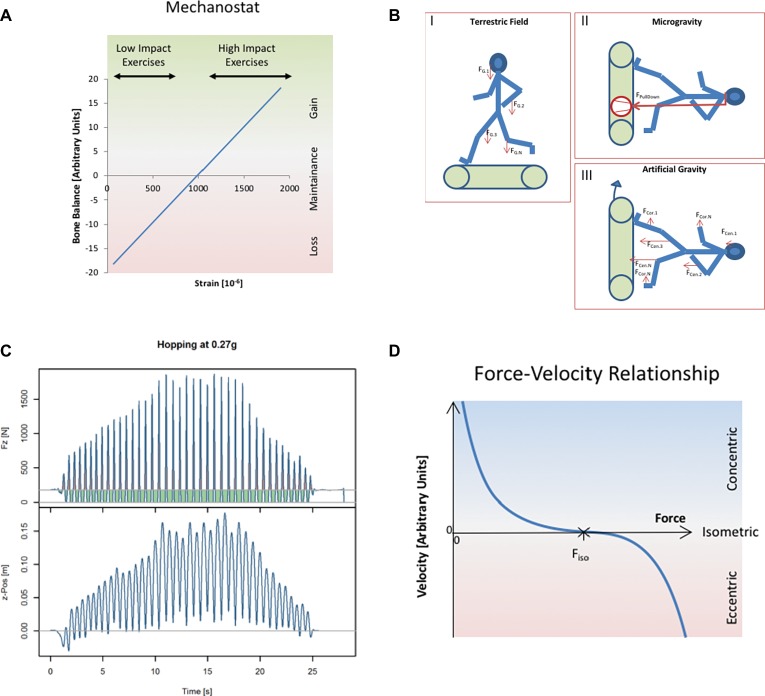
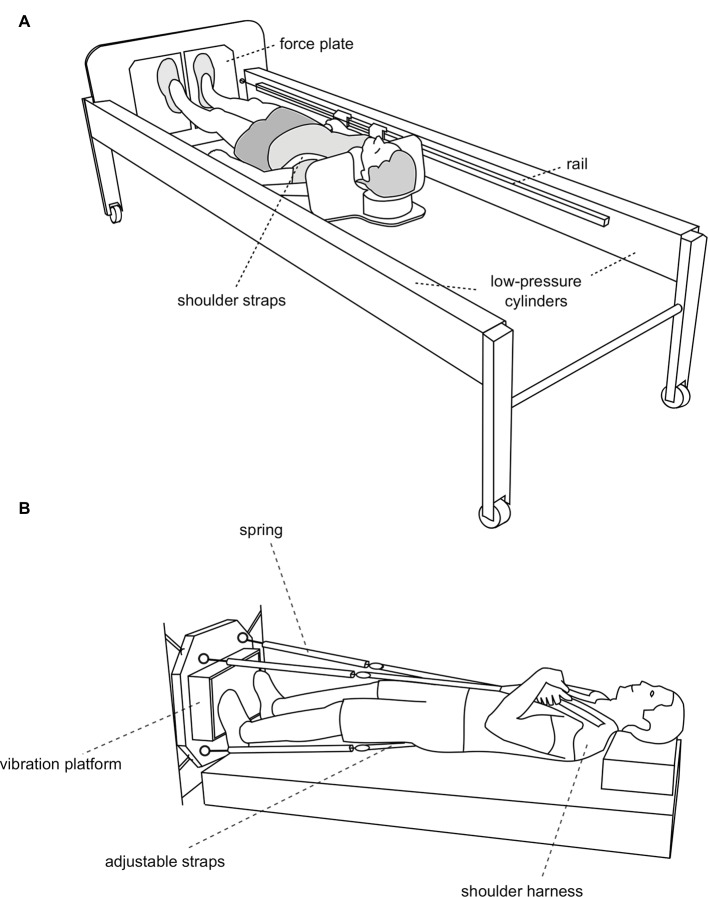
Pronounced muscle and bone losses indicate that the musculoskeletal system suffers substantially from prolonged microgravity. A likely reason for these detrimental adaptations in the lower extremity is the lack of impact loading and the difficulty to apply large loading forces on the human body in microgravity. The human body is well adapted to ambulating in Earth's gravitational field. A key principle herein is the periodic conversion of kinetic to elastic energy and . Predominantly tendons and to a lesser extent muscles, bones and other tissues contribute to this storage and release of energy, which is most efficient when organized in the stretch-shortening cycle (SSC). During SSC, muscles, especially those encompassing the ankle, knee, and hip joints, are activated in a specific manner, thereby enabling the production of high muscle forces and elastic energy storage. In consequence, the high forces acting throughout the body deform the viscoelastic biological structures sensed by mechanoreceptors and feedback in order to regulate the resilience of these structures and keep strains and strain rates in an uncritical range. Recent results from our lab indicate, notably, that SSC can engender a magnitude of tissue strains that cannot be achieved by other types of exercise. The present review provides an overview of the physiology and mechanics of the natural SSC as well as the possibility to mimic it by the application of whole-body vibration. We then report the evidence from bed rest studies on effectiveness and efficiency of plyometric and resistive vibration exercise as a countermeasure. Finally, implications and applications of both training modalities for human spaceflight operations and terrestrial spin-offs are discussed.
明显的肌肉和骨骼流失表明,肌肉骨骼系统在长期微重力环境下会受到严重影响。下肢出现这些有害适应性变化的一个可能原因是缺乏冲击负荷,以及在微重力环境下难以对人体施加较大的负荷力。人体非常适应在地球引力场中行走。这里的一个关键原则是动能到弹性能的周期性转换。主要是肌腱,在较小程度上还有肌肉、骨骼和其他组织参与了这种能量的储存和释放,当以拉长 - 缩短周期(SSC)的形式组织起来时,这种能量转换最为高效。在SSC期间,肌肉,尤其是那些环绕踝关节、膝关节和髋关节的肌肉,会以特定方式被激活,从而能够产生高肌肉力量并储存弹性能量。因此,作用于全身的高力量会使机械感受器感知到的粘弹性生物结构发生变形,并产生反馈,以调节这些结构的弹性,使应变和应变率保持在安全范围内。我们实验室最近的结果特别表明,SSC能够产生其他类型运动无法达到的组织应变程度。本综述概述了自然SSC的生理学和力学原理,以及通过全身振动模拟它的可能性。然后,我们报告卧床研究中关于增强式和抵抗性振动运动作为对策的有效性和效率的证据。最后,讨论了这两种训练方式对载人航天操作和地面衍生应用的影响和应用。