Altinova Haktan, Hammes Sebastian, Palm Moniek, Gerardo-Nava Jose, Achenbach Pascal, Deumens Ronald, Hermans Emmanuel, Führmann Tobias, Boecker Arne, van Neerven Sabien Geraldine Antonia, Bozkurt Ahmet, Weis Joachim, Brook Gary Anthony
Department of Neurosurgery, RWTH Aachen University Hospital, Aachen, Germany.
Institute of Neuropathology, RWTH Aachen University Hospital, Aachen, Germany.
Regen Biomater. 2019 Mar;6(2):75-87. doi: 10.1093/rb/rbz006. Epub 2019 Feb 4.
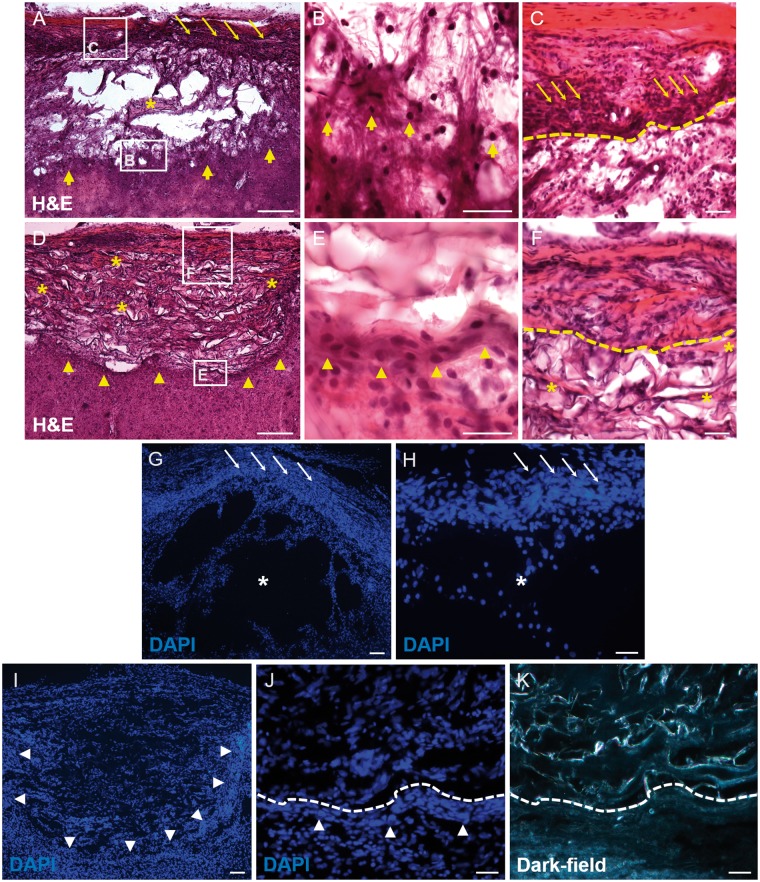
Severe traumatic spinal cord injury (SCI) results in a devastating and permanent loss of function, and is currently an incurable condition. It is generally accepted that future intervention strategies will require combinational approaches, including bioengineered scaffolds, to support axon growth across tissue scarring and cystic cavitation. Previously, we demonstrated that implantation of a microporous type-I collagen scaffold into an experimental model of SCI was capable of supporting functional recovery in the absence of extensive implant-host neural tissue integration. Here, we demonstrate the reactive host cellular responses that may be detrimental to neural tissue integration after implantation of collagen scaffolds into unilateral resection injuries of the adult rat spinal cord. Immunohistochemistry demonstrated scattered fibroblast-like cell infiltration throughout the scaffolds as well as the presence of variable layers of densely packed cells, the fine processes of which extended along the graft-host interface. Few reactive astroglial or regenerating axonal profiles could be seen traversing this layer. Such encapsulation-type behaviour around bioengineered scaffolds impedes the integration of host neural tissues and reduces the intended bridging role of the implant. Characterization of the cellular and molecular mechanisms underpinning this behaviour will be pivotal in the future design of collagen-based bridging scaffolds intended for regenerative medicine.
严重创伤性脊髓损伤(SCI)会导致功能的毁灭性和永久性丧失,目前是一种无法治愈的疾病。人们普遍认为,未来的干预策略将需要包括生物工程支架在内的联合方法,以支持轴突跨越组织瘢痕和囊性空洞生长。此前,我们证明将微孔I型胶原蛋白支架植入SCI实验模型中,能够在没有广泛的植入物-宿主神经组织整合的情况下支持功能恢复。在此,我们展示了将胶原蛋白支架植入成年大鼠脊髓单侧切除损伤后,可能对神经组织整合有害的宿主细胞反应。免疫组织化学显示,整个支架中有散在的成纤维细胞样细胞浸润,以及存在不同层数的密集细胞层,其精细突起沿移植物-宿主界面延伸。很少能看到有反应性星形胶质细胞或再生轴突穿过这一层。生物工程支架周围的这种包封型行为阻碍了宿主神经组织的整合,并降低了植入物预期的桥接作用。确定支撑这种行为的细胞和分子机制对于未来用于再生医学的基于胶原蛋白的桥接支架的设计至关重要。