Department of Protein Engineering, Faculty of Biotechnology, University of Wroclaw, Poland.
PORT - Polish Center for Technology Development, Wroclaw, Poland.
FEBS Open Bio. 2019 May;9(5):914-924. doi: 10.1002/2211-5463.12618. Epub 2019 Apr 9.
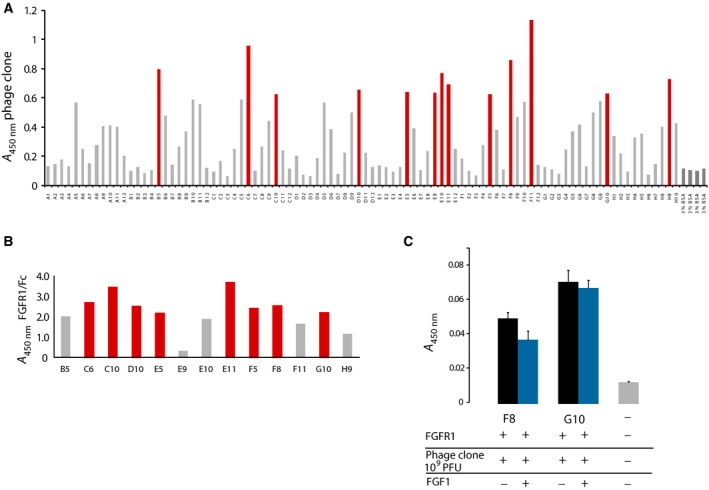
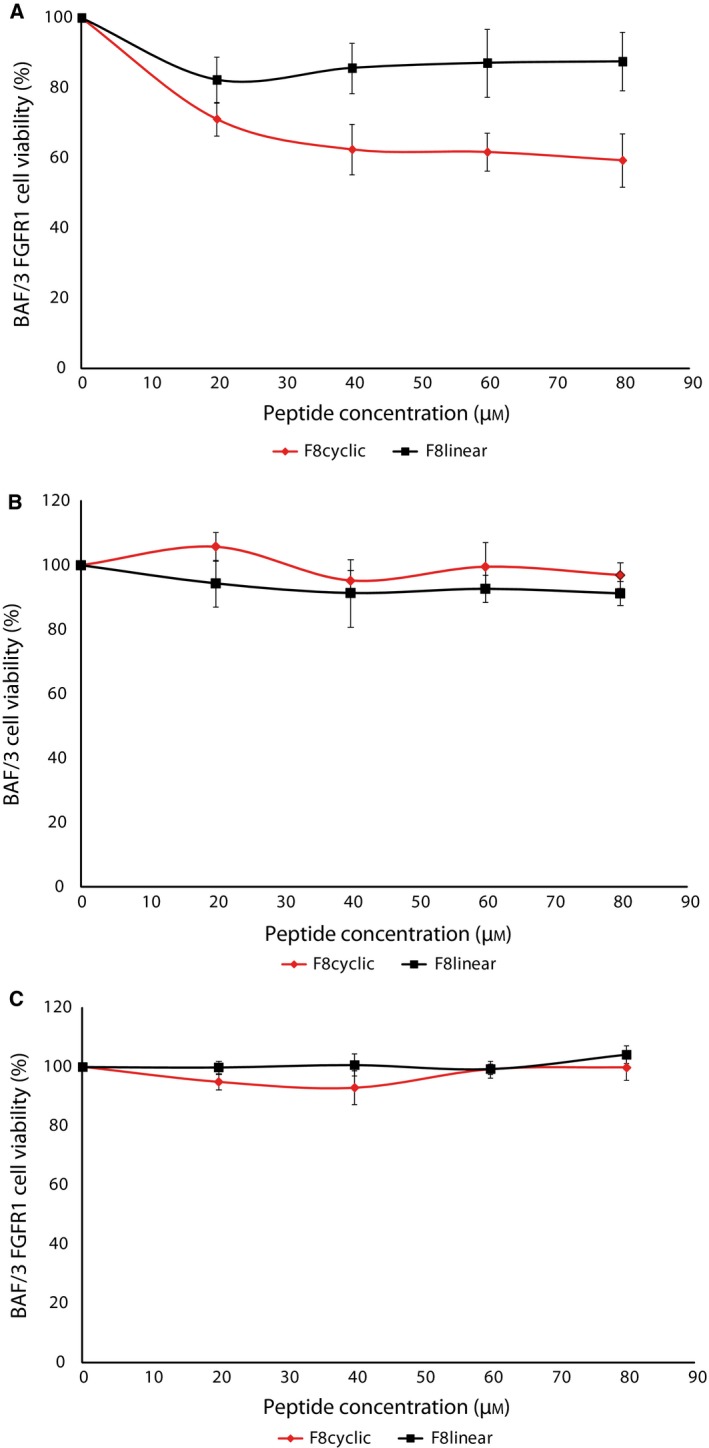
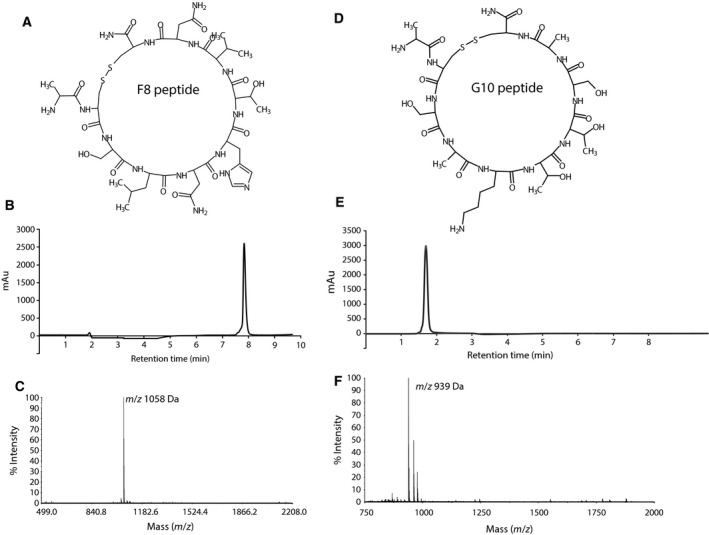
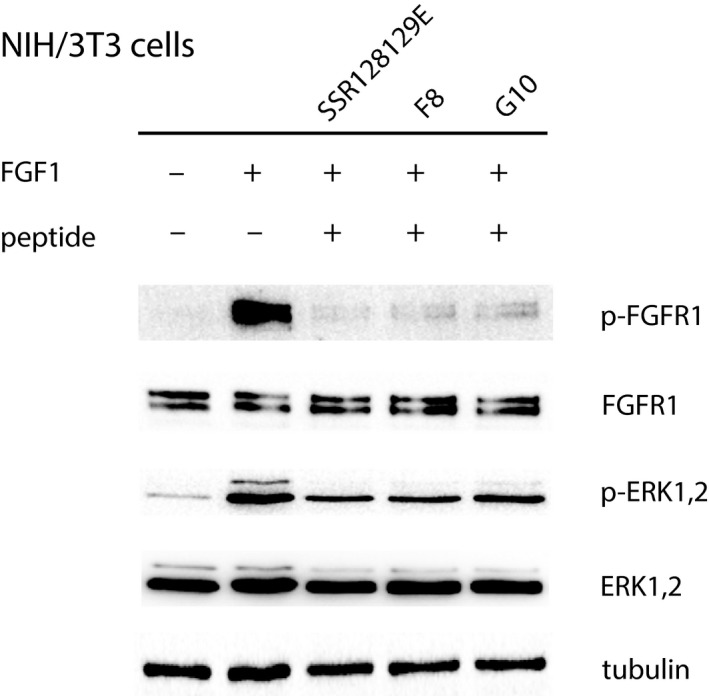
Overexpression of fibroblast growth factor receptor 1 (FGFR1) is a common aberration in lung and breast cancers and has necessitated the design of drugs targeting FGFR1-dependent downstream signaling and FGFR1 ligand binding. To date, the major group of drugs being developed for treatment of FGFR1-dependent cancers are small-molecule tyrosine kinase inhibitors; however, the limited specificity of these drugs has led to increasing attempts to design molecules targeting the extracellular domain of FGFR1. Here, we used the phage display technique to select cyclic peptides F8 (ACSLNHTVNC) and G10 (ACSAKTTSAC) as binders of the fibroblast growth factor 1 (FGF1)-FGFR1 interface. ELISA and in vitro cell assays were performed to reveal that cyclic peptide F8 is more effective in preventing the FGF1-FGFR1 interaction, and also decreases FGF1-induced proliferation of BA/F3 FGFR1c cells by over 40%. Such an effect was not observed for BA/F3 cells lacking FGFR1. Therefore, cyclic peptide F8 can act as a FGF1-FGFR1 interaction antagonist, and may be suitable for further development for potential use in therapies against FGFR1-expressing cancer cells.
成纤维细胞生长因子受体 1(FGFR1)的过表达是肺癌和乳腺癌的常见异常现象,这就需要设计针对 FGFR1 依赖性下游信号和 FGFR1 配体结合的药物。迄今为止,为治疗 FGFR1 依赖性癌症而开发的主要药物组是小分子酪氨酸激酶抑制剂;然而,这些药物的有限特异性导致越来越多的尝试来设计针对 FGFR1 细胞外结构域的分子。在这里,我们使用噬菌体展示技术筛选出结合纤维母细胞生长因子 1(FGF1)-FGFR1 界面的环状肽 F8(ACSLNHTVNC)和 G10(ACSAKTTSAC)。进行 ELISA 和体外细胞测定以揭示环状肽 F8 更有效地阻止 FGF1-FGFR1 相互作用,并且还使 BA/F3 FGFR1c 细胞中由 FGF1 诱导的增殖降低超过 40%。在缺乏 FGFR1 的 BA/F3 细胞中未观察到这种作用。因此,环状肽 F8 可以作为 FGF1-FGFR1 相互作用的拮抗剂,并且可能适合进一步开发,用于针对表达 FGFR1 的癌细胞的潜在治疗。