López-González L, Viñuela-Prieto J M, Rodriguez-Avial I, Manzano R, Candel F J
Francisco Javier Candel González, Department of Clinical Microbiology and Infectious Diseases. Hospital Clínico San Carlos. IdISSC Health Research Institute. Universidad Complutense. Madrid. Spain.
Rev Esp Quimioter. 2019 Jun;32(3):254-262. Epub 2019 Apr 8.
The aim of the study was to carry out an epidemiological analysis of patients with carbapenemase-producing Enterobacteriaceae (CPE) isolations in our hospital as well as to perform a description of the genotypic temporal evolution of CPE isolated.
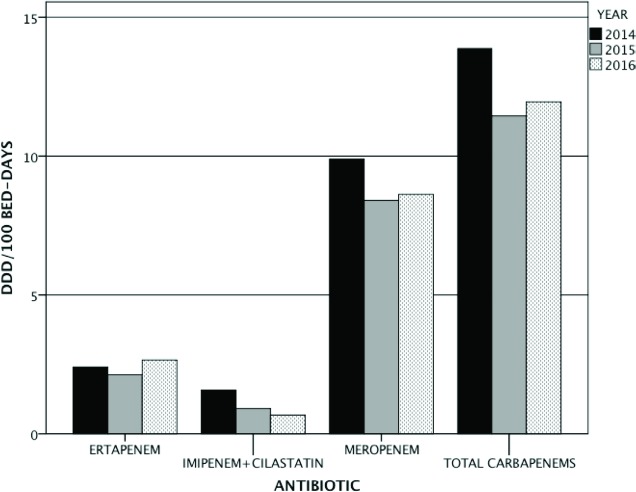
An observational prospective cohort study was performed involving all patients with CPE isolates from clinical samples during November 2014 to November 2016 in a Spanish teaching hospital. Patients were clinically evaluated and classified either as infected or colonized. Information on the consumption of carbapenems in the hospital during the study period was also analyzed. PCR was used for identification of the carbapenemase genes blaKPC, blaVIM, and blaOXA-48.
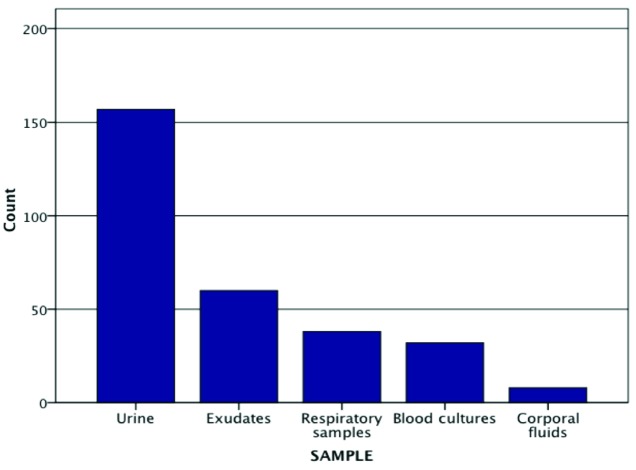
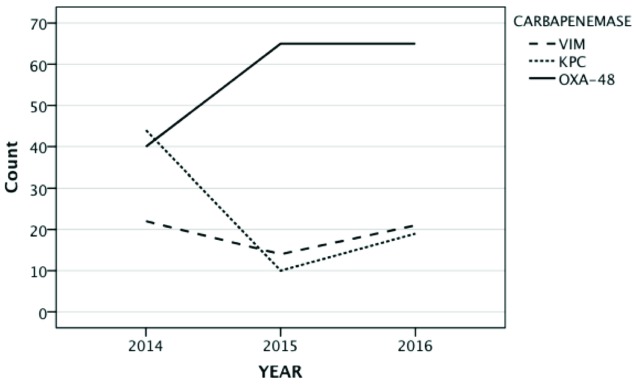
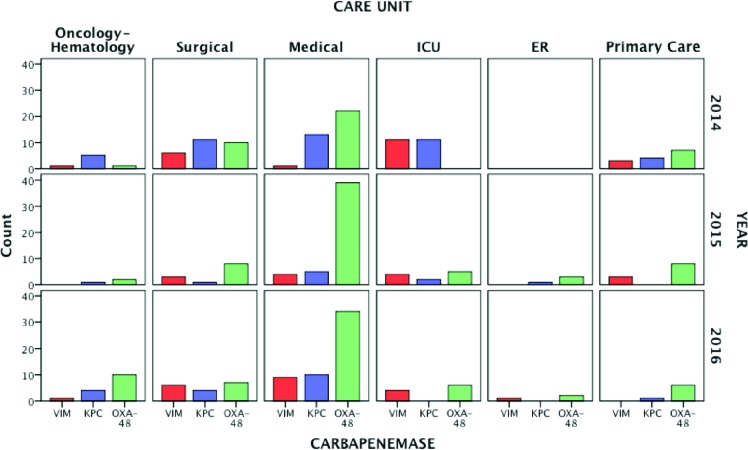
A total of 301 CPE isolates were obtained (107 in 2014, 89 in 2015 and 105 in 2016). Klebsiella pneumoniae (73.4%) was the most prevalent microorganism. Hundred and seventy (56.7%) of carbapenemases detected were blaOXA-48, 73 (24.3%) were blaKPC and 57 (19%) were blaVIM. In year 2014 KPC was predominant while in 2016 OXA-48 predominated. In 2014 we observed a significant association between the medical wards and the ICU with a higher prevalence of OXA-48 (OR 4.15; P<0.001) and VIM (OR 7.40; P<0.001) in the univariate analysis, in the following years there was no association. Regarding the clinical significance of microbiological results after assessing our patients, 60% of isolates represented infection and 40% behaved as colonizers. One third of hospitalized patients with CPE isolation died within 30 days, regardless of whether they were colonized or infected.
We have observed an epidemiological change in the genotypes of our isolates along the study period. A thorough knowledge of the CPE's epidemiological distribution in each hospital is fundamental for optimizing antimicrobial chemotherapy.
本研究旨在对我院产碳青霉烯酶肠杆菌科细菌(CPE)分离株患者进行流行病学分析,并对分离出的CPE的基因型时间演变进行描述。
在西班牙一家教学医院进行了一项观察性前瞻性队列研究,纳入了2014年11月至2016年11月期间临床样本中分离出CPE的所有患者。对患者进行临床评估并分类为感染或定植。还分析了研究期间医院内碳青霉烯类药物的使用情况。采用聚合酶链反应(PCR)鉴定碳青霉烯酶基因blaKPC、blaVIM和blaOXA - 48。
共获得301株CPE分离株(2014年107株,2015年89株,2016年105株)。肺炎克雷伯菌(73.4%)是最常见的微生物。检测到的碳青霉烯酶中,170株(56.7%)为blaOXA - 48,73株(24.3%)为blaKPC,57株(19%)为blaVIM。2014年KPC占主导,而2016年OXA - 48占主导。2014年单因素分析显示,内科病房和重症监护病房(ICU)之间存在显著关联,OXA - 48(比值比[OR]4.15;P<0.001)和VIM(OR 7.40;P<0.001)的患病率较高,在随后几年无此关联。在评估患者后,就微生物学结果的临床意义而言,60%的分离株代表感染,40%表现为定植菌。三分之一的CPE分离株住院患者在30天内死亡,无论其为定植还是感染。
在研究期间,我们观察到分离株的基因型发生了流行病学变化。全面了解每家医院CPE的流行病学分布对于优化抗菌化疗至关重要。