Schliemann Désirée, Su Tin Tin, Paramasivam Darishiani, Treanor Charlene, Dahlui Maznah, Loh Siew Yim, Donnelly Michael
Queen's University Belfast, Belfast, United Kingdom.
Monash University Malaysia, Bandar Sunway, Malaysia.
J Glob Oncol. 2019 Apr;5:1-20. doi: 10.1200/JGO.19.00011.
The main objective of this systematic review was to identify whether mass and small media interventions improve knowledge and attitudes about cancer, cancer screening rates, and early detection of cancer in Asia.
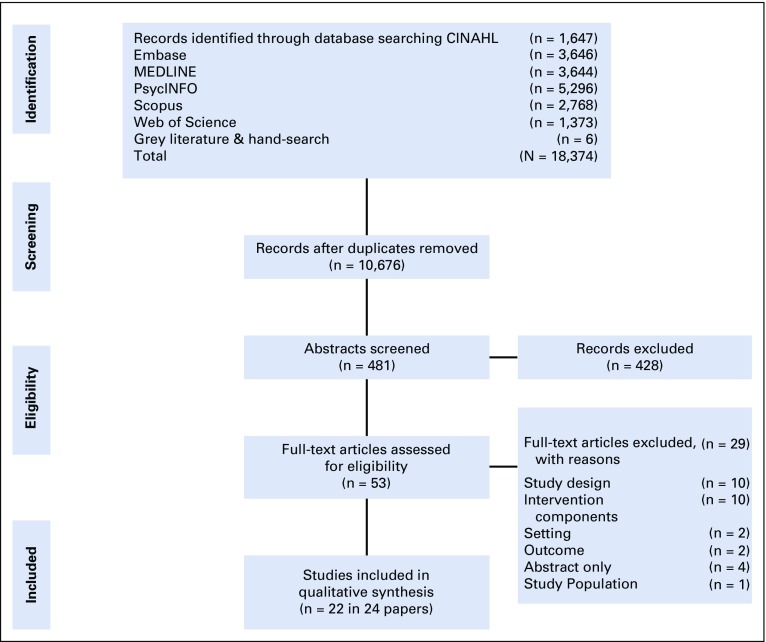
The review was conducted according to a predefined protocol. Medline, EMBASE, CINAHL, Web of Science, Cochrane Library, and Google Scholar were searched in September 2017, and data extraction and rating of methodologic study quality (according to Joanna Briggs Institute rating procedures) were performed independently by reviewers.
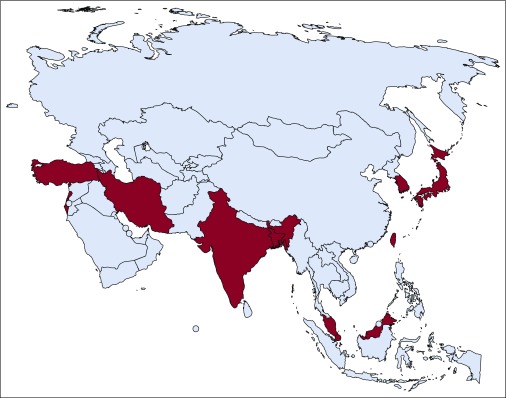
Twenty-two studies (reported across 24 papers) met the inclusion criteria. Most studies (n = 21) were conducted in high or upper-middle income countries; targeted breast (n = 11), cervical (n = 7), colorectal (n = 3), or oral (n = 2) cancer; and used small media either alone (n = 15) or in combination with mass media and other components (n = 5). Studies regarding cancer screening uptake were of medium to high quality and mainly reported positive outcomes for cervical cancer and mixed results for breast and colorectal cancer. The methodologic strength of research that investigated change in cancer-related knowledge and the cost effectiveness of interventions, respectively, were weak and inconclusive.
Evidence indicated that small media campaigns seemed to be effective in terms of increasing screening uptake in Asia, in particular cervical cancer screening. Because of the limited number of studies in Asia, it was not possible to be certain about the effectiveness of mass media in improving screening uptake and the effectiveness of campaigns in improving cancer-related knowledge.
本系统评价的主要目的是确定大众媒体和小众媒体干预措施是否能提高亚洲地区对癌症的认识和态度、癌症筛查率以及癌症的早期发现。
该评价按照预先定义的方案进行。2017年9月检索了Medline、EMBASE、CINAHL、Web of Science、Cochrane图书馆和谷歌学术,评审人员独立进行数据提取和方法学研究质量评级(根据乔安娜·布里格斯研究所的评级程序)。
22项研究(发表在24篇论文中)符合纳入标准。大多数研究(n = 21)在高收入或中高收入国家进行;针对乳腺癌(n = 11)、宫颈癌(n = 7)、结直肠癌(n = 3)或口腔癌(n = 2);单独使用小众媒体(n = 15)或与大众媒体及其他成分联合使用(n = 5)。关于癌症筛查接受情况的研究质量为中等至高,主要报告了宫颈癌的阳性结果以及乳腺癌和结直肠癌的混合结果。分别调查癌症相关知识变化和干预措施成本效益的研究的方法学强度较弱且尚无定论。
有证据表明,在亚洲,小众媒体宣传活动在提高筛查接受率方面似乎是有效的,尤其是宫颈癌筛查。由于亚洲的研究数量有限,无法确定大众媒体在提高筛查接受率方面的有效性以及宣传活动在提高癌症相关知识方面的有效性。