Liu Qingyuan, Jiang Pengjun, Wu Jun, Gao Bin, Wang Shuo
Department of Neurosurgery, Beijing Tiantan Hospital, Capital Medical University, Beijing, China.
China National Clinical Research Center for Neurological Diseases, Beijing, China.
Front Neurosci. 2019 Mar 26;13:233. doi: 10.3389/fnins.2019.00233. eCollection 2019.
Intraoperative aneurysm rupture (IOR) is a difficult event during the clipping process for intracranial aneurysms, and could result in a bad prognosis. Preoperative discrimination of aneurysms with high risk of IOR is vital for operators. The aim of this study was to explore the hemodynamic-morphological risk factors for the IOR.
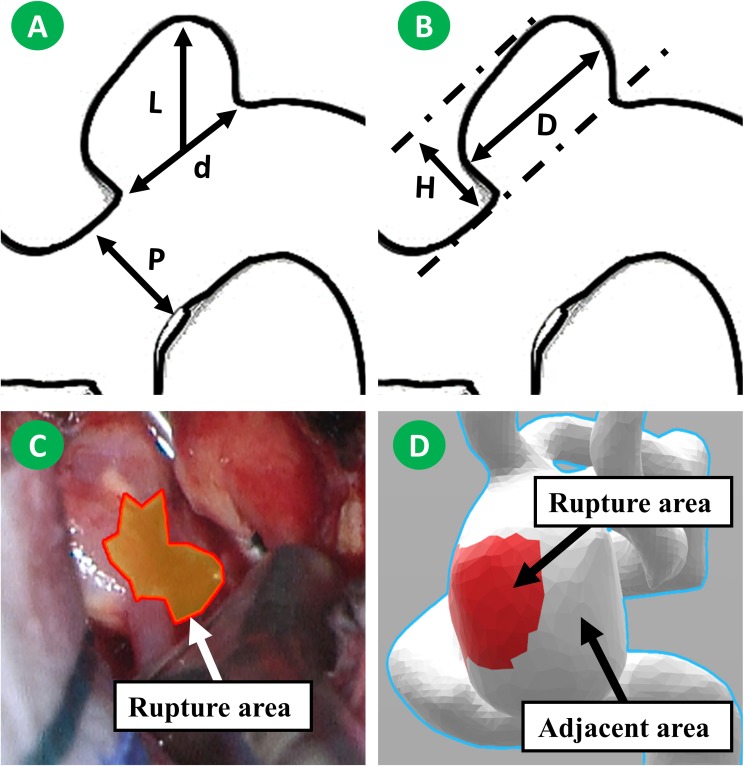
In the present study, patients admitted for unruptured IA from January 2012 to April 2018 were retrospectively reviewed. A propensity score matching was performed to match patients. The morphological features and the hemodynamic features were extracted. Differences in the morphologic and hemodynamic parameters were compared. Risk factors associated with IOR were explored. Subsequently, the hemodynamic characteristics in different rupture stages and different regions in IOR aneurysm were compared.
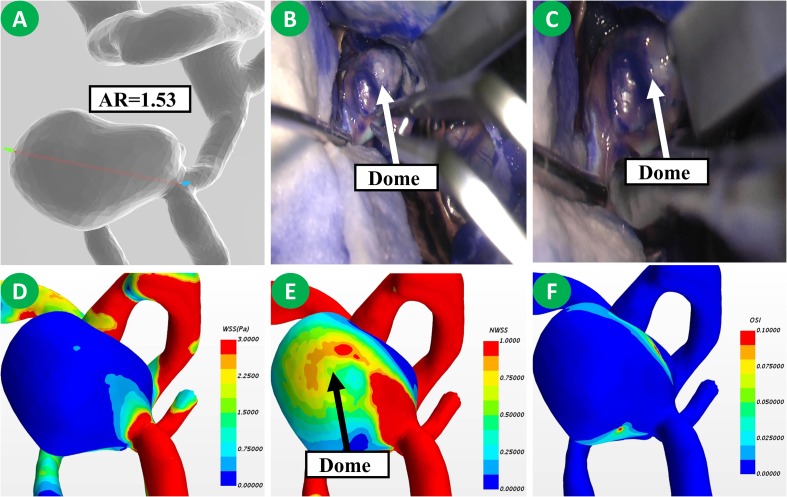
96 cases of patients with aneurysms, were found by the matching process in each group. The statistically significant difference was found in the maximum length (L) ( = 0.041), maximum diameter of body (D) ( = 0.032), aspect ratio (AR) ( < 0.001), non-sphericity index (NSI) ( < 0.001), normalized wall shear stress maximum (NWSSm) ( < 0.001) and oscillatory shear index (OSI) ( < 0.001). A regression analysis demonstrated AR (OR = 7.03, < 0.001), NWSSm (OR = 15.55, p = 0.014) and OSI (OR = 28.30, < 0.001) as the independent risk factors for IOR. AR was much larger, and NWSSm and NWSSa were much lower for IAs that ruptured in early or pre-dissection stage than those for IAs that ruptured in dissection stage or clip application stage. NWSSa and NWSSm in rupture area were both lower than those in adjacent area.
AR, NWSSm, and OSI are considered three independent risk factors for intraoperative aneurysm rupture, which could serve as predictors. A selection of intervention methods for aneurysms with high AR, low NWSSm, and high OSI should carefully be considered.
术中动脉瘤破裂(IOR)是颅内动脉瘤夹闭过程中的棘手事件,可导致预后不良。术前鉴别具有高IOR风险的动脉瘤对手术医生至关重要。本研究旨在探讨IOR的血流动力学-形态学危险因素。
回顾性分析2012年1月至2018年4月收治的未破裂颅内动脉瘤患者。进行倾向评分匹配以匹配患者。提取形态学特征和血流动力学特征。比较形态学和血流动力学参数的差异。探索与IOR相关的危险因素。随后,比较IOR动脉瘤不同破裂阶段和不同区域的血流动力学特征。
每组通过匹配过程发现96例动脉瘤患者。在最大长度(L)(P = 0.041)、瘤体最大直径(D)(P = 0.032)、纵横比(AR)(P < 0.001)、非球形指数(NSI)(P < 0.001)、归一化壁面切应力最大值(NWSSm)(P < 0.001)和振荡切应力指数(OSI)(P < 0.001)方面发现有统计学显著差异。回归分析表明AR(OR = 7.03,P < 0.001)、NWSSm(OR = 15.55,P = 0.014)和OSI(OR = 28.30,P < 0.001)是IOR的独立危险因素。与在夹层期或夹闭期破裂的颅内动脉瘤相比,在早期或夹层前期破裂的颅内动脉瘤的AR更大,而NWSSm和NWSSa更低。破裂区域的NWSSa和NWSSm均低于相邻区域。
AR、NWSSm和OSI被认为是术中动脉瘤破裂的三个独立危险因素,可作为预测指标。对于具有高AR、低NWSSm和高OSI的动脉瘤,应谨慎考虑选择干预方法。