Chalatsa Ioanna, Arvanitis Demetrios A, Koulakiotis Nikolaos Stavros, Giagini Athina, Skaltsounis Alexios Leandros, Papadopoulou-Daifoti Zeta, Tsarbopoulos Anthony, Sanoudou Despina
Clinical Genomics and Pharmacogenomics Unit, 4th Department of Internal Medicine, Medical School, National and Kapodistrian University of Athens, Athens, Greece.
Molecular Biology Division, Center for Basic Research, Biomedical Research Foundation, Academy of Athens, Athens, Greece.
Front Neurosci. 2019 Mar 26;13:249. doi: 10.3389/fnins.2019.00249. eCollection 2019.
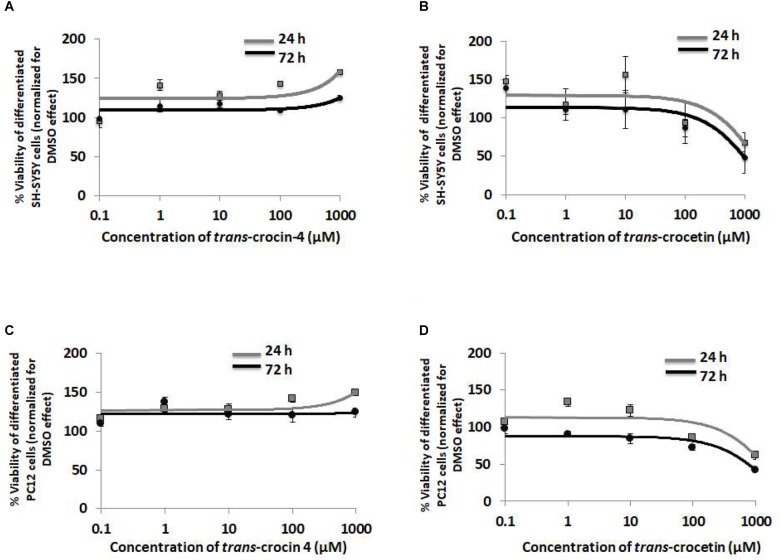
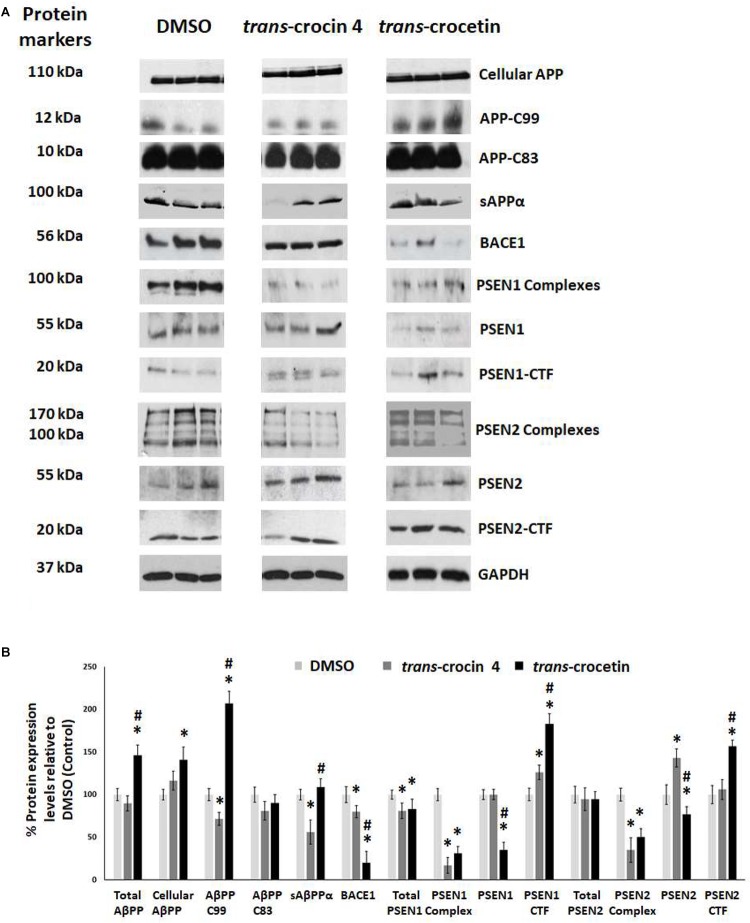
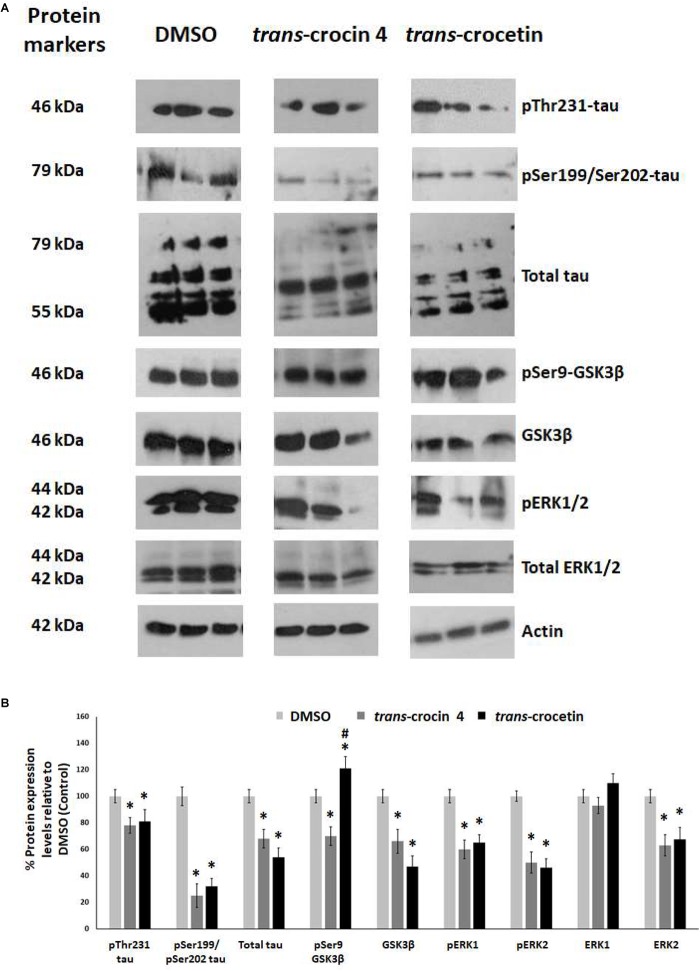
L. natural compounds have been extensively used in traditional medicine for thousands of years. Recent research evidence is now emerging in support of its therapeutic potential for different pathologies including neurodegenerative diseases. Herein, the L. natural compounds -crocin 4 and -crocetin were selected for in depth molecular characterization of their potentially protective effects against Alzheimer's Disease (AD), utilizing two AD neuronal cell culture models (SH-SY5Y overexpressing APP and PC12 expressing hyperphosphorylated tau). Biologically relevant concentrations, ranging from 0.1 μM to 1 mM, applied for 24 h or 72 h, were well tolerated by differentiated wild type SH-SY5Y and PC12 cells. When tested on neuronally differentiated SH-SY5Y-APP both -crocin 4 and -crocetin had significant effects against amyloidogenic pathways. -crocin 4 significantly decreased of β-secretase, a key enzyme of the amyloidogenic pathway, and APP-C99, while it decreased γ-secretases that generate toxic beta-amyloid peptides. Similarly, -crocetin treatment led to a reduction in β- and γ-secretases, as well as to accumulation of cellular AβPP. When tested on the neuronally differentiated PC12-htau cells, both compounds proved effective in suppressing the active forms of GSK3β and ERK1/2 kinases, as well as significantly reducing total tau and tau phosphorylation. Collectively, our data demonstrate a potent effect of -crocin 4 and -crocetin in suppressing key molecular pathways of AD pathogenesis, rendering them a promising tool in the prevention and potentially the treatment of AD.
天然化合物在传统医学中已被广泛使用了数千年。最近的研究证据表明,其对包括神经退行性疾病在内的不同病理具有治疗潜力。在此,我们选择了天然化合物藏红花素4和藏红花酸,利用两种阿尔茨海默病(AD)神经元细胞培养模型(过表达APP的SH-SY5Y细胞和表达高度磷酸化tau的PC12细胞),对它们针对AD的潜在保护作用进行深入的分子表征。分化的野生型SH-SY5Y细胞和PC12细胞对0.1 μM至1 mM范围内的生物相关浓度、作用24小时或72小时具有良好的耐受性。当在神经元分化的SH-SY5Y-APP细胞上进行测试时,藏红花素4和藏红花酸对淀粉样蛋白生成途径均有显著影响。藏红花素4显著降低了淀粉样蛋白生成途径的关键酶β-分泌酶和APP-C99,同时降低了产生有毒β-淀粉样肽的γ-分泌酶。同样,藏红花酸处理导致β-和γ-分泌酶减少,以及细胞AβPP的积累。当在神经元分化的PC12-htau细胞上进行测试时,这两种化合物均被证明可有效抑制GSK3β和ERK1/2激酶的活性形式,并显著降低总tau蛋白和tau蛋白磷酸化水平。总体而言,我们的数据表明藏红花素4和藏红花酸在抑制AD发病机制的关键分子途径方面具有强大作用,使其成为预防和潜在治疗AD的有前途的工具。