Soylu Esra, Ozturk Kerem, Gokalp Gokhan, Topal Ugur
Radiology Clinic, Cekirge State Hospital, Bursa, TR.
Department of Radiology, Uludag University Faculty of Medicine, Bursa, TR.
J Belg Soc Radiol. 2019 Apr 4;103(1):21. doi: 10.5334/jbsr.1591.
Bleeding in the biopsy tract has been studied for its ability to decrease the risk of pneumothorax with indefinite results in the previous studies.
To investigate the risk factors for needle-tract bleeding (NTB) and the possible effect of NTB on the pneumothorax and resultant chest tube placement after CT-guided cutting needle biopsy (CT-CNB) of pulmonary lesions.
Predictive variables for NTB and the effect of NTB on the development of pneumothorax and consequent chest tube placement were retrospectively determined in 416 patients who had undergone an 18-gauge non-coaxial CT-CNB (338 men and 78 women; average age, 59.3 years). Patient-related parameters were age, gender, patient position, and severity of pulmonary emphysema. Lesion-related variables were size, localization, and contour characteristics of the lesion. Procedure-related variables were the presence of atelectasis, pleural tag, and fissure in the needle-tract, length of the aerated lung parenchyma crossed by needle, needle entry angle, number of pleural punctures, the experience of the operator, and procedure duration. All variables were analyzed by x test and logistic regression analysis.
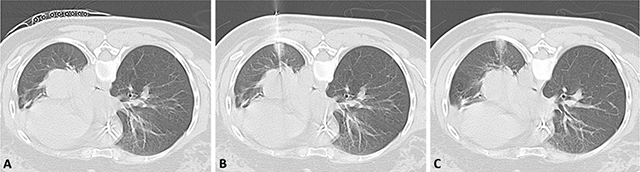
NTB was demonstrated in 142 of 421 (33.7%) procedures. The predictive variables of NTB were smaller lesion size (p = 0.011) and greater lesion depth (p = 0.002). In patients without emphysema around the lesion, the pneumothorax developed in 44/190 cases (23.1%) without NTB and in 12/95 procedures (12.6%) with NTB (p < 0.001).
NTB may have a preventive effect on pneumothorax development, particularly in the absence of emphysema around the lesion.
活检通道出血已被研究,因其具有降低气胸风险的能力,但先前研究结果并不确定。
探讨CT引导下肺病变切割针活检(CT-CNB)后针道出血(NTB)的危险因素以及NTB对气胸和后续放置胸管的可能影响。
回顾性分析416例行18G非同轴CT-CNB的患者(男性338例,女性78例;平均年龄59.3岁),确定NTB的预测变量以及NTB对气胸发生和后续胸管放置的影响。患者相关参数包括年龄、性别、患者体位和肺气肿严重程度。病变相关变量包括病变大小、位置和轮廓特征。操作相关变量包括针道内肺不张、胸膜粘连和肺裂的存在、针穿过的含气肺实质长度、进针角度、胸膜穿刺次数、操作者经验和操作时间。所有变量均通过x检验和逻辑回归分析。
421例操作中有142例(33.7%)出现NTB。NTB的预测变量为病变较小(p = 0.011)和病变深度较大(p = 0.002)。在病变周围无肺气肿的患者中,无NTB的190例中有44例(23.1%)发生气胸,有NTB的95例中有12例(12.6%)发生气胸(p < 0.001)。
NTB可能对气胸的发生有预防作用,尤其是在病变周围无肺气肿的情况下。