Wang Xiu, Yu Zhihuai, Bian Huiyang, Wu Weibing, Xiao Huining, Dai Hongqi
Jiangsu Co-Innovation Center of Efficient Processing and Utilization of Forest Resources, Nanjing Forestry University, Nanjing 210037, China.
Department of Chemical Engineering, University of New Brunswick, Fredericton, NB E3B5A3, Canada.
Polymers (Basel). 2019 Apr 10;11(4):660. doi: 10.3390/polym11040660.
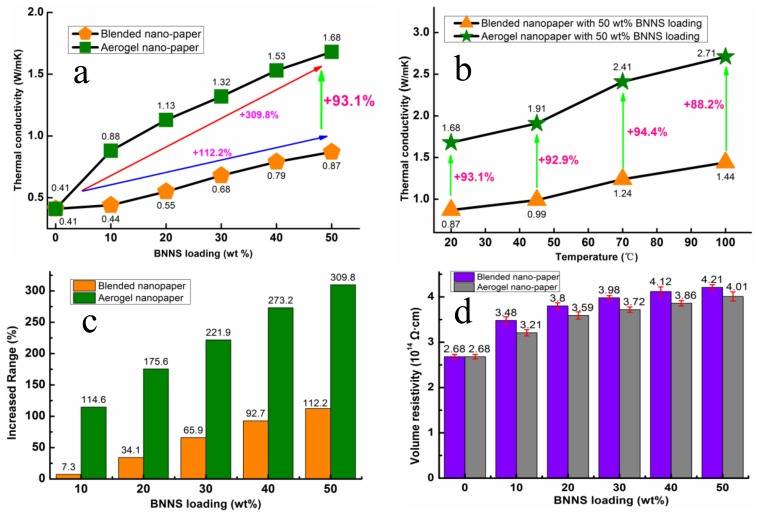
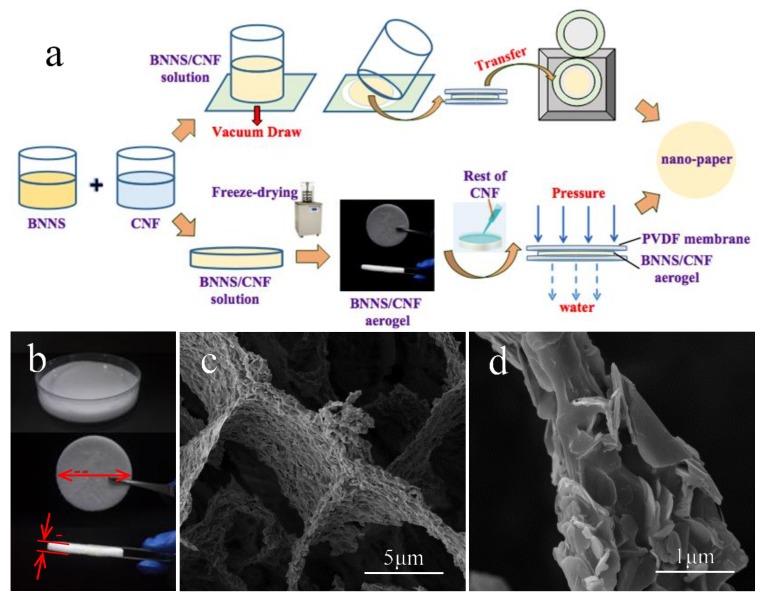
Adding heat conducting particles to a polymer matrix to prepare thermally conductive and electrical insulation materials is an effective approach to address the safety issues arising from the accumulation of heat in the working process of electronic devices. In this work, thermally conductive and electrical insulation nano-paper, consisting of Boron Nitride nano-sheet (BNNS) and cellulose nanofiber (CNF), was prepared using an aerogel 3D skeleton template method. For comparison, BNNS/CNF nano-paper was also produced using a simple blending method. At a BNNS loading of 50 wt%, the thermal conductivity of BNNS/CNF aerogel nano-paper and blended nano-paper at 70 °C are 2.4 W/mK and 1.2 W/mK respectively, revealing an increase of 94.4%. Under similar conditions, the volume resistivity of BNNS/CNF aerogel nano-paper and blended nano-paper are 4.0 × 10 and 4.2 × 10 Ω·cm respectively. In view of its excellent thermal conductivity and electrical insulation performance, therefore, BNNS/CNF aerogel nano-paper holds great potential for electronic-related applications.
在聚合物基体中添加导热颗粒以制备导热且电绝缘的材料,是解决电子设备工作过程中因热量积累而产生的安全问题的有效方法。在这项工作中,采用气凝胶三维骨架模板法制备了由氮化硼纳米片(BNNS)和纤维素纳米纤维(CNF)组成的导热且电绝缘的纳米纸。为作比较,还采用简单共混法制备了BNNS/CNF纳米纸。在BNNS负载量为50 wt%时,BNNS/CNF气凝胶纳米纸和共混纳米纸在70℃时的热导率分别为2.4 W/mK和1.2 W/mK,提高了94.4%。在类似条件下,BNNS/CNF气凝胶纳米纸和共混纳米纸的体积电阻率分别为4.0×10和4.2×10Ω·cm。因此,鉴于其优异的导热性和电绝缘性能,BNNS/CNF气凝胶纳米纸在电子相关应用方面具有巨大潜力。