Natural Resources Institute Finland (Luke), 31600, Jokioinen, Finland.
Chair of Animal Breeding, Technische Universität München, 85354, Freising-Weihenstephan, Germany.
BMC Genomics. 2019 Apr 11;20(1):286. doi: 10.1186/s12864-019-5628-y.
Cattle populations are highly amenable to the genetic mapping of male reproductive traits because longitudinal data on ejaculate quality and dense microarray-derived genotypes are available for thousands of artificial insemination bulls. Two young Nordic Red bulls delivered sperm with low progressive motility (i.e., asthenospermia) during a semen collection period of more than four months. The bulls were related through a common ancestor on both their paternal and maternal ancestry. Thus, a recessive mode of inheritance of asthenospermia was suspected.
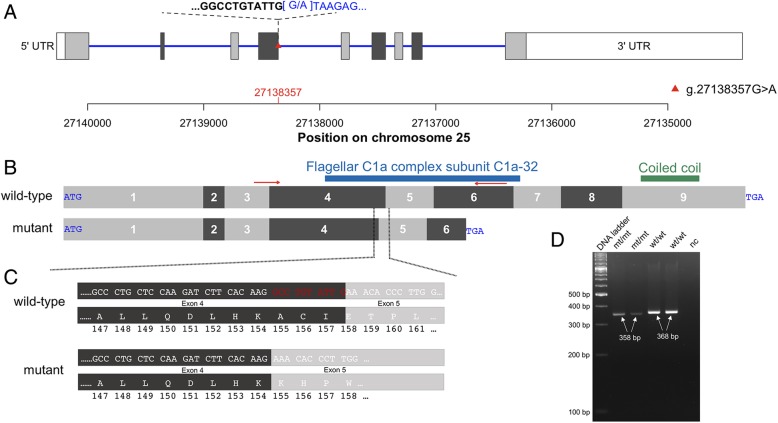
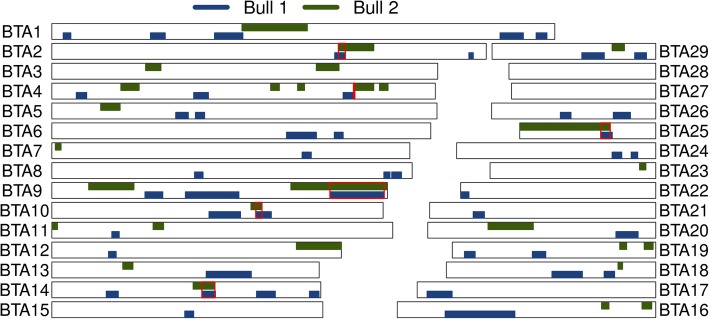
Both bulls were genotyped at 54,001 SNPs using the Illumina BovineSNP50 Bead chip. A scan for autozygosity revealed that they were identical by descent for a 2.98 Mb segment located on bovine chromosome 25. This haplotype was not found in the homozygous state in 8557 fertile bulls although five homozygous haplotype carriers were expected (P = 0.018). Whole genome-sequencing uncovered that both asthenospermic bulls were homozygous for a mutation that disrupts a canonical 5' splice donor site of CCDC189 encoding the coiled-coil domain containing protein 189. Transcription analysis showed that the derived allele activates a cryptic splice site resulting in a frameshift and premature termination of translation. The mutated CCDC189 protein is truncated by more than 40%, thus lacking the flagellar C1a complex subunit C1a-32 that is supposed to modulate the physiological movement of the sperm flagella. The mutant allele occurs at a frequency of 2.5% in Nordic Red cattle.
Our study in cattle uncovered that CCDC189 is required for physiological movement of sperm flagella thus enabling active progression of spermatozoa and fertilization. A direct gene test may be implemented to monitor the asthenospermia-associated allele and prevent the birth of homozygous bulls that are infertile. Our results have been integrated in the Online Mendelian Inheritance in Animals (OMIA) database ( https://omia.org/OMIA002167/9913/ ).
牛群非常适合进行雄性生殖性状的基因图谱绘制,因为可以获得数千头人工授精公牛的精液质量和密集的微阵列衍生基因型的纵向数据。两头年轻的北欧红牛在四个多月的精液采集期间精子的前向运动能力(即弱精症)较低。这两头公牛在其父系和母系血统上都有一个共同的祖先,因此怀疑弱精症是隐性遗传模式。
使用 Illumina BovineSNP50 Bead 芯片对两头公牛进行了 54001 个 SNP 的基因分型。对自交性的扫描显示,它们在位于牛 25 号染色体上的 2.98Mb 片段上是同系物。尽管预计有五个纯合子携带者,但在 8557 头可育公牛中没有发现这种纯合子状态(P = 0.018)。全基因组测序发现,两头弱精症公牛都纯合了一个突变,该突变破坏了编码卷曲螺旋域包含蛋白 189 的 CCDC189 的典型 5' 剪接供体位点。转录分析表明,衍生等位基因激活了一个隐蔽的剪接位点,导致移码和翻译提前终止。突变的 CCDC189 蛋白截短超过 40%,因此缺乏纤毛 C1a 复合物亚基 C1a-32,该亚基 supposed 调节精子鞭毛的生理运动。突变等位基因在北欧红牛中的频率为 2.5%。
我们在牛中的研究表明,CCDC189 对于精子鞭毛的生理运动是必需的,从而使精子能够主动前进并受精。可以实施直接基因测试来监测与弱精症相关的等位基因,并防止不育的纯合公牛出生。我们的研究结果已被整合到在线孟德尔遗传在动物(OMIA)数据库中(https://omia.org/OMIA002167/9913/)。