Laboratório de Pesquisa Clínica em Medicina Intensiva, Instituto Nacional de Infectologia Evandro Chagas (INI), Fundação Oswaldo Cruz (FIOCRUZ), Rio de Janeiro, Brazil.
Laboratório de HIV, Instituto de Nacional de Infectologia Evandro Chagas (INI), Fundação Oswaldo Cruz (FIOCRUZ), Rio de Janeiro, Brazil.
BMC Infect Dis. 2019 Apr 11;19(1):319. doi: 10.1186/s12879-019-3894-6.
The identification and management of cardiovascular risk factors became a major clinical issue among HIV-infected individuals in the post-cART era. As in the past decades the link between acute infections and cardiovascular diseases became clear in the general population, we sorted to investigate the role of severe infections on incident cardiovascular diseases (CVDs) among HIV-infected individuals.
HIV-infected individuals aged ≥18 years, with no history of CVD were followed from January 2000 to December 2013 until the occurrence of the first CVD event, death or end of study, whichever occurred first. To explore the effect of severe infections on the incidence of CVD we used extended Cox regression models and stratified post-hospitalization follow-up time into three periods: < 3 months, 3-12 months and > 12 months post discharge.
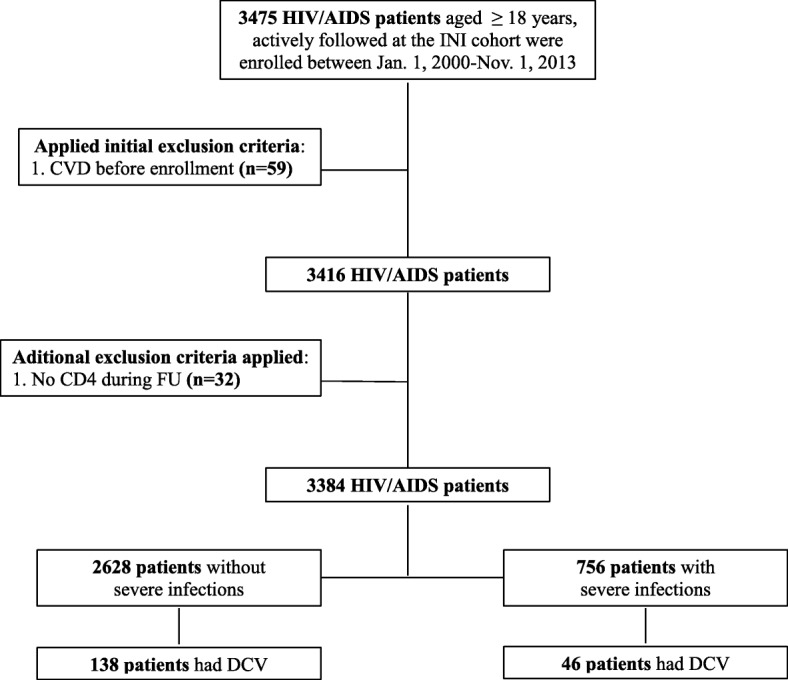
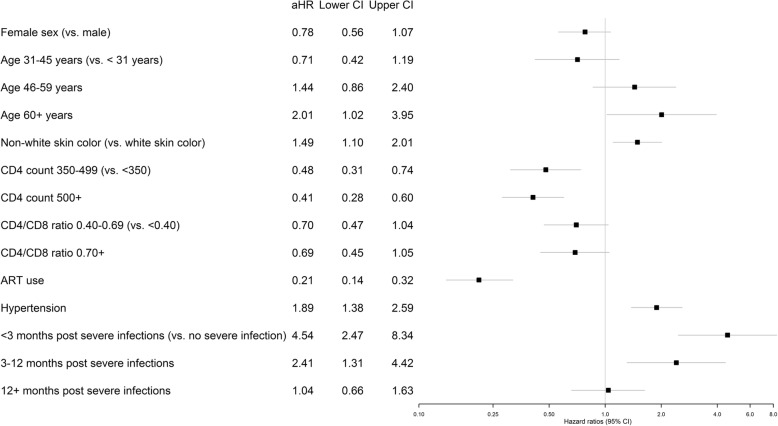
One hundred-eighty four persons from 3384 HIV-infected individuals developed incident CVD events during the follow-up (incidence rate = 11.10/1000 PY (95%CI: 9.60-12.82)). Risk of an incident CVD was 4-fold higher at < 3 months post-hospitalization for severe infections (adjusted hazard ratio [aHR], 4.52; 95% confidence interval [CI] 2.46-8.30), after adjusting for sociodemographic and clinical factors as well as comorbidities. This risk remained significant up to one year (3-12 months post hospital discharge aHR 2.39, 95% CI 1.30-4.38). Additionally, non-white race/ethnicity (aHR 1.49, 95% CI 1.10-2.02), age ≥ 60 years (aHR 2.01, 95% CI 1.01-3.97) and hypertension (aHR 1.90, 95% CI 1.38-2.60) were associated with an increased risk of CVD events. High CD4 (≥ 500 cells/mm: aHR 0.41, 95% CI 0.27-0.62) and cART use (aHR 0.21, 95% CI 0.14-0.31) reduced the risk of CVD events.
We provide evidence for a time-dependent association between severe infection and incident cardiovascular disease in HIV-infected individuals. cART use, and high CD4 count were significantly associated with reduced hazards of CVD.
在 cART 时代,艾滋病毒感染者的心血管危险因素的识别和管理成为一个主要的临床问题。正如过去几十年中在普通人群中清楚表明的那样,急性感染与心血管疾病之间存在联系,因此我们着手研究严重感染在艾滋病毒感染者中发生心血管疾病(CVD)的作用。
我们对 2000 年 1 月至 2013 年 12 月期间年龄≥18 岁、无 CVD 病史的艾滋病毒感染者进行了随访,直至首次发生 CVD 事件、死亡或研究结束,以先发生者为准。为了探讨严重感染对 CVD 发病率的影响,我们使用了扩展的 Cox 回归模型,并将住院后随访时间分为三个时期:<3 个月、3-12 个月和>12 个月。
在随访期间,3384 名艾滋病毒感染者中有 184 人发生了 CVD 事件(发病率为 11.10/1000 人年(95%CI:9.60-12.82))。严重感染后住院<3 个月的 CVD 事件风险增加 4 倍(调整后的危险比 [aHR],4.52;95%置信区间 [CI],2.46-8.30),调整了社会人口统计学和临床因素以及合并症后仍然显著。这种风险持续到一年(3-12 个月后出院 aHR 2.39,95%CI 1.30-4.38)。此外,非白种人种族/民族(aHR 1.49,95%CI 1.10-2.02)、年龄≥60 岁(aHR 2.01,95%CI 1.01-3.97)和高血压(aHR 1.90,95%CI 1.38-2.60)与 CVD 事件风险增加相关。高 CD4(≥500 个细胞/mm:aHR 0.41,95%CI 0.27-0.62)和 cART 使用(aHR 0.21,95%CI 0.14-0.31)降低了 CVD 事件的风险。
我们提供了艾滋病毒感染者严重感染与心血管疾病事件之间存在时间依赖性关联的证据。cART 的使用和高 CD4 计数与 CVD 风险的降低显著相关。