Gao Dong, Hao Xiaoyu, Rowell Nelson, Kreouzis Theo, Lockwood David J, Han Shuo, Fan Hongsong, Zhang Hai, Zhang Chunchun, Jiang Yingnan, Zeng Jianrong, Zhang Meng, Yu Kui
Institute of Atomic and Molecular Physics, Sichuan University, 610065, Chengdu, P. R. China.
Metrology Research Centre, National Research Council of Canada, Ottawa, ON, K1A 0R6, Canada.
Nat Commun. 2019 Apr 11;10(1):1674. doi: 10.1038/s41467-019-09705-w.
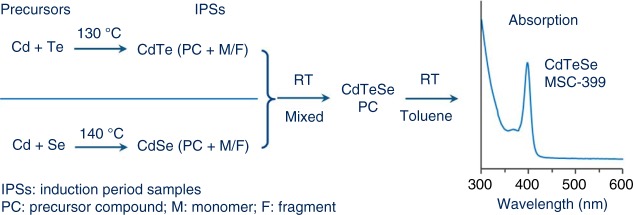
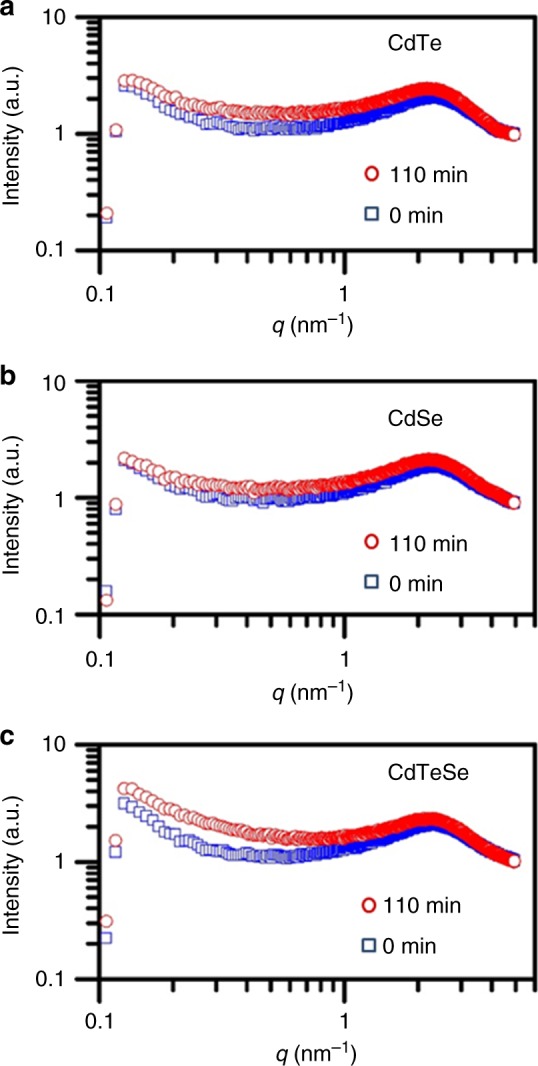
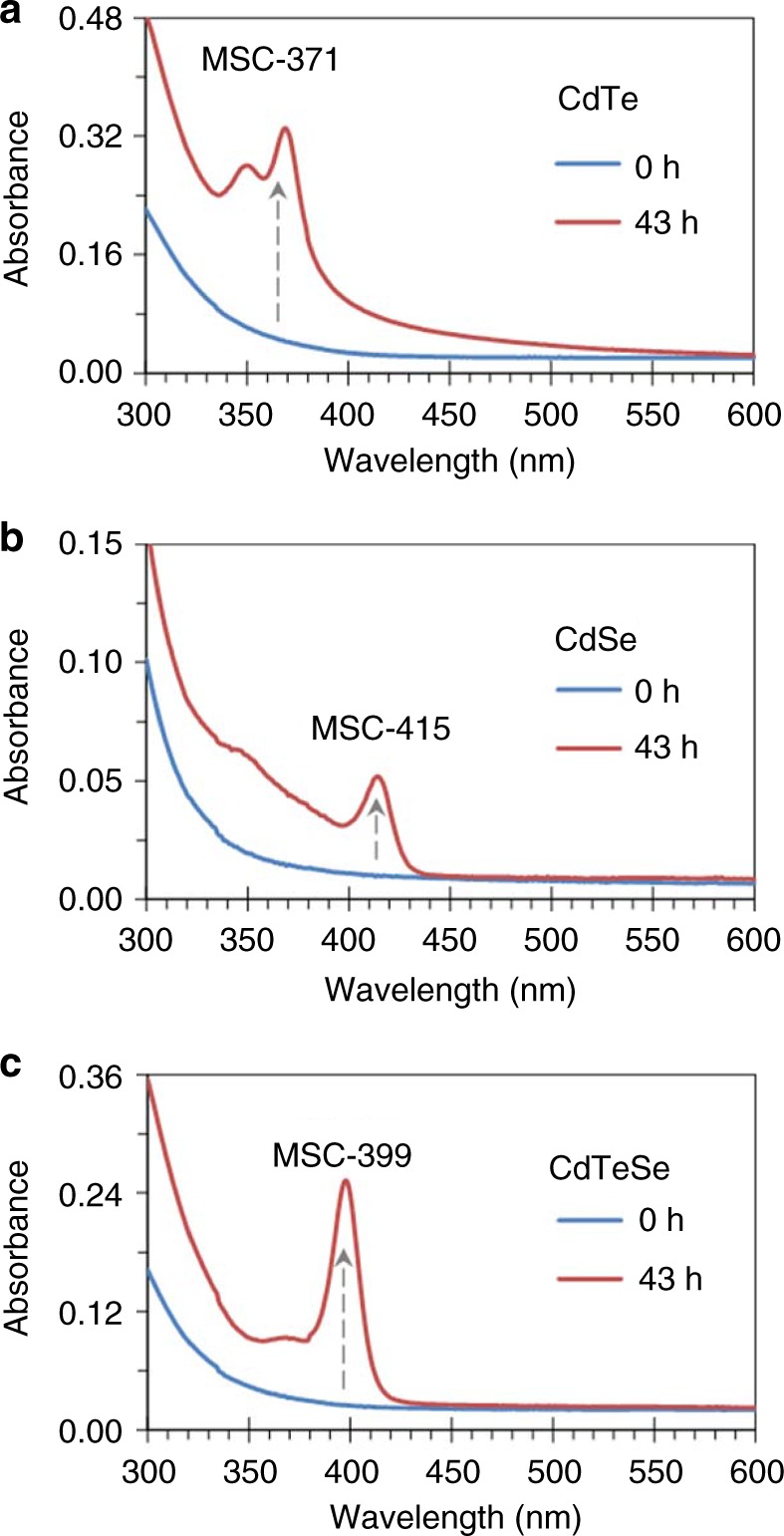
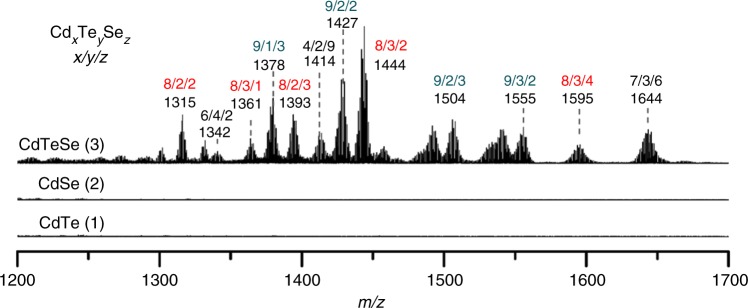
Alloy semiconductor magic-size clusters (MSCs) have received scant attention and little is known about their formation pathway. Here, we report the synthesis of alloy CdTeSe MSC-399 (exhibiting sharp absorption peaking at 399 nm) at room temperature, together with an explanation of its formation pathway. The evolution of MSC-399 at room temperature is detected when two prenucleation-stage samples of binary CdTe and CdSe are mixed, which are transparent in optical absorption. For a reaction consisting of Cd, Te, and Se precursors, no MSC-399 is observed. Synchrotron-based in-situ small angle X-ray scattering (SAXS) suggests that the sizes of the two samples and their mixture are similar. We argue that substitution reactions take place after the two binary samples are mixed, which result in the formation of MSC-399 from its precursor compound (PC-399). The present study provides a room-temperature avenue to engineering alloy MSCs and an in-depth understanding of their probable formation pathway.
合金半导体魔尺寸团簇(MSCs)很少受到关注,人们对其形成途径知之甚少。在此,我们报告了室温下合金CdTeSe MSC-399(在399nm处呈现尖锐吸收峰)的合成及其形成途径的解释。当二元CdTe和CdSe的两个成核前阶段样品混合时,检测到室温下MSC-399的演变,这两个样品在光吸收方面是透明的。对于由Cd、Te和Se前驱体组成的反应,未观察到MSC-399。基于同步加速器的原位小角X射线散射(SAXS)表明,两个样品及其混合物的尺寸相似。我们认为,两个二元样品混合后发生取代反应,从而由其前驱体化合物(PC-399)形成MSC-399。本研究为工程合金MSCs提供了一条室温途径,并深入了解了它们可能的形成途径。