Division of Malaria Research, Proteo-Science Center, Ehime University, 3 Bunkyo-cho, Matsuyama, Ehime, 790-8577, Japan.
Division of Medical Zoology, Department of Microbiology and Immunology, Faculty of Medicine, Tottori University, 86 Nishi-cho, Yonago, Tottori, 683-8503, Japan.
Sci Rep. 2019 Apr 11;9(1):5923. doi: 10.1038/s41598-019-42366-9.
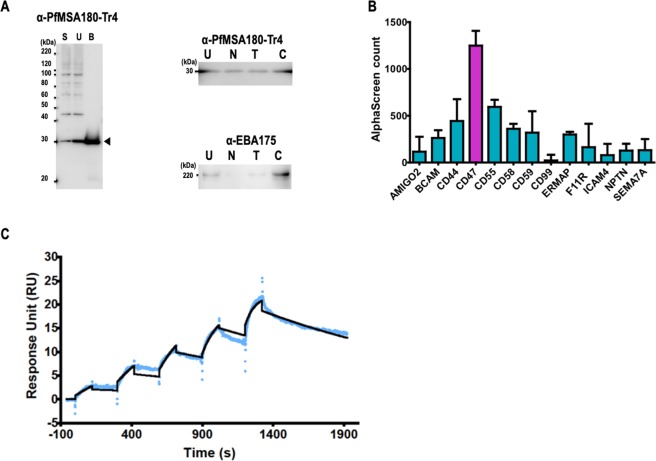
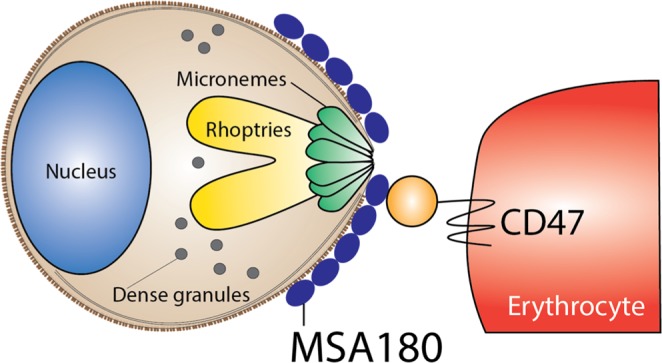
Malaria symptoms and pathology are initiated by invasion of host erythrocytes by Plasmodium merozoites in a complex process that involves interactions between parasite and host erythrocyte proteins. Erythrocyte invasion presents attractive targets for malaria vaccine and drug development. Recently it was observed that antibodies against PfMSA180 (PF3D7_1014100) are associated with protection from symptomatic malaria, suggesting that this protein is a target of naturally acquired protective antibodies. Here we characterize PfMSA180, a ~170 kDa merozoite surface antigen that is potentially involved in erythrocyte invasion. PfMSA180 synthesized by the wheat germ cell-free system was used to raise antibodies in rabbits. Growth inhibition assays revealed that parasite invasion is inhibited by antibodies to the PfMSA180 C-terminal region, which contains an erythrocyte-binding domain. Surface plasmon resonance analysis showed that PfMSA180 specifically interacts with human erythrocyte integrin associated protein (CD47), suggesting that PfMSA180 plays a role during merozoite invasion of erythrocytes. Polymorphism analysis revealed that pfmsa180 is highly conserved among field isolates. We show that naturally acquired PfMSA180-specific antibodies responses are associated with protective immunity in a malaria-exposed Thai population. In sum, the data presented here supports further evaluation of the conserved erythrocyte-binding C-terminal region of PfMSA180 as an asexual blood-stage malaria vaccine candidate.
疟疾的症状和病理是由疟原虫裂殖子入侵宿主红细胞引起的,这是一个涉及寄生虫和宿主红细胞蛋白相互作用的复杂过程。红细胞入侵为疟疾疫苗和药物开发提供了有吸引力的靶点。最近观察到,针对 PfMSA180(PF3D7_1014100)的抗体与免受症状性疟疾有关,这表明该蛋白是天然获得的保护性抗体的靶标。在这里,我们描述了 PfMSA180,一种~170kDa 的裂殖子表面抗原,它可能参与红细胞入侵。使用小麦胚无细胞系统合成的 PfMSA180 来在兔子中产生抗体。生长抑制试验表明,针对 PfMSA180 C 端区域的抗体可抑制寄生虫入侵,该区域包含一个红细胞结合域。表面等离子体共振分析表明 PfMSA180 特异性地与人类红细胞整合素相关蛋白(CD47)相互作用,这表明 PfMSA180 在裂殖子入侵红细胞过程中发挥作用。多态性分析表明,pfmsa180 在野外分离株中高度保守。我们表明,在疟疾暴露的泰国人群中,天然获得的 PfMSA180 特异性抗体反应与保护性免疫有关。总之,这里提出的数据支持进一步评估 PfMSA180 的保守红细胞结合 C 端区域作为无性血阶段疟疾疫苗候选物。