Bio-information College, ChongQing University of Posts and Telecommunications, ChongQing, 400065, China.
Sci Rep. 2019 Apr 11;9(1):5927. doi: 10.1038/s41598-019-42361-0.
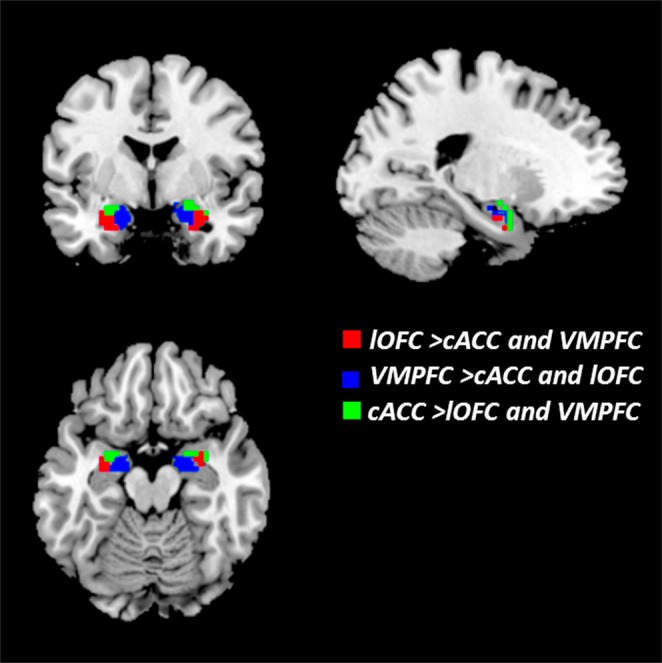
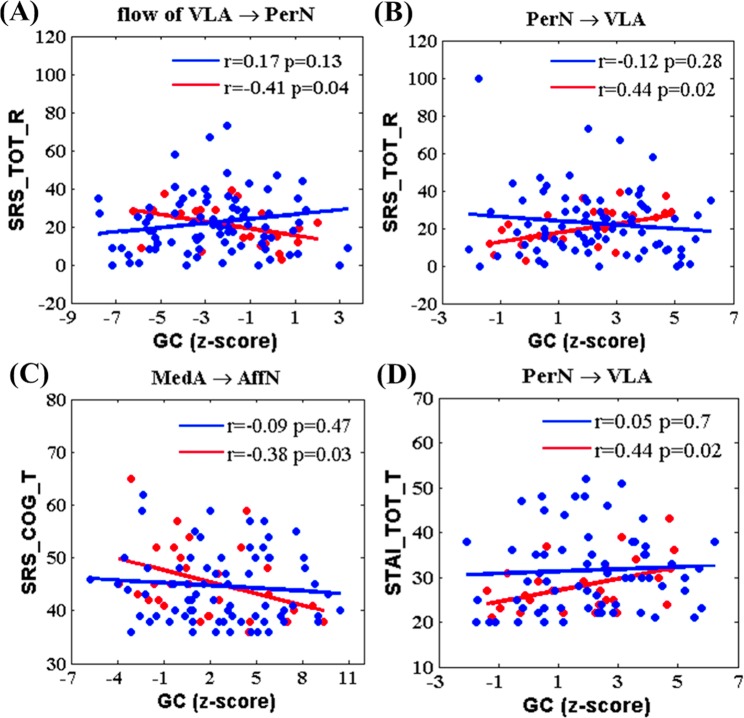
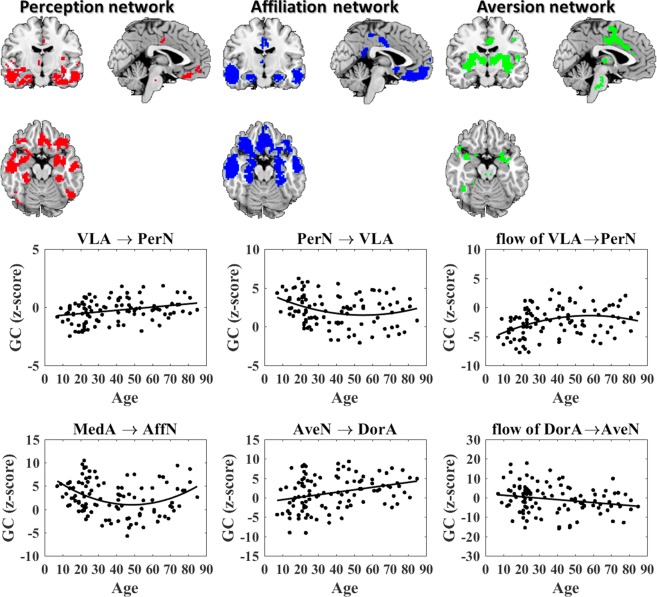
There is growing evidence that the amygdala serves as the base for dealing with complex human social communication and emotion. Although amygdalar networks plays a central role in these functions, causality connectivity during the human lifespan between amygdalar subregions and their corresponding perception network (PerN), affiliation network (AffN) and aversion network (AveN) remain largely unclear. Granger causal analysis (GCA), an approach to assess directed functional interactions from time series data, was utilized to investigated effective connectivity between amygdalar subregions and their related networks as a function of age to reveal the maturation and degradation of neural circuits during development and ageing in the present study. For each human resting functional magnetic resonance imaging (fMRI) dataset, the amygdala was divided into three subareas, namely ventrolateral amygdala (VLA), medial amygdala (MedA) and dorsal amygdala (DorA), by using resting-state functional connectivity, from which the corresponding networks (PerN, AffN and AveN) were extracted. Subsequently, the GC interaction of the three amygdalar subregions and their associated networks during life were explored with a generalised linear model (GLM). We found that three causality flows significantly varied with age: the GC of VLA → PerN showed an inverted U-shaped trend with ageing; the GC of MedA→ AffN had a U-shaped trend with ageing; and the GC of DorA→ AveN decreased with ageing. Moreover, during ageing, the above GCs were significantly correlated with Social Responsiveness Scale (SRS) and State-Trait Anxiety Inventory (STAI) scores. In short, PerN, AffN and AveN associated with the amygdalar subregions separately presented different causality connectivity changes with ageing. These findings provide a strong constituent framework for normal and neurological diseases associated with social disorders to analyse the neural basis of social behaviour during life.
越来越多的证据表明,杏仁核是处理复杂人类社会交流和情感的基础。尽管杏仁核网络在这些功能中起着核心作用,但在人类生命过程中,杏仁核亚区与其相应的感知网络(PerN)、关联网络(AffN)和厌恶网络(AveN)之间的因果连通性在很大程度上仍不清楚。格兰杰因果分析(GCA)是一种从时间序列数据评估有向功能相互作用的方法,本研究利用该方法研究了杏仁核亚区与其相关网络之间的有效连接作为年龄的函数,以揭示神经回路在发育和衰老过程中的成熟和退化。对于每个人类静息功能磁共振成像(fMRI)数据集,通过静息状态功能连接将杏仁核分为三个亚区,即腹外侧杏仁核(VLA)、内侧杏仁核(MedA)和背侧杏仁核(DorA),并从这些亚区中提取相应的网络(PerN、AffN 和 AveN)。随后,使用广义线性模型(GLM)探讨了三个杏仁核亚区及其相关网络在生命过程中的 GC 相互作用。我们发现三种因果流随年龄显著变化:VLA→PerN 的 GC 随年龄呈倒 U 形趋势;MedA→AffN 的 GC 随年龄呈 U 形趋势;而 DorA→AveN 的 GC 随年龄下降。此外,在衰老过程中,上述 GC 与社会反应量表(SRS)和状态-特质焦虑量表(STAI)评分显著相关。总之,与杏仁核亚区分别相关的 PerN、AffN 和 AveN 随年龄呈现出不同的因果连通性变化。这些发现为分析生命过程中的社会行为的神经基础提供了一个强大的组成框架,用于分析与社会障碍相关的正常和神经疾病。