Albassam Ahmed A, Frye Reginald F
Department of Clinical Pharmacy, College of Pharmacy, Prince Sattam Bin Abdulaziz University, Al-Kharj, Saudi Arabia.
Department of Pharmacotherapy and Translational Research, College of Pharmacy, University of Florida, Gainesville, FL, USA.
Saudi Pharm J. 2019 Mar;27(3):406-412. doi: 10.1016/j.jsps.2019.01.001. Epub 2019 Jan 7.
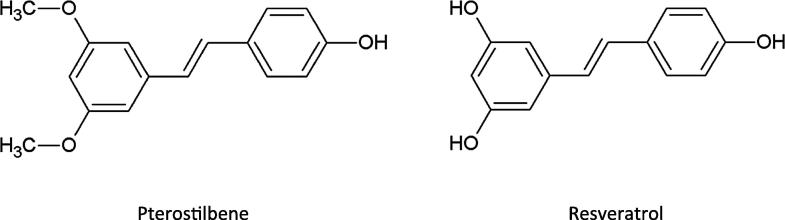
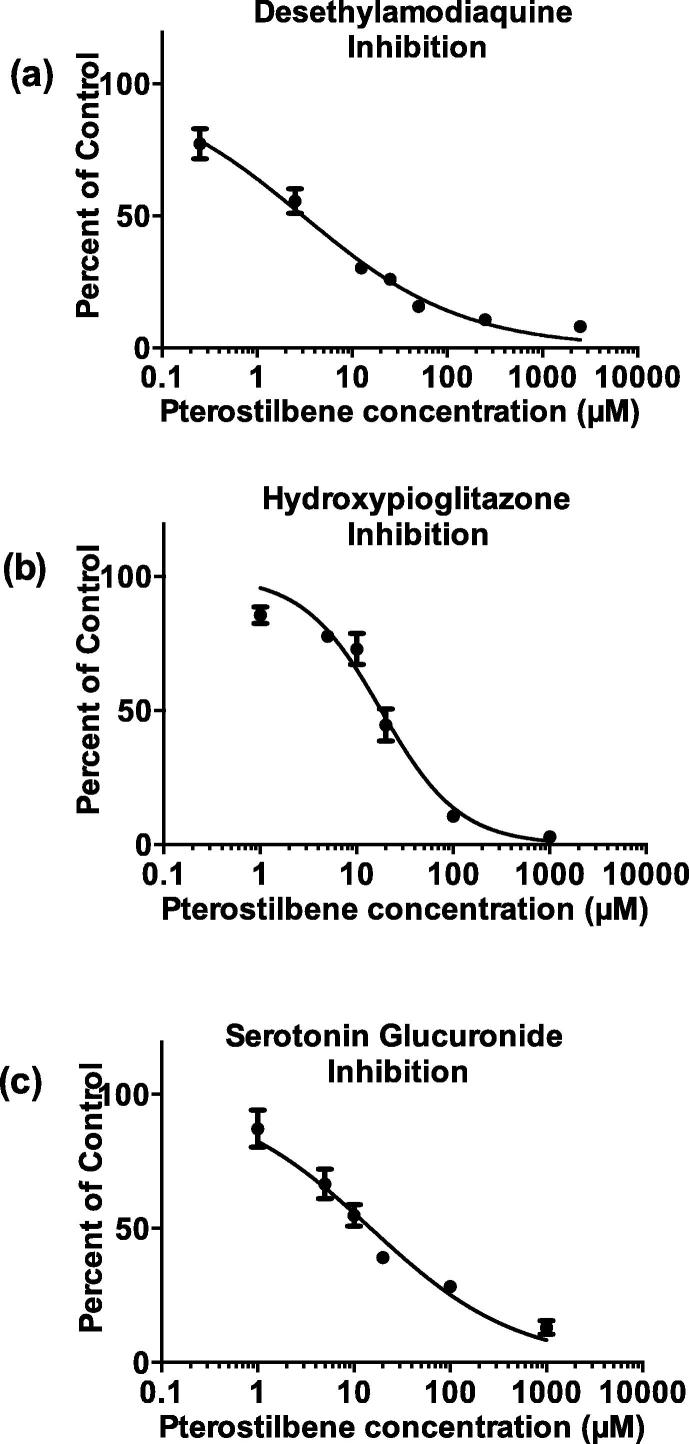
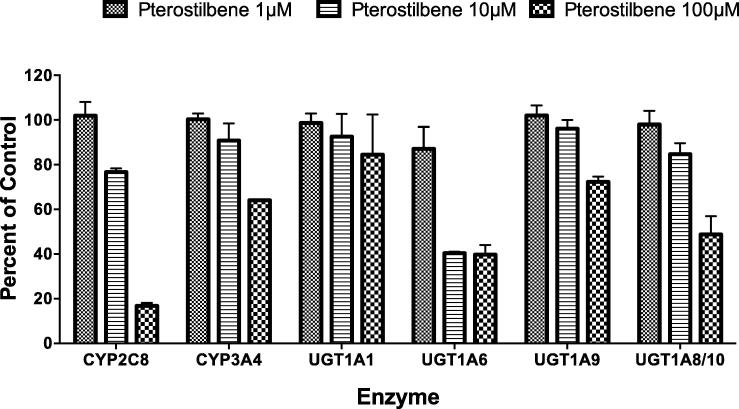
Pterostilbene is a natural polyphenol compound found in small berries that is related to resveratrol, but has better bioavailability and a longer half-life. The purpose of this study was to assess the potential inhibitory effect of pterostilbene on drug metabolism. The effect of pterostilbene on cytochrome P450 (CYP) and UDP-glucuronosyltransferase (UGT) enzyme activities were studied using the enzyme-selective substrates amodiaquine (CYP2C8), midazolam (CYP3A4), estradiol (UGT1A1), serotonin (UGT1A6) and mycophenolic acid (UGT1A8/9/10). The IC value was used to express the strength of inhibition. Further, a volume per dose index (VDI) was used to estimate the potential for interactions. Pterostilbene significantly inhibited CYP2C8 and UGT1A6 activities. The IC50 (mean ± SE) values for CYP2C8 and UGT1A6 inhibition were 3.0 ± 0.4 µM and 15.1 ± 2.8 µM, respectively; the VDI exceeded the predefined threshold of 5 L/dose for both CYP2C8 and UGT1A6, suggesting a potential for interaction . Pterostilbene did not inhibit the metabolism of the other enzyme-selective substrates. The results of this study indicate that pterostilbene inhibits CYP2C8 and UTG1A6 activity and may inhibit metabolism by these enzymes . Clinical studies are warranted to evaluate the relevance of these interactions.
紫檀芪是一种存在于小浆果中的天然多酚化合物,与白藜芦醇有关,但具有更好的生物利用度和更长的半衰期。本研究的目的是评估紫檀芪对药物代谢的潜在抑制作用。使用酶选择性底物氨酚喹(CYP2C8)、咪达唑仑(CYP3A4)、雌二醇(UGT1A1)、血清素(UGT1A6)和霉酚酸(UGT1A8/9/10)研究了紫檀芪对细胞色素P450(CYP)和尿苷二磷酸葡萄糖醛酸基转移酶(UGT)酶活性的影响。IC值用于表示抑制强度。此外,使用每剂量体积指数(VDI)来估计相互作用的可能性。紫檀芪显著抑制CYP2C8和UGT1A6活性。CYP2C8和UGT1A6抑制的IC50(平均值±标准误)值分别为3.0±0.4µM和15.1±2.8µM;CYP2C8和UGT1A6的VDI均超过了预先定义的5 L/剂量阈值,表明存在相互作用的可能性。紫檀芪未抑制其他酶选择性底物的代谢。本研究结果表明,紫檀芪抑制CYP2C8和UTG1A6活性,并可能抑制这些酶的代谢。有必要进行临床研究以评估这些相互作用的相关性。