Muro Ryunosuke, Takayanagi Hiroshi, Nitta Takeshi
Department of Immunology, Graduate School of Medicine and Faculty of Medicine, The University of Tokyo, Tokyo, 113-0033 Japan.
Inflamm Regen. 2019 Mar 28;39:6. doi: 10.1186/s41232-019-0095-z. eCollection 2019.
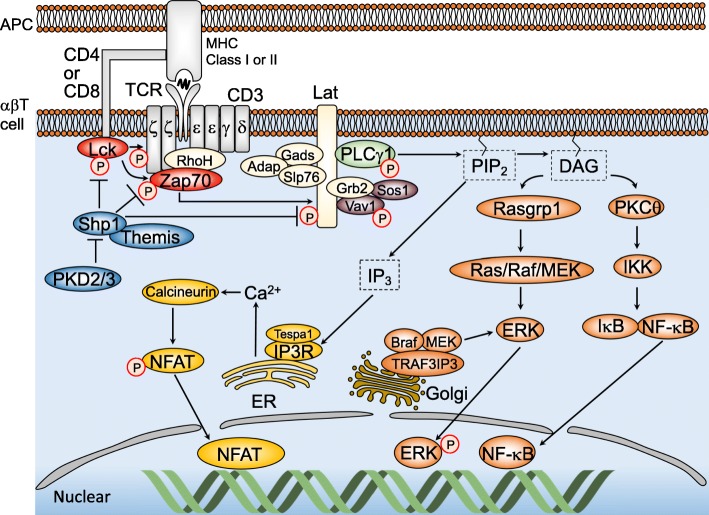
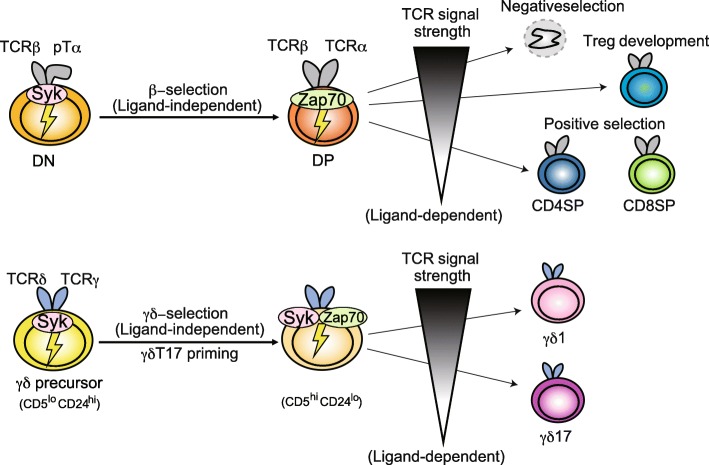
T cells are central to the vertebrate immune system. Two distinct types of T cells, αβT and γδT cells, express different types of T cell antigen receptors (TCRs), αβTCR and γδTCR, respectively, that are composed of different sets of somatically rearranged TCR chains and CD3 subunits. γδT cells have recently attracted considerable attention due to their ability to produce abundant cytokines and versatile roles in host defense, tissue regeneration, inflammation, and autoimmune diseases. Both αβT and γδT cells develop in the thymus. Unlike the development of αβT cells, which depends on αβTCR-mediated positive and negative selection, the development of γδT cells, including the requirement of γδTCR, has been less well understood. αβT cells differentiate into effector cells in the peripheral tissues, whereas γδT cells acquire effector functions during their development in the thymus. In this review, we will discuss the current state of knowledge of the molecular mechanism of TCR signal transduction and its role in the thymic development of γδT cells, particularly highlighting a newly discovered mechanism that controls proinflammatory γδT cell development.
T细胞是脊椎动物免疫系统的核心。两种不同类型的T细胞,即αβT细胞和γδT细胞,分别表达不同类型的T细胞抗原受体(TCR),即αβTCR和γδTCR,它们由不同组的体细胞重排TCR链和CD3亚基组成。γδT细胞最近因其产生丰富细胞因子的能力以及在宿主防御、组织再生、炎症和自身免疫性疾病中的多种作用而备受关注。αβT细胞和γδT细胞均在胸腺中发育。与依赖αβTCR介导的阳性和阴性选择的αβT细胞发育不同,γδT细胞的发育,包括对γδTCR的需求,目前了解较少。αβT细胞在外周组织中分化为效应细胞,而γδT细胞在胸腺发育过程中获得效应功能。在这篇综述中,我们将讨论TCR信号转导分子机制的当前知识状态及其在γδT细胞胸腺发育中的作用,特别强调一种新发现的控制促炎性γδT细胞发育的机制。