Department of Psychology, University of Pittsburgh, Pittsburgh, PA, USA.
Department of Psychology, University of California, Los Angeles, CA, USA.
Soc Cogn Affect Neurosci. 2019 May 31;14(5):471-479. doi: 10.1093/scan/nsz026.
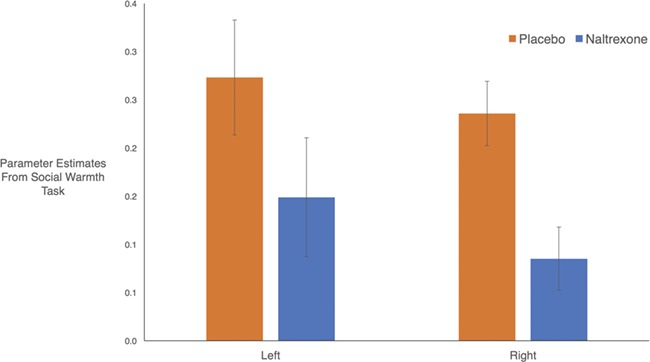
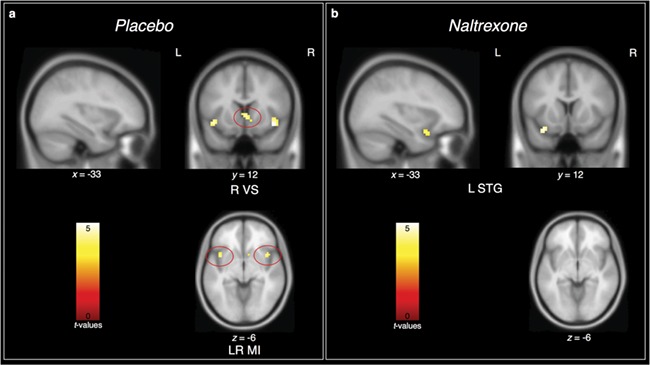
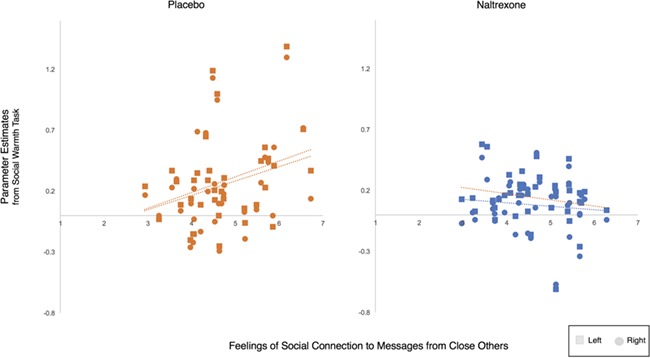
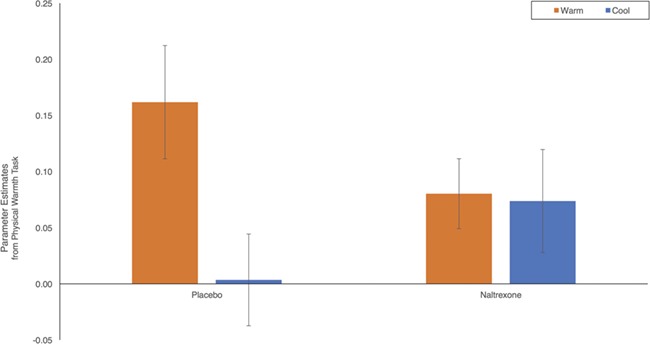
Socially warm experiences, when one feels connected to others, have been linked with physical warmth. Opioids, hypothesized to support social bonding with close others and, separately, physical warmth, may underlie both experiences. In order to test this hypothesis, 80 participants were randomly assigned to the opioid antagonist, naltrexone or placebo before neural and emotional responses to social and physical warmth were collected. Social and physical warmth led to similar increases in ventral striatum (VS) and middle-insula (MI) activity. Further, feelings of social connection were positively related to neural activity to social warmth. However, naltrexone (vs placebo) disrupted these effects by (i) reducing VS and MI activity to social and physical warmth, (ii) erasing the subjective experience-brain association to social warmth and (iii) disrupting the neural overlap between social and physical warmth. Results provide additional support for the theory that social and physical warmth share neurobiological, opioid receptor-dependent mechanisms and suggest multiple routes by which social connections may be maintained.
社交温暖体验,即人们感受到与他人的联系,与身体温暖有关。阿片类药物被假设为支持与亲密他人的社交联系,以及身体温暖,可能是这两种体验的基础。为了验证这一假设,80 名参与者在接受社交和身体温暖的神经和情绪反应之前,被随机分配到阿片受体拮抗剂纳曲酮或安慰剂组。社交和身体温暖都会导致腹侧纹状体(VS)和中脑岛(MI)活动的相似增加。此外,社交联系的感觉与社交温暖的神经活动呈正相关。然而,纳曲酮(与安慰剂相比)通过以下方式破坏了这些效应:(i)降低 VS 和 MI 对社交和身体温暖的活动,(ii)消除对社交温暖的主观体验-大脑关联,以及(iii)破坏社交和身体温暖之间的神经重叠。研究结果为社交和身体温暖共享神经生物学、阿片受体依赖机制的理论提供了额外的支持,并表明了维持社交联系的多种途径。